Usnea Sp. - Beard lichen
Usnea Sp. of B.C.
Usnea cavernosa - Pitted beard
Usnea ceratina - Speckled beard
Usnea chaetophora - Articulated beard
Usnea cornuta - Crab's beard
Usnea diplotypus - Untrimmed beard
Usnea esperantiana - Seaside beard
Usnea filipendula - Herringbone beard
Usnea flavocardia - blood-splattered beard
Usnea fragilescens - Inflationary beard
Usnea glabrata - Lustrous beard
Usnea glabrescens - Spotted beard
Usnea hesperina - Western beard
Usnea hirta - Sugar-frosted beard
Usnea intermedia - Exploding beard
Usnea lapponica - Powder-ringed beard
Usnea longissima - Methuselah's beard
Usnea nidulans - Nested beard
Usnea pacificana - Pacific beard
Usnea rubicunda - Red beard
Usnea scabrata - Scarecrow's beard
Usnea silesiaca - Neptune's beard
Usnea subfloridana - Nit beard
Usnea substerilis - Embossed beard
Usnea trichodea - Deadman's beard
Usnea hirta - Sugar-frosted beard
Bioindicator
"Fritze et al. (1989) measured soil microbial parameters along a 20,000-m
transect away from a copper and nickel smelter in Finland. Within 500 m of the
smelter there was an absence of epiphytic lichens and their place taken by an alga.
Hypogymnia physoides and Pseudevernia furfuracea were more tolerant of heavy
metal exposure than Usnea hirta, Bryoria fuscescens, and Platismatia glauca,
demonstrating a differential tolerance within epiphytic lichens. Fungal hyphal
length and soil respiration increased significantly at greater than 10 km from the
smelter. The pattern of distribution of both lichens and mosses was found to
correlate with levels of heavy metal loading in the environment (Kosta-Rick et al.,
2001), where they found that the level of several heavy metals (Cd, Cu, Hg, Pb,
Sb, Sn, and Zn) was significantly higher in lichens than in mosses. This is
possibly attributable to the presence of fungal mycelia in the lichen, which may
have a higher affinity for metals than moss tissue." [Dighton FEP]
Usnea intermedia - Exploding beard
Usnea lapponica - Powder-ringed beard
Usnea longissima - Methuselah's beard
Medicinal Use
"Usnea longissima is known for its wounds healing properties and is effective
against tumor (Crockett et al., 2003)." [Amritesh AM]
Usnea longissima and Usnea diffracta used in TCM to "clear heat and resolve toxin", "dispel damp and free network vessels", "expel worms",
"regulate menstruation and stanch bleeding", "relieve cough and dispel phlegm", "bleeding due to external injury", "cough with profuse phlegm",
"flooding and spotting", "headache", "malaria", "poisonous snake bite", "red eyes", "scrofula", "swollen welling abscess",
and "vaginal discharge". [EncyTCMV.6]
Pharmacology
"Shahi and Patra (2003) synthesized bioactive nanoparticles of usnic acid from
the lichen-forming fungus Usnea longissima in a defined medium. The
nanoparticles they obtained were uniform in shape, with a diameter of 50–200
nm, and their bioactivity was investigated both in vitro and in vivo in a
nanoemulsion. The in vitro results showed that the nanoemulsion had a
minimum inhibitory concentration (MIC) of 0.1 µl/ml against the dermatophytes
Epidermophyton floccosum, Microsporum audouinii, M. canis, M. gypseum, M.
nanum, Trichophyton mentagrophytes, T. rubrum, T. tonsurans and T. violaceum.
The in vivo results showed that the nanoemulsion was safe and effective in
controlling dermatophyte infections in humans." [AppliedMycology]
"The broad-spectrum antibacterial properties of silver nanoparticles may
also lead to a future role in pharmaceutical development (Ingle et al., 2008).
Similarly, the bioactive nanoparticles synthesized by the lichen-fungi Usnea
longissima may have potential as a future natural nanomedicine against
microbial infections (Shahi and Patra, 2003)." [AppliedMycology]
Biochemicals
β-Glutinol - "Glutin-5-en-3β-ol C30H50O (426.73). White amorphous material, mp 211ºC,
mp 212ºC, [α]D25 = 63.3º (c = 0.71, CHCl3). Pharm: Anti-inflammatory
(modified assay of Tan and Berridge, 400μg/mL, InRt = 11.44%, control
Aspirin, InRt = 70.45%)[5316]; cell viability (hmn isolated neutrophils,
12.5μg/mL, cell viability = 100%, 100μg/mL, cell viability = 100%,
200μg/mL, cell viability = 72.29%)[5316]. Source: BA WANG BIAN
Euphorbia royleana, CHI YANG Alnus japonica, MENG GU LI Quercus
mongolica, SONG LUO Usnea longissima, TAI WAN XIU XIAN JU Spiraea
formosana. Ref: 6, 611, 2575, 5316." [EncyTCMV.2]
Barbatic acid - "[17636-16-7] C19H20O7 (360.37). mp 191ºC, 186ºC. Source: SONG LUO
Usnea longissima, HUAN JIE SONG LUO Usnea diffracta. Ref: 6, 660." [EncyTCMV.1]
Diffractaic acid - "[436-32-8] C20H22 7
(inhibits a tumor which induces Epstein-Barr virus activation). Source:
SONG LUO Usnea longissima, HUAN JIE SONG LUO Usnea diffracta.
Ref: 6, 658, 660." [EncyTCMV.2]
Longissiminone - "A
C10H10O5 (210.19). White amorphous solid, mp 132ºC. Pharm:
Anti-inflammatory (modified assay of Tan and Berridge, 400ȝg/mL, InRt =
72.13%, IC50 50 =
(50.30±4.42)ȝg/mL); cell viability (hmn isolated neutrophils, 12.5ȝg/mL, cell
viability = 89.68%, 50ȝg/mL, cell viability = 90.05%, 100ȝg/mL, cell
viability = 52.91%). Source: SONG LUO Usnea longissima. Ref: 5316." [EncyTCMV.3]
Longissiminone B - "C10H9ClO5 (244.63). White amorphous material, mp 113ºC. Pharm:
Anti-inflammatory (modified assay of Tan and Berridge, 400ȝg/mL, InRt =
34.34%, control Aspirin, InRt = 70.45%); cell viability (hmn isolated
neutrophils, 12.5ȝg/mL, cell viability = 78.81%, 50ȝg/mL, cell viability =
100%, 200ȝg/mL, cell viability = 68.85%). Source: SONG LUO Usnea
longissima. Ref: 5316." [EncyTCMV.3]
Ramalic acid - "[500-37-8] C18H18O7 (346.34). mp 203ºC (dec). Source: SONG LUO Usnea
longissima. Ref: 6." [EncyTCMV.4]
Usnea longissima - Usnic acid, barbatic acid, diffractaic acid, glutinol,
longissiminone A, longissiminone B, salazinic acid,
protocetraric acid, evernic acid, 4-O-demethyl-
barbatic acid
Diffractaic acid and usnic acid -
Antibacterial/antifungal/
antitumor/insecticidal -
Sachin et al. (2018), Crockett
et al. (2003), and Zugic et al.
(2018)[Amritesh AM]
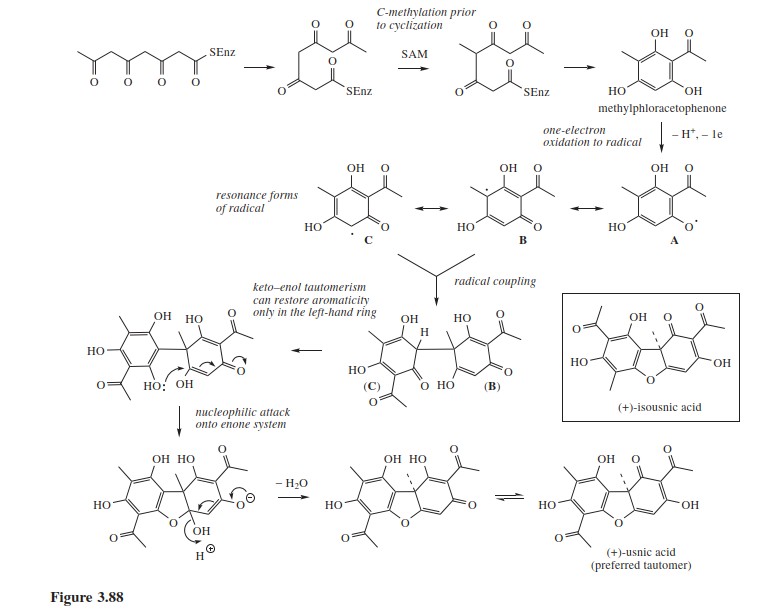
"C-Methylation also features in the biosynthesis of us-
nic acid (Figure 3.88), an antibacterial metabolite found
in many lichens, e.g. Usnea and Cladonia species, which
are symbiotic combinations of alga and fungus. However,
the principal structural modification encountered involves
phenolic oxidative coupling (see page 28). Two molecules
of methylphloracetophenone are incorporated, and these
are known to derive from a pre-aromatization methyla-
tion reaction, not by methylation of phloracetophenone
(Figure 3.88). The two molecules are joined together by
an oxidative coupling mechanism which can be rational-
ized via the one-electron oxidation of a phenol group in
methylphloracetophenone giving radical A, for which res-
onance forms B and C can be written. Coupling of B and
C occurs. Only the left-hand ring can subsequently be re-
stored to aromaticity by keto–enol tautomerism; this is not
possible in the right-hand ring because coupling occurred
on the position para to the original phenol and this po-
sition already contains a methyl. Instead, a heterocyclic
ring is formed by attack of the phenol onto the enone
system (see khellin, above). The outcome of this reac-
tion is enzyme controlled; two equivalent phenol groups
are present as potential nucleophiles, and two equivalent
enone systems are also available. Potentially, four differ-
ent products could be formed, but only one is typically
produced. Loss of water then leads to usnic acid. Usnic acid is found in both (+)- and (−)-forms in nature,
according to source. The product from using the alterna-
tive hydroxyl nucleophile in heterocyclic ring formation
is isousnic acid, also known as a natural product in some
species of lichens. Usnic acid is used as an antibacterial
and preservative in toiletries." [MNP Dewick]
 [MNP Dewick]
Usnea nidulans - Nested beard
Usnea pacificana - Pacific beard
Usnea rubicunda - Red beard
Usnea scabrata - Scarecrow's beard
Usnea silesiaca - Neptune's beard
Usnea subfloridana - Nit beard
Usnea substerilis - Embossed beard
Usnea trichodea - Deadman's beard
Usnea Sp.
Food Use
"Boiled by the Lime Village
Tanaina of Alaska and eaten
with fish, grease, or berries" [Turner&Kuhnlein]
Medicinal Use
"Ethnobotanists, in studying plant usages throughout the world's indigenous cultures, typically cross-reference plant usage among
many cultures. If usnea {Usnea spp.) is commonly found to have strong
antibiotic properties throughout the world's cultures, ethnobotanists tend
to think that some aspect of usnea has been transculturally discovered and
suggest conducting laboratory studies to try to verify its medicinal effects.
However, when faced with universal attribution of nonphysical activity
by a plant, they are usually not so bold." [Buhner SHHB]
"Usnea barbata is effective against Bacillus subtilis and Pseudomonas fluores-
cens. Besides, it also possesses antioxidant properties (Bazarnova et al., 2018)." [Amritesh AM]
"Usnea ghattensis shows antimicrobial activity against gram-negative and gram-
positive pathogenic bacteria (Staphylococcus aureus, Streptococcus faecalis,
Bacillus cereus, Escherichia coli, Pseudomonas aeruginosa, and Salmonella
typhimurium). Lecanora muralis, Peltigera polydactyla, Ramalina farinacea, and
Xanthoria elegans also possess antibacterial activity (Srivastava et al., 2013)." [Amritesh AM]
"Antimicrobial activity against some bacteria viz. Escherichia coli, Pseudomonas
aeruginosa, Enterococcus faecalis, Staphylococcus aureus, and a fungus Candida
albicans was shown by Melanohalea exasperata, Physcia aipolia, Usnea florida,
Usnea subfloridana and Xanthoria parietina. Antimicrobial activity by lichens was
reported both against gram positive and gram-negative strains (Çobanoğlu
et al., 2016)." [Amritesh AM]
Reproductive Strategies: "Both sexual and asexual propagules are formed by some spe-
cies of Cladonia and Usnea, however, as in many bryophytes, and this
pattern may be more common in temperate than in tropical regions. Sexuality is regarded as the
primitive condition. Where pairs of related species
are recognised, one sorediate and the other apotheciate, the former is
generally the more widespread and abundant but it may be less well
equipped to contend with future environmental change." [Longton BPB]
"Asexual reproduction may be particularly important in lichens as the
propagules contain both mycobiont and photobiont. Many rock surfaces
on Signy I are densely covered by unbranched individuals of Usnea antarc-
tica only a few millimetres in length, and Hooker (1980d) demonstrated
a predominance of small, presumably young thalli on imported timber.
As apothecia are rarely produced, he suggested that large numbers of
young plants become established from soredia, with relatively few surviv-
ing to maturity. There is thus little evidence that the abundance of mature
thalli is controlled by problems of establishment." [Longton BPB]
"In boreal regions, Cladonia stellaris commonly becomes established
from thallus fragments some years after fire (Chapter 3). In contrast to
the pattern in Usnea antarctica, subsequent clonal development by a var-
iety of different branching patterns results in a logistic increase in the
number of individuals, the maximum density of about 900 podetia m-2
being reached after a further 30 years (Yarranton, 1975)." [Longton BPB]
Arctic reproduction: "Dodge (1973) regards sexual reproduction as 'almost universal'
among fungi in cold- and frigid-Antarctic lichens, although he notes that
apothecia are rare in most Antarctic species of Usnea and Cladonia. How-
ever, Lindsay (1977) reports that in many Antarctic lichens, including
Usnea fasciata (Fig. 2.2), apothecia are abundant but mature ascospores
rarely develop." [Longton BPB]
Biochemicals
Usnea ghattensis - Usnic acid, norstictic acid - Antibacterial/antioxidant - Verma et al. (2008) and
Srivastava et al. (2013) [Amritesh AM]
"Usnic acid (7.53)—a highly biologically active dibenzofuran—is a phenol
oxidation product of an acylphloroglucinol. It is produced by numerous lichens,
including several Usnea species. Apart from its antibiotic and anti-leukemic
activity, it has insect anti-feedant activity. Its presence may account for the
observation that many lichens are resistant to serious insect attack." [ChemofFungi]
Properties
"Some fruticose lichens, such as Usnea, have a differentiated stiff central strand,
which gives the lichen considerable strength and flexibility." [Laursen CIAC]
Habitat
"In forested areas, atmospheric water condensation zones are characterized by the
presence of epiphytes, in particular hanging lichens of the genera Usnea (U. articulata) and Telechistes spp., but also ferns and orchids, and American bromeliads
such as the “Spanish moss” Tillandsia usneoides and T. recurvata." [Houerou BBA]
"Lichen communities show similar trends. In the maritime zone there are extensive areas
where fruticose lichens are dominant, the fruticose and foliose lichen formation, typically
on the sides of rocks or boulders forming marine benches or similar areas (Figure 13.2).
This distribution seems to be determined by improved water relations and it is easy to see
how snow gathers in such areas, how wind is reduced and how light is high but rarely direct
sunlight. Such sites are well illustrated in Kappen (1993a). The genera Usnea (Figure 13.3)
and Umbilicaria are typically dominant and plants can reach large sizes, 20 + cm across
for Umbilicaria specimens. These formations are rarer in the continental zone but do occur,
for example, Birthday Ridge (Kappen 1985a) and Botany Bay, Granite Harbour (unpub-
lished, in preparation)." [Pugnaire FPE]
"Arctic Climate growth rate: "Macrolichen phytomass reaches 800-1750 g m-2 in Umbilicaria,
Himantormia and Usnea spp,
with productivity up to 250 gm-2 in Usnea fasciata (Smith, 1984a), in the more wide-
spread, open communities of lichens and small acrocarpous mosses on
drier terrain. Lichen production in terms of relative growth rate ranges
from 34 mg g-1 yr-1 in Sphaerophorus globosus to 84 mg g-1 yr-1 in
Cladonia rangiferina. It is strongly age-related in Usnea fasciata, falling from
50-200 mg g-1 yr-1 in young thalli to 35 mg g-1 yr-1 in mature, and
1-5 mg g-1 yr-1 in old individuals (Hooker, 1980c, d)." [Longton BPB]
Lichenicolous Fungi
"Stromatopogon baldwinii, which grows on various
species of Usnea, is known only from Tasmania and the
South Sandwich Islands (Diederich 1992)." [BOF Elsevier]
Habitat Restoration
Usnea Sp. are listed as "Medicinal and aromatic plants capable of growing on contaminated soils", with the "whole
plant" listed as the part used. [Lichtfouse SAR 17]
"However, these same tree islands are very important for
recolonization of disturbed habitats by forest-dwelling birds (Mackenzie and Steventon
1996; Tittler et al. 2001b), arthropods (Lindgren et al. 1999), lichens, liverworts, and
mosses (Peck and McCune 1997). The size of residual tree patches influences their
effectiveness. In northwestern Quebec, for example, abundance of Usnea spp., the most
sensitive of the common epiphytic lichens, is negatively affected when retained patches
are less than 1 ha (Rheault et al. 2003)." [Burton TSMBF]
Journals of Interest
- Ivanovic, J., Meyer, F., Misic, D., Asanin,
J., Jaeger, P., Zizovic, I., and Eggers,
I. (2013) influence of different pre-
treatment methods on isolation of
extracts with strong antibacterial activity
from lichen Usnea barbata using carbon
dioxide as a solvent. J. Supercrit. Fluids,
76, 1–9.
- Zugic, A., Tadic, V., & Kundakovic, T. (2018). Chemical composition and biological activities of
the extracts and secondary metabolites of Lichens belonging to the genus Usnea, Parmeliaceae.
ResearhGate, Lekovite Sirovine, 38, 68–80.
- Diederich, P., and M.S. Christiansen. 1994. Biatoropsis usnearum
Räsänen, and other heterobasidiomycetes on Usnea. Lichenologist
26:47–66.