Protoanemonin
Classification: Glycoside [PDR]
Pharmacological Profile
Bioactivity & Minimum Inhibitory Concentrations (MIC)| Bacillus coli | 12~30 mol/L |
| Staphylococcus aureus | 16.7 mol/L |
| Shigella shigae | 16.7 mol/L |
| Mycobacterium tuberculosis | 2.5 mol/L |
- Binds with sulfhydryl (-SH) groups
- Inhibits mitosis in plants
- Dimerizes into inert Anemonin
Actaea & Anemone
Ranunculaceae spp [EncyTCMV.1]- Actaea alba; A. arguta; A. pachypoda [PTH]
- Actaea rubra [PTH][Polya BTPBC]
- Anemone Spp. [Polya BTPBC][APAK Turner]
- Anemone nemorosa [PDR] 0.33 mg/g (wet weight) [Barceloux MTNS]
- Anemone trifolia 0.17 mg/g (wet weight) [Barceloux MTNS]
- Anemone cernua Root [CRNAH]
- Anemone hepatica [CRNAH]
- Anemone patens [CRNAH]
- Anemone pulsatilla Root [CRNAH]
- Anemone pulsatilla var. chinensis Bunge. Root [CRNAH]
Clematis & Helleborus
Botanical Sources- Clematis Spp. [Polya BTPBC][APAK Turner]
- Clematis chinensis, [EncyTCMV.1]
- Clematis flammula 0.50 mg/g (wet weight) [Barceloux MTNS]
- Clematis recta [PDR] 0.01 mg/g (wet weight) [Barceloux MTNS]
- Clematis virginiana L. [CRNAH]
- Clematis vitalba - Traveler's Joy [CRNAH][Pieroni 1999][HMH Duke] 0.15 mg/g (wet weight) [Barceloux MTNS]
- Helleborus niger [Adams et al., 2009] 5.82 mg/g (wet weight) [Barceloux MTNS]
- Helleborus foetidus 0.67 mg/g [Barceloux MTNS]
- Helleborus odorus 0.004 mg/g [Barceloux MTNS]
Ranunculus (Buttercups)
High Ranunculin Content- Ranunculus Spp. [Polya BTPBC][APAK Turner]
- Ranunculus aquatilis [PTH]
- Ranunculus bulbosus 7.77 mg/g (wet weight) [Barceloux MTNS] High levels (of Ranunculin) [Cheryll Williams] Aerial Part Essential oil [LLCEOPS]
- Ranunculus ficaria L. - Pilewort [HerbalMed3]
- Ranunculus hirsutus Curt. (R. sardous Crantz) Aerial Part Essential oil (hydrodistillation) [LLCEOPS]
- Ranunculus repens 0.13 mg/g [Barceloux MTNS] 0.27% (of Ranunculin) [Cheryll Williams]
- Ranunculus sceleratus [EncyTCMV.1][Misra&Dixit][PDR][CRNAH] Essential oil [LLCEOPS]
Ranunculus Species (Cont.)
High Levels & Specific Variants- Ranunculus acris (Buttercup) [PDR]
- Ranunculus cantoniensis [EncyTCMV.1]
- Ranunculus chinensisBunge. - whole plant [CRNAH]
- Ranunculus flammula High levels (of Ranunculin) [Cheryll Williams]
- Ranunculus gramineus High levels (of Ranunculin) [Cheryll Williams]
- Ranunculus japonicus [EncyTCMV.1][CRNAH]
- Ranunculus sardous High levels (of Ranunculin) [Cheryll Williams]
- Ranunculus sarmentosa Adams - whole plant [CRNAH]
- Ranunculus sceleratus L. whole plant [CRNAH]
- Ranunculus stevenii High levels (of Ranunculin) [Cheryll Williams]
Pulsatilla & Others
Diverse Ranunculaceae- Caltha palustris [EncyTCMV.1][LLCEOPS][Jernigan EYK][PTH]Whole plant (var. membranacea & siberica)[CRNAH]
- Clematis chinensis [EncyTCMV.1]
- Hepatica nobilis [PDR]
- Pulsatilla ambigua Turcz. ex Pritz. - root [CRNAH]
- Pulsatilla cernua (Thunb.) Bercht. et Opiz. - root [CRNAH]
- Pulsatilla chinensis [EncyTCMV.1] - root [CRNAH]
- Pulsatilla occidentalis - Western Pasque Flower [Moore MPPW]
- Pulsatilla pratensis (Pasque Flower) [PDR]
- Pulsatilla vulgaris [HerbalMed3][CRNAH]
- Thalictrum spp. - Meadow-rue [APAK Turner]
- Trautvetteria caroliniensis [APAK Turner]
Protoanemonin Containing Species
"The family Ranunculaceae (buttercup) has various species in a number of genera that contain the skin irritant, protoanemonin" [Barceloux MTNS], including species of the genera;
Anemone [Barceloux MTNS][Seiger PSM],
Ceratophalus [Seiger PSM],
Clematis (clematis, leather flower) [Barceloux MTNS][Seiger PSM],
Clematopsis [Seiger PSM],
Pulsatilla [Barceloux MTNS][Seiger PSM],
Helleborus (hellebore) [Barceloux MTNS][Seiger PSM],
Hepatica [Seiger PSM],
Knowltonia [Seiger PSM],
Myosurus [Seiger PSM],
Ranunculus (buttercup) [Barceloux MTNS][Seiger PSM],
Trautvetteria [Seiger PSM], and
Caltha (marsh marigold) [Barceloux MTNS]
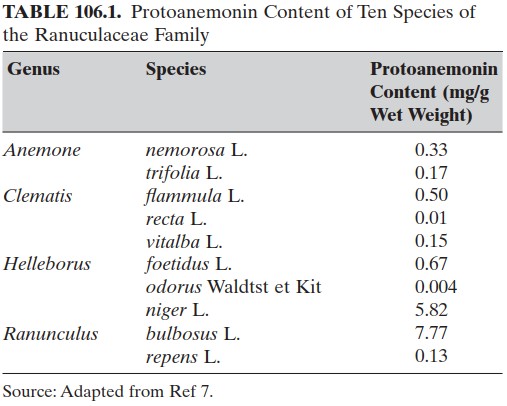
[Barceloux MTNS]
The results of numerous tests indicate that these glycosides do not occur in Aconitum, Actaea, Adonis, Anemonella, Anemonopsis, Aquilegia, Callianthemum, Caltha, Cimifuga, Consolida, Coptis, Delphinium, Erantis, Hydrastis, lsopyrum, Leptopyrum, Nigella, Semiaquilegia, Thalictrum, Trollius, and Zanthorhiza (Hegnauer, 1973)." [Seiger PSM]
Caltha Sp.
Caltha palustris: "The leaves and stem are collected early, before they flower in the summer. They are boiled, changing the water two or three times to leach out toxic chemicals, including protoanemonin before eating." [Jernigan EYK] "In its raw state, marsh marigold is a toxic plant, due to the presence of protoanemonin. In this area it is dried or lactofermented before use." "Protoanemonin is broken down by drying and long cooking (43,44). In the study area, the plant is either dried and then used like other wild greens, or it is lacto-fermented after the initial blanching. The dried specimens of marsh marigolds we ate had no bitterness even prior to cooking. Further studies are needed to establish if the local population of marsh marigolds is a low-protoanemonin form easier to prepare as food than the European Caltha. For example, one of the authors’ (ŁŁ) unpublished experiments show that C. palustris from Poland needs one to two hours of cooking to get rid of the bitterness caused by protoanemonin." (Kang et al., 2014)
Caltha palustris L. "The leaves and stem are collected early, before they flower in the summer. They are boiled, changing the water two or three times to leach out toxic chemicals, including protoanemonin before eating. Griffin (2001) reports that people on Nunivak eat the cooked young leaves and stems with seal flipper or seal oil." [Jernigan EYK]
"Caltha, like many members of the Ranunculaceae (crowfoot family), contains terpenes that are broken down into protoanemonin and other derivatives, substances that are acrid and irritating to the gastrointestinal tract. However, the amount of these substances Caltha palustris contains in early season is minimal." [Haines AP]
Clematis Sp
"The entire genus Clematis contains chemical protoanemonin which is extremely irritating to the skin and mucous membranes (Frohne and Pfander, 2005; Tilford, 1997)." (Rakesh Chawla; Suresh Kumar; Anupam Sharma (2012))
"Almost all species of genus contain protoanemonin which is extremely toxic, and may cause irritation to skin, mucous membranes and internal bleeding of the digestive tract. C. chinensis, C. erecta, C. flammula and C. vitalba fresh materials have shown protoanemonin poisoning upon topical application and oral administration. This compound occurs only in fresh plant material and is hydrolysed to a harmless metabolite on drying." (Rakesh Chawla; Suresh Kumar; Anupam Sharma (2012))
"Clematis contains acrid, toxic compounds, including anemonin, a dilactone derived from protoanemonin, that are highly irritating to skin and mucous membranes (Lampe and McCann 1985, Diggs et al. 1999). Rafinesque (1830) noted: “Bark and blossoms acrid, raising blisters on the skin; a corrosive poison internally, loses the virulence by cooking.”" [Daniel F. Austin]
"Ingestion of any part of extracts may cause vomiting of blood, severe diarrhea, and convulsions (Foster and Duke 1990)." [Daniel F. Austin]
"It is said that beggars in ancient Rome rubbed their hands with juices of these Clematis species to cause blisters to form on their hands in order to evoke more compassion as they reached out to ask for money." (Rakesh Chawla; Suresh Kumar; Anupam Sharma (2012)) "The French (herbe aux gueux) and Spanish (hierba de los pordioseros) names referring to beggars are a reference to their past use to irritate the skin to simulate sores and induce sympathy from potential donors (Bown 1995)." [Daniel F. Austin]
Clematis recta: "Extended skin contact with the freshly harvested, bruised plant can lead to blister formation and cauterizations that heal poorly, due to the released protoanemonine, which is severely irritating to the skin and mucous membranes. If taken internally, severe irritation to the gastrointestinal tract, combined with colic and diarrhea, as well as irritation of the urinary drainage passages, are possible." [PDR]
"Protoanemonin hydrate glucoside C11H16O8 (276.25). Source: BAI HUA TENG Clematis terniflora [Syn. Clematis maximowicziana]. Ref: 6." [Encyclopedia of TCM V4]
Pulsatilla Sp
Pulsatilla Sp, "Pulsatilla is considered specific for painful or inflammatory reproductive conditions, including dysmenorrhea... Its sedative action is beneficial when there is nervous tension causing or accompanying dysmenorrhea, and it also exerts pronounced effects on uterine pain.... No pharmacologic or clinical trials were identified on this herb. Only the dried herb is used. Fresh plant contains an irritating component, protoanemonin.... This plant is teratogenic and abortifacient in cattle, and should not be used during pregnancy." [BMWH]
Pulsatilla pratensis - Pasque Flower; Whole plant used fresh to prevent migrane. 0.2-0.6g daily dose. Aerial Parts used as a herbal antiseptic in the "...treatment of infections of the skin and skin structures" [Capasso PQR] Synonym of Anemone pratensis (2/3 confidence) [ThePlantList]
Pulsatilla vulgaris: " Fresh pulsatilla is poisonous because of the toxic volatile oil component, protoanemonin. Protoanemonin rapidly degrades to the non-toxic anemonin. Inhalation of vapour from the volatile oil may cause irritation of the nasal mucosa and conjunctiva.... External contact with the fresh plant should be avoided. The toxic principle, protoanemonin, rapidly degrades to the non-toxic anemonin during drying of the plant material. " [HerbalMed3]
Ranunculus Sp
Ranunculus Sp.; "It (protoanemonin) may be removed from the plants by thorough cooking. If any acid taste remains, spit out the mouthful, and recook the plants in fresh water." [Kirk WEP]
Ranunculus bulbosa; "Studies of Ranunculus bulbosus have reported signifcant antimicrobial properties for protoanemonin (a lactone), particularly against various Streptococcus bacteria. It is of particular interest that the antimicrobial effect could be enhanced by combination with various conventional antibiotic drugs. Tis activity was linked to the ability of protoanemonin to penetrate the microbes’ cell walls, thereby facilitating the entry of the antibiotic, with a resultant enhancement of its efficacy (Didry 1993)." [Cheryll Williams] "R. bulbosus (also an Old World native) is one of the best in providing edible roots. Early western settlers pickled the young flowers.... It has been reported by some authors that the bulbs of R. bulbosus which have wintered over are mild enough to eat raw in the spring, but this is probably risky." [Kirk WEP]
- Remediation Byproduct
- "... 4- chlorocatechol degradation through the 3-oxoadipate pathway was shown to produce toxic intermediate called protoanemonin (38). The authors proved that PCB cometabolizing microorganisms have been negatively affected by the formation of this antibiotic. Also indigenous soil microflora in that study was shown to convert 4-chlorobenzoate into a toxic product, most probably protoanemonin." [Reible IAARCS]
Hazards & Toxicity
"The vesicant (blistering) reputation of the genus is linked to a pale yellow oil that contains protoanemonin..." [Cheryll Williams] , an acrid compound and "... an enzymatic breakdown product of the glycoside ranunculin. When the plants are dried, the protoanemonin becomes the innocuous anemonin." [Daniel F. Austin][Seiger PSM] "Protoanemonin, which arises by cleavage of ranunculin by glucosidases found in the plant, also has been isolated by steam distillation of plant material." [Seiger PSM]
"Poisoning from protoanemonin in animals and humans has similar symptoms: stomach pain, throat inflammation, salivation, cracked and excoriated tongue, smarting teeth, tenderness, and bleeding of the cornea of the eye (Millspaugh 1892)." [Cheryll Williams]
"Few Human reports. "Bloody emesis and diarrhea develop in association with severe abdominal cramps. Central nervous system involvement is manifested by dizziness, syncope, and seizures....Most exposures result in minimal or no toxicity." [HPIP Shih]
"Protoanemonin is known to be a central nervous system depressant and to induce abortions." [Skidmore-Roth MHH]
"Poisoning from protoanemonin in animals and humans has similar symptoms: stomach pain, throat inflammation, salivation, cracked and excoriated tongue, smarting teeth, tenderness, and bleeding of the cornea of the eye (Millspaugh 1892)." [Cheryll_Williams]
Treatment
"Treatment is supportive. The most common toxic effect associated with exposure to protoanemonin - containing plants is an irritant contact dermatitis that responds to wound cleansing and topical steroids (0.05% fluocinonide). Gut decontamination measures are unnecessary." [Barceloux MTNS]
Activities & Antiseptic Properties
Protoanemonin, albeit a powerful vesicant agent, has effective antibacterial, antifungal, antimutagenic and anthelmintic activity.
- Antifungal: Freshly prepared active principle completely inhibited mycelial growth of test fungi at 1:10,000 dilution.
- Antiseptic: Active against aerobes, anaerobes, dermatophytes, yeast, and MDR pathogens.
- Synergy: Antimicrobial effect could be enhanced by combination with conventional drugs as it penetrates microbe cell walls.
Dextoxification
"According to Kingsbury , the poisonous principle is a volatile yellow oil called protoanemonin. It may be removed from the plants by thorough cooking. If any acid taste remains, spit out the mouthful, and recook the plants in fresh water." [WEP]
"When dried, the plant is not capable of protoanemonine formation." [PDR]
"Drying or boiling of protoanemonin - containing herbs destroys the irritant properties in Anemone and Pulsatilla species by accelerating the polymerization of protoanemonin.... Protoanemonin occurs in varying concentrations in different species with the highest concentrations (0.5 – 0.8%) in bulbs from Ranunculus bulbosus L. and Helleborus niger L. " [Barceloux MTNS]
"Heat exposure (cooking) is usually effective for detoxification of these herbs, although merely crushing or pounding will facilitate the process. This permitted the use of many European species of Ranunculus as pot herbs, although, at times, the strategy failed due to inadequate cooking: ‘some cases are reported where this happy result failed, and serious symptoms supervened’ (Millspaugh 1892)." [Cheryll_Williams]
Medicinal Use
"There are a variety of herbal uses in traditional medicine for protoanemonin - containing species including Anemone and Pulsatilla species. The most common use by Native American peoples for these plants was as a counter - irritant in the form of an external poultice for abrasions, boils, cuts, and skin sores.1 Other traditional uses for extracts from these plants included rheumatism, stomach troubles, and promoting childbirth." [Barceloux MTNS]
Activities
"From past work two lactones, anemonin and protoanemonin were obtained and considered as its antiinflammatory compounds. But recent pharmacological studies showed that such effects were very weak. " [Yang APG]
"Vesicant; antibiotic;" [EncyTCMV.1]
"Protoanemonin is stated to have a marked ability to combine with sulfhydryl (-SH) groups and it is thought that the toxic subdermal properties of protoanemonin may depend on the inactivation of enzymes containing -SH groups.(G33) An LD50 value (mice, intraperitoneal injection) for anemonin has been reported as 150 mg/kg body weight." [HerbalMed3]
"Protoanemonin, albeit a powerful vesicant agent, has effective antibacterial, antifungal, antimutagenic and anthelmintic activity. Protoanemonin, however, is highly unstable and is readily converted to a more inert derivative, anemonin – which is much less active, although it retains antibacterial properties." [Cheryll_Williams]
"Protoanemonin with significant antiseptic activity on aerobes, anaerobes, dermatophytes, and yeast, including MDR pathogens." "antibacterial (against Gram-positive and Gram-negative, Candida, diphtheria toxin, Escherichia, and Staphylococcus) antiviral, cytopathogenic, vesicant, vermicide (WOI)." [HMH Duke]
Antifungal: "Both anemonin and protoanemonin have antifungal properties (Misra and Dixit, 1980)." [Seiger PSM] "Antibacterial and antifungal properties have been documented for both anemonin and protoanemonin, although anemonin is reported to exhibit much weaker activity.(G33, G48)" [HerbalMed3]
"...protoanemonin, a constituent of ... (Ranunculus) damascenus, which inhibits mitosis in plants" [SEHM]
Antibiotic: "Various members of the Ranunculaceae were next investigated as sources of this type of antibiotic. Ranunculin, for example, was already known from Anemone pulsatilla, but as such it shows no antibiotic activity. Removal of the glucose produces protoanemonin, which has high antibiotic activity (18), but this in its turn rapidly dirnerises to inactive anemonin. It soon became apparent that ranunculin is not a primary product of the isolation and it is not obtained when extracts are treated carefully." [Wagner PP]
"Studies of Ranunculus bulbosus have reported significant antimicrobial properties for protoanemonin (a lactone), particularly against various Streptococcus bacteria. It is of particular interest that the antimicrobial effect could be enhanced by combination with various conventional antibiotic drugs. This activity was linked to the ability of protoanemonin to penetrate the microbes’ cell walls, thereby facilitating the entry of the antibiotic, with a resultant enhancement of its efficacy (Didry 1993)." [Cheryll_Williams]
Ranunculus sceleratus L. (Hindi: jaldhania; English:
buttercup or water crowfoot) -
"NMR of the only substance obtained from a 6-day-old steam distillate stored
at room temperature indicated the presence of 88% protoanemonin and 12%
anemonin. The oil on standing at room temperature crystallized, and its NMR
spectrum showed the presence of 65% protoanemonin and 35% anemonin. These
studies revealed that the monomer protoanemonin gradually dimerised into its
dimer anemonin. Therefore, the compound must be stored in a deep freeze." (Misra&Dixit)
"The spectrum of the freshly prepared oily substance showed it to be a mixture
of protoanemonin (93%) and anemonin (7%)." (Misra&Dixit)
"It was noted that the freshly prepared active principle protoanemonin and its
dimer anemonin completely inhibited the mycelial growth of all the test fungi up
to 1:10,000 and 1:100 dilutions, respectively" (Misra&Dixit)
"The active principle of the plant, having
strong fungitoxicity and little phytotoxicity, can be exploited as an effective fun-
gicide against a wide range of pathogens after it passes successful in vivo trials.
It is further hoped that the active principle may also prove to be a valuable
antibiotic for the cure of human fungal diseases in the future." (Misra&Dixit)
 (Misra&Dixit)
Chemical Pathways & Related Compounds
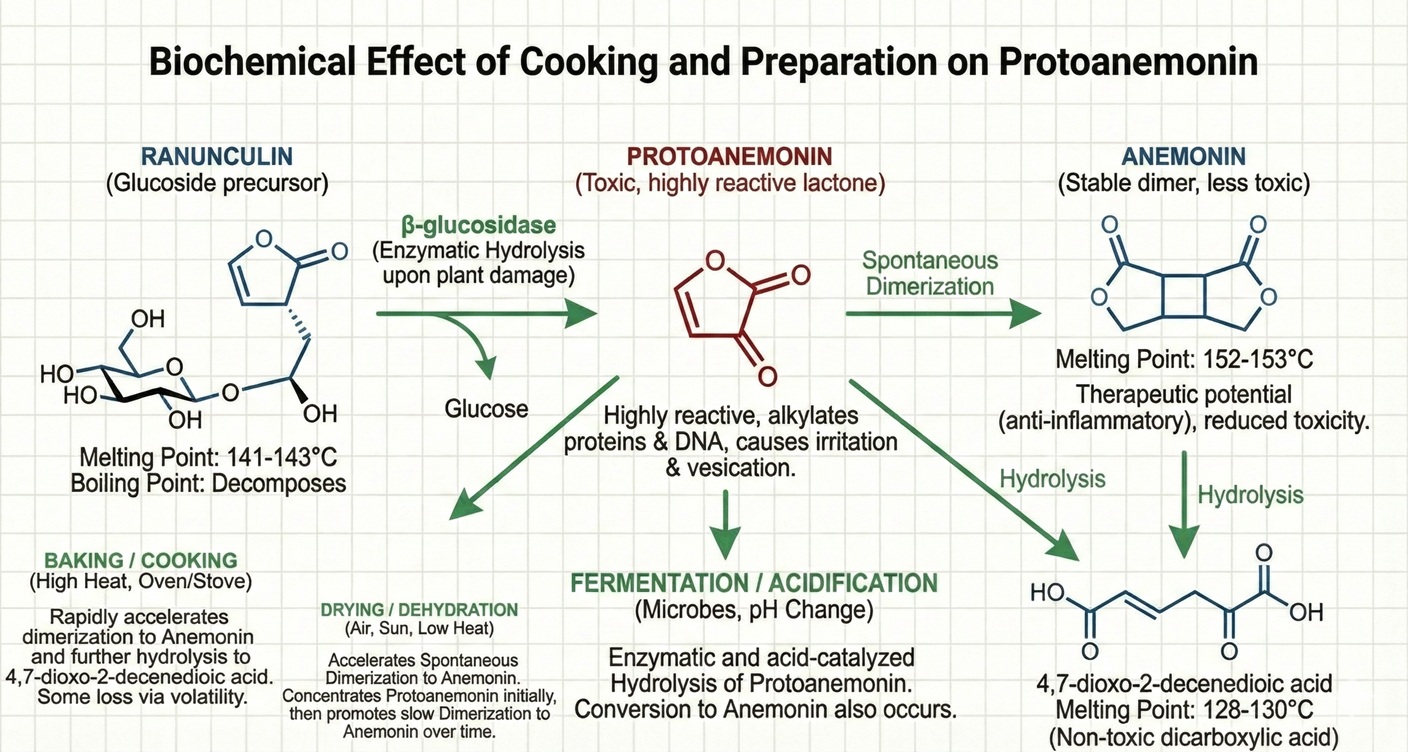
- Protoanemonin
- "Protoanemonin (CAS RN: 108-28-1, C5H4O2) is an unstable, pale yellow oil with a water solubility of approximately 1 g/dL.3 This simple lactone compound is volatile. Protoanemonin possess some antibacterial4 and antifungal5,6 properties in vitro." [Barceloux MTNS]
- Anemonin
- "Protoanemonin is readily converted to anemonin, which has marked irritant properties" [Klasseen CDT]
- "Anemonin (CAS RN: 508-44-1, C10H8O4) is an inactive crystalline solid with limited water solubility. Drying or boiling of protoanemonin-containing herbs destroys the irritant properties in Anemone and Pulsatilla species by accelerating the polymerization of protoanemonin." [Barceloux MTNS]
- Ranunculin
- "Ranunculosides (ranunculins)
They are volatile lactones, chemically similar to coumarins. However,
they are less stable as compared to coumarins as they are not phenolic
substances. On hydrolysis, they produce ranunculine and glucose.
Ranunculin is then converted into unsaturated lactone: protoanemonine
(very unstable compound). Upon drying, protoanemonine gets converted
into anemonine, which further converts into anemonic acid by itself.
Ranunculin and protoanemonine have medicinal value" [HPEP]
"Ranunculin, for example, was already known fromAnemone pulsatilla, but as such it shows no antibiotic activity. Removal of the glucose produces protoanemonin, which has high antibiotic activity (18), but this in its turn rapidly dirnerises to inactive anemonin." [Wagner PP]
References
- (Adams et al., 2009) - Adams, Michael, et al. "Medicinal herbs for the treatment of rheumatic disorders—a survey of European herbals from the 16th and 17th century." Journal of ethnopharmacology 121.3 (2009): 343-359.
- (Kang et al., 2014) - Kang, Yongxiang, et al. "Wild food plants used by the Tibetans of Gongba Valley (Zhouqu county, Gansu, China)." Journal of ethnobiology and ethnomedicine 10.1 (2014): 20.
- (Misra&Dixit) - Misra, S. B., and S. N. Dixit. "Antifungal principle of Ranunculus sceleratus." Economic Botany 34.4 (1980): 362-367.
- (Pieroni 1999) - Pieroni, Andrea. "Gathered wild food plants in the upper valley of the Serchio River (Garfagnana), Central Italy." Economic Botany 53.3 (1999): 327-341.
- (Rakesh Chawla; Suresh Kumar; Anupam Sharma (2012)) Chawla, Rakesh, Suresh Kumar, and Anupam Sharma. "The genus Clematis (Ranunculaceae): chemical and pharmacological perspectives." Journal of ethnopharmacology 143.1 (2012): 116-150.
- ThePlantList - http://www.theplantlist.org/tpl1.1/record/kew-2544208 , Accessed June 4, 2018
Journals of Interest
- Southwell IA et al., Protoanemonin in australian Clematis. In: PH 33:1099. 1993.
- Bruckmann M , Blasco R , Timmis KN , Pieper DH . Detoxification of protoanemonin by dienelactone hydrolase. J Bacteriol 1998;180:400–402.
- Minakata H, Komura H, Nakanishi K, Kada T. Protoanemonin, an antimutagen isolated from plants. Mutation Res 1983;116:317–322.
- Didry, N., L. Dubreuil, and M. Pinkas. "Microbiological properties of protoanemonin isolated from Ranunculus bulbosus." Phytotherapy Research 7.1 (1993): 21-24.
Source Material Depth
49 / 943
238 pages