Perideridia gairdneri - Gairdner's yampah
Family: Apiaceae [E-flora]
Other Names: False Caraway, Wild Carrot (Stubbs,1966)
.jpg)
(Wikimedia)1
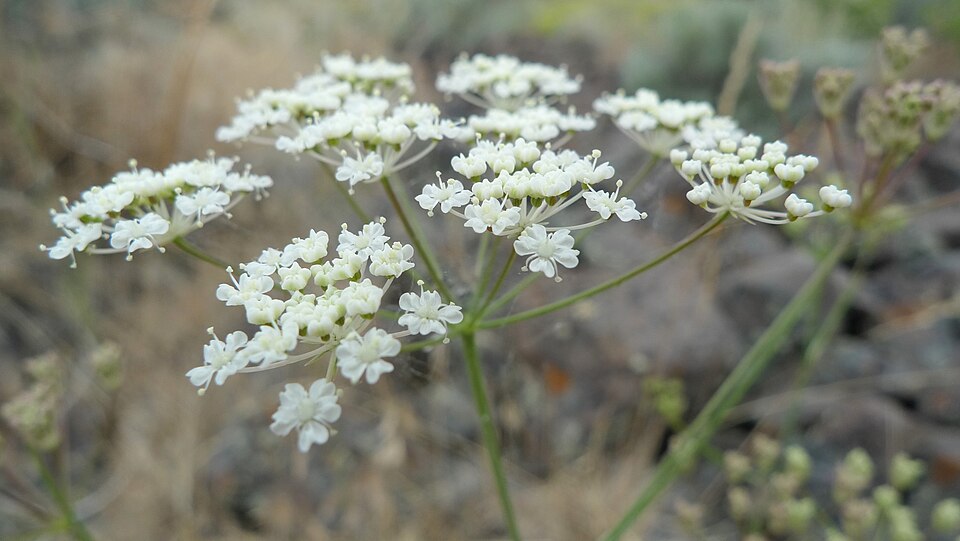
(Wikimedia)2
Image References
- 1, Perideridia gairdneri, Matt Lavin from Bozeman, Montana, USA, CC BY-SA 2.0
- 2, Perideridia gairdneri, Thayne Tuason, CC BY-SA 4.0
"Perideridia gairdneri is a PERENNIAL growing to 1.2 m (4ft). It is in flower from Apr to May, and the seeds ripen from May to July. The flowers are hermaphrodite (have both male and female organs) and are pollinated by Insects.The plant is self-fertile.
Suitable for: light (sandy), medium (loamy) and heavy (clay) soils. Suitable pH: acid, neutral and basic (alkaline) soils. It can grow in
semi-shade (light woodland) or no shade. It prefers dry moist or wet soil." [PFAF]
General: Slender perennial herb from tuberous-thickened and often clustered edible root, often fascicled,
glabrous; stems solitary, 0.4-1.2 m tall." [IFBC-E-flora]
Leaves: Several, well distributed along stem, divided 1-3 times, elongate; basal leaf sheaths not much inflated;
ultimate segments long and narrow." [IFBC-E-flora]
Flowers: Inflorescence of compound umbels; flowers terminal and lateral; spokes up to 6 cm long at maturity;
flowers white or pink; involucel bractlets bristly or obsolete." [IFBC-E-flora]
Fruits: Roundish, 2-3 mm long and wide, slightly flattened, glabrous, prominent ribs." [IFBC-E-flora]
Habitat / Range
"Moist to dry meadows and woodlands in the lowland and montane zones; infrequent in SE and SW BC (known from SE Vancouver Island and the Gulf Islands), also rare in SC BC; E to SK and S to SD, CO, NM and CA." [IFBC-E-flora]
Ecological Indicator Information
"A very shade-intolerant, submontane to montane. North American forb distributed equally in the Pacific, Cordilleran, and Atlantic regions. Occurs in maritime to submaritime summer-dry cool mesothermal climates on moderately dry to fresh, nitrogen-medium soils; its occurrence increases with increasing temperature and decreases with increasing precipitation. Scattered in forest openings and non-forested communities on water-shedding sites. Characteristic of moisture-deficient sites." (Indicator Plants of Coastal British Columbia) [E-flora]
Hazards
Caution
General carrot family dangers related to poisonous lookalikes and confusing/misapplied common names.
"In British Columbia, there is some confusion over the identity of various types of "wild carrot" (see also under
Angelica lucida and Lomatium macrocarpum), and some literature reports of the use of this species may be inaccurate.
For example, the "wild carrot" eaten by the Kwak-waka'wakw, Heiltsuk, and Haisla has been verified as
Conioselinum pacificum (Brian Compton pers. comm., 1989)." [Turner&Kuhnlein]
"In some areas, the name for this root is now applied to garden carrot, which has apparently replaced its wild counterpart almost entirely (cf. Galloway, 1982)." [Turner&Kuhnlein]
Edible Uses
Taproot
"Root - raw or cooked 60, 61. A pleasant sweet and nutty taste 2, 46, 95, 161, it can be eaten in quantity as a staple food183. It is best used when the plant is dormant 85. The root can also be dried for later use or ground into a powder and used with cereals when making porridges, cakes etc183." [PFAF]
"It was known to the Indians of the Pacific Northwest as yampa or ipo (Medsger,
1947). The fleshy roots were eaten raw or boiled, or were dried for winter use. (NV3sp)
The fleshy spindle-shaped roots of this plant were eaten ... fresh, roasted, boiled, or dried (Anderson, 1925). Sometimes they were
cooked like potatoes and ground into cakes, They have a pleasant taste like raw carrots." [Turner&Bell1]
"The fleshy, pleasant-tasting taproots were an important food of Indigenous Peoples from British Columbia and Alberta to California and the Great Basin region (Yanovsky, 1936). Groups reported to have eaten it include the Blackfoot of Alberta and Montana, and Straits, Halkomelem, Squamish, Okanagan-Colville, and Kootenay of British Columbia, as well as neighboring Flathead, Kalispel, and Cheyenne peoples (Hellson and Gadd, 1974; Hart, 1976; Turner, 1975,1978; Turner et al., 1980; Galloway, 1982; Johnston, 1987)." [Turner&Kuhnlein]
"The roots were generally dug before flowering, from early spring to early summer, depending upon elevation. Some people ate them raw; otherwise they were cooked by boiling, or by steaming in pits. Often they were cooked, then dried for winter use, when they would be boiled in soups, orwith deer meat, saskatoon berries, or black tree lichen. The fresh roots could be stored for a short while in an underground cache pit lined with pine needles or Cottonwood bark (Hart, 1976; Turner, 1978; Turner et al., 1980; Johnston, 1987)." [Turner&Kuhnlein]
"In this area wild carrot has a root about one-half the length of a man's little finger. The root was dug in July and either eaten raw or boiled. After boiling, large quantities of it were mashed and formed into small round cakes which were then dried. The Flathead "really liked this," and it was one of their principal root crops." (Stubbs,1966)
Seed
"The seed is used as a caraway-like seasoning, or can be parched and eaten in porridge or used as piñole." 85, 177, 183, 257 [PFAF]
Young Leaves
"Young leaves - raw or cooked." 257 [PFAF]
Medicinal Uses
Root
"The root is carminative, diuretic, mildly laxative and ophthalmic." 94, 257 [PFAF]
Infusion:"...taken to counter the cathartic and emetic effects of another infusion 257.... applied as a wash to sores
and wounds and also used as
a nasal wash to get rid of catarrh." 257 [PFAF]
Poultice Used to draw inflammation from swellings." 257 [PFAF]
Juice: "... of the slowly chewed root is said to be beneficial in the treatment of
sore throats and coughs." 213, 257 [PFAF]
Smudge: The Blackfoot of North America smudged the roots for relief from bad coughs (Hellson 1974). [UAPDS]
Cultivation
"We have very little information on the cultivation needs of this plant and do not know if it will be hardy in Britain. Judging by its native range it is likely to succeed outdoors in most parts of the country. From its native habitat it is assumed that the plant is fairly tolerant of soil conditions and of sun or shade. Yampa is a marvellous food plant that has been widely used as a staple wild food by native N. American Indians. It is just asking for cultivation in order to improve the root size[85]." [PFAF]
Propagation
"Seed - we have no information for this species but suggest sowing the seed in a cold frame as soon as it is ripe. Alternatively, sow it in early spring in a cold frame. Prick out the seedlings into individual pots when they are large enough to handle and grow them on in the greenhouse for their first winter, planting out in late spring of the following year. Division may be possible in spring or autumn." [PFAF]
Synonyms
- Carum gairdneri [Turner&Kuhnlein][Harrington][PFAF]
- [E-flora] http://linnet.geog.ubc.ca/Atlas/Atlas.aspx?sciname=Perideridia%20gairdneri [Accessed: 5/04/2015]
- [NV3sp] Nutritive Value of Indian Bread-root, Squaw-root, and Jerusalem Artichoke M. S. KALDY, A. JOHNSTON,AND D. B. WILSON, Economic Botany, 34(4),1980,pp. 352-357
- [PFAF] http://www.pfaf.org/user/Plant.aspx?LatinName=Perideridia+gairdneri, Accessed May 4, 2015
- (Stubbs,1966) Stubbs, Ron D. "An investigation of the edible and medicinal plants used by the Flathead Indians." (1966).
PERIDERIDIA - YAMPAH
"Perennial herb, glabrous, generally glaucous; roots tuberous, single or clustered, or clustered-fibrous. Stem: erect, branched. Leaf: blade lanceolate to triangular-ovate, generally 1–2-ternate-pinnate or 1–2-pinnately or ternate-pinnately dissected, leaflets or segments generally linear to lance-linear. Inflorescence: umbels compound; bracts 0–many, conspicuous and reflexed or not; bractlets several to many, narrow, ± scarious; rays, pedicels few to many, generally spreading-ascending; 2° umbels generally convex distally. Flower: calyx lobes evident; petals generally obovate, white, tips narrowed. Fruit: linear-oblong, ± compressed side-to-side or not at all, glabrous; ribs ± equal, thread-like to prominent, not winged; oil tubes 1–several per rib-interval; fruit axis divided to base. Seed: face flat to grooved.
± 12 species: generally western America. (Greek: around the neck, from involucre) [Chuang & Constance 1969 Univ Calif Publ Bot 55:1–74]
Roots, basal leaves needed for identification." [Jepson]
Local Species;
- Perideridia gairdneri - Gairdner's yampah [E-flora]
- Perideridia montana - Common yampeh [E-flora]
Phytochemicals
"A survey of flavonoids in sixteen of the seventeen taxa in the genus Perideridia (Umbelliferae) showed the presence of thirteen glycosides of the flavonols kaempferol, quercetin, and isorhamnetin, and seven glycosides of the flavones apigenin, luteolin and chrysoeriol. An anthocyanin and four other flavonoids also occur, but remain unidentified dueto their low concentration. Several species characteristically produce speciesspecific compounds. The majority of species, however, produce flavonoids common to one or more taxa, but each taxon can be distinguished by its own specific complement of these flavonoids. Based on classes of flavonoids the genus can be divided into three groups: (1) those species which produce only flavonols; (2) those which produce mainly flavonols and a few flavones; and (3) those which produce predominantly flavones with flavonols absent or present only in trace amounts. Geographically, the flavonol-producing species are centered in California, extending northeastward to Idaho and eastward into Arizona. The flavonol/flavone producers are concentrated more towards the Pacific Northwest and eastward through the Rocky Mountains to the midwestern United States." (Giannasi&Chuang)
Cultivation & Propagation
References
- (Giannasi&Chuang) Giannasi, David E., and Tsan Iang Chuang. "Flavonoid systematics of the genus Perideridia (Umbelliferae)." Brittonia 28.2 (1976): 177-194.
- [Jepson] 2013. Perideridia, in Jepson Flora Project (eds.) Jepson eFlora, http://ucjeps.berkeley.edu/cgi-bin/get_IJM.pl?tid=10209, accessed on Jan 28 2015