Pastinaca sativa - common parsnip
Family: Apiaceae [E-flora]
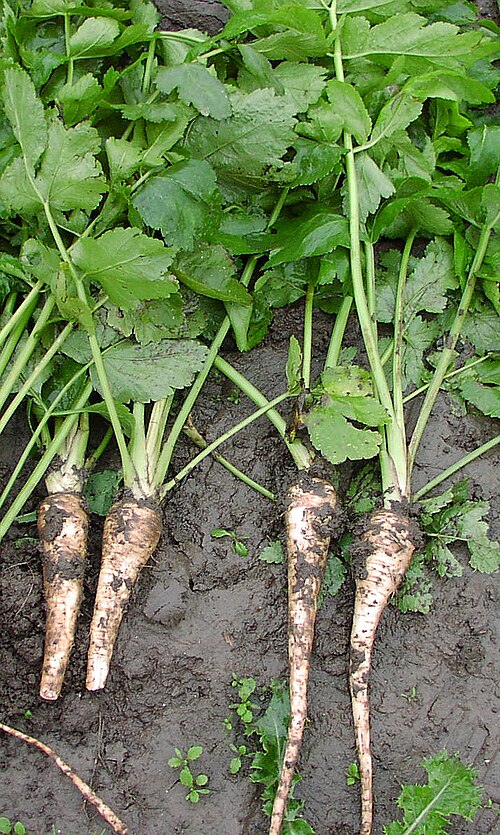
(Wikimedia)1
.jpg)
(Wikimedia)2
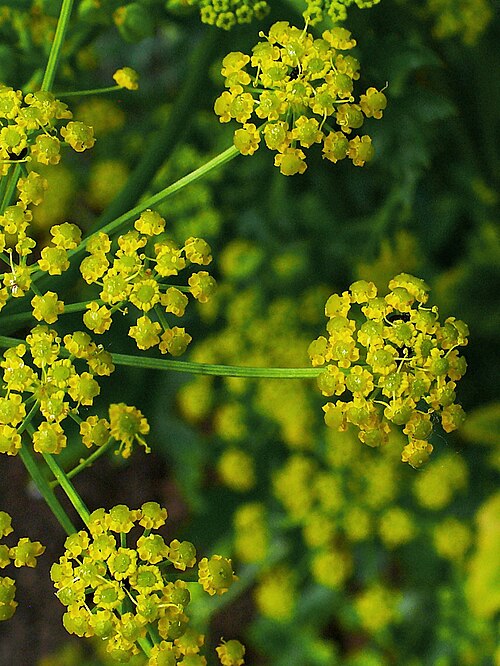
(Wikimedia)3
Image References
- 1, Pastina sativa, Goldlocki, CC BY-SA 3.0
- 2, Pastina sativa, Magnus Manske, CC BY-SA 3.0
- 3, Pastina sativa, H. Zell, CC BY-SA 3.0
"Pastinaca sativa is a BIENNIAL growing to 1 m (3ft 3in) by 0.3 m (1ft). It is hardy to zone (UK) 5 and is not frost tender. It is in flower from Jul to August, and the seeds ripen from Aug to September. The flowers are hermaphrodite (have both male and female organs) and are pollinated by Insects.The plant is self-fertile.
Suitable for: light (sandy), medium (loamy) and heavy (clay) soils and prefers well-drained soil. Suitable pH: acid, neutral and basic
(alkaline) soils. It can grow in semi-shade (light woodland) or no shade. It prefers moist soil." [PFAF]
General: "Stout, aromatic biennial herb from a stout taproot; stems erect, .3-1.8 m tall." [IFBC-E-flora]
Leaves: "Pinnately compound, stem leaves progressively reduced, basal leaves up to 50 cm long and nearly half as wide;
leaflets pinnately cleft." [IFBC-E-flora]
Flowers: "Inflorescence of compound umbels on terminal and lateral stalks; flowers yellow; spokes 15-25, unequal." [IFBC-E-flora]
Fruits: "Broadly elliptic, 5-6 mm long, strongly flattened crosswise, glabrous." [IFBC-E-flora]
Habitat & Range: "Fields, roadsides and waste places in the lowland zone; rare in SW BC; introduced from Europe." [IFBC-E-flora]
Status: Exotic [E-flora]
Hazards
Skin contact with the sap can cause photosensitivity and/or dermatitis in some people[65, 76, 218]. Parsnip is said to contain the alleged
'psychotroph' myristicine[218]." [PFAF]
"Contraindications, Interactions, and Side Effects (Parsnip) — Not covered (PH2). “Hazards and/or side effects not known for proper therapeutic dosages” (PH2). Fair complexions may suffer photodermatosis (PH2)." [HMH Duke]
Edible Uses
Root
Roots used in various cooked or fried foods, dug out in late autumn, until the early 19th century commonly grown as a vegetable, later the roots sometimes collected from the wild or semi-wild state and used as a vegetable (Luczaj) "Root - raw or cooked[2, 4, 5, 9, 27, 183]. When well grown, the cooked root has a very tender texture, though it is rather chewy raw[K]. It is best harvested after there have been some autumn frosts because it will have developed a sweeter flavour[61]. The root is delicious baked, it can also be used in soups etc and can be added to cakes, pies and puddings[183]." [PFAF]
Leaves & Young Shoots
"Leaves and young shoots - cooked with other greens as a vegetable or added to soups etc[9, 183]. Used in early spring[9]." [PFAF]
Seed
"The seed is used as a condiment[9]. Similar in taste to dill[183]." [PFAF]
Other Uses
Insecticide
The leaves and roots are used to make an insect spray[20]. Roughly chop the leaves and roots, put them in a basin with enough water to cover, leave them overnight then strain and use as an insecticide against aphids and red spider mite[201]." [PFAF]
Medicinal Uses
"A tea made from the roots has been used in the treatment of women's complaints[222]. A poultice of the roots has been applied to inflammations and sores[222]. The root contains xanthotoxin, which is used in the treatment of psoriasis and vitiligo[222]. Xanthotoxin is the substance that causes photosensitivity (see note above on toxicity)[222]." [PFAF]
"The root is used by the Forest Potawatomi to make a poultice for inflammation and sores. In discussing this medicine, they say that it is not to drink for it would surely kill one who uses it for a tea. Among the whites,310 the root of the cultivated Pastinaca is considered an esculent and nutritious while the seeds and the top of the plant are considered to have diuretic properties." [HuronSmith Zuni]
"Indications (Parsnip) — Bladder Stone (f; SKJ); Cancer (f; JLH); Cancer, breast (f; JLH); Cancer, liver (f; JLH); Cancer, neck (f; JLH); Cancer, spleen (f; JLH); Cancer, stomach (f; JLH); Cancer, testes (f; JLH); Cramp (1; WOI); Cystosis (f; HHB); Delirium (f; PH2); Dyspepsia (f; PH2); Enterosis (f; PH2); Fever (f; MAD; PH2); Gastrosis (f; HHB; JLH; PH2; SKJ); Hepatosis (f; MAD); Induration (f; JLH); Kidney Stone (f; PH2); Leukoderma (1; WOI); Malaria (f; MAD); Mastosis (f; JLH); Nephrosis (f; PH2); Orchosis (f; JLH); Phthisis (f; HHB); Respirosis (f; MAD); Splenosis (f; MAD); Sprain (f; PH2); Stone (f; HHB; PH2); Tuberculosis (f; MAD); Water Retention (f; MAD)." [HMH Duke]
"Dosages (Parsnip) — Root food farmacy (JAD); 1 tsp fresh herb 3 ×/day (MAD); handful herb boiled 10 minutes in 1 liter water, drink one wine glassful to 3 ×/day, or up to 2 liters/day, for 4–6 weeks (MAD; PH2)." [HMH Duke]
Pharmacology
"Activities (Parsnip) — Abortifacient (f; MAD); Antispasmodic (1; WOI); Aphrodisiac (f; MAD); Carminative (f; HHB; SKJ); Depurative (f; MAD); Diuretic (f; HHB; MAD; SKJ); Emmenagogue (f; MAD); Litholytic (f; HHB)." [HMH Duke]
Nutritional information
 [Turner&Kuhnlein]
 [Turner&Kuhnlein]
Cultivation
"Parsnips. (Pastinaca sativa, biennial) One of the easier root vegetables for home seed saving because it keeps well under mulch right in the garden row even in a bitter cold winter. Insects pollinate the blossoms, and cross-pollination with other parsnip varieties is likely up to 200 feet. How many home gardeners save more than one kind of parsnip seed, though, or have neighbors who save another kind?
Overwintered roots send up leaves and then flower stalks in early spring. The seeds shatter soon after they ripen, so keep an eye on the seed heads
and gather the light, dry, browned seeds as they mature. That occurs around the end of July in my Pennsylvania garden." [NSSH Bubel]
Synonyms
Pastinaca sativa var. pratensis Pers. [E-flora]
- [E-flora] https://linnet.geog.ubc.ca/Atlas/Atlas.aspx?sciname=Pastinaca%20sativa [Accessed: 5/03/2015 & July 18, 2021]
- [Luczaj] Wild vascular plants gathered for consumption in the Polish countryside: a review, Łukasz Łuczaj and Wojciech M Szymański, Journal of Ethnobiology and Ethnomedicine 2007, 3:17
- [PFAF] http://www.pfaf.org/user/Plant.aspx?LatinName=Pastinaca+sativa, Accessed May 3, 2015
Pastinaca Sp.
"Biennial, perennial herb, taprooted, ± glabrous to hairy. Stem: erect, branched. Leaf: blade oblong to
triangular-ovate, 1–2-pinnate, leaflets oblong to ovate. Inflorescence: umbels compound; bracts generally 0; bractlets
generally 0; rays 5–20, pedicels many, rays and pedicels spreading-ascending. Flower: calyx lobes minute; petals wide,
yellow [orange], tips narrowed. Fruit: oblong to obovate, compressed front-to-back; ribs unequal, marginal narrowly
winged, others thread-like; oil tube 1 per rib-interval, all equal in length; fruit axis
divided to base. Seed: face flat.
± 10 species: Eurasia. (Ancient name for parsnip)" [Jepson]
Local Species;
- Pastinaca sativa - common parsnip [E-flora]
References
- [Jepson] Lincoln Constance & Margriet Wetherwax, 2013. Pastinaca, in Jepson Flora Project (eds.) Jepson eFlora, http://ucjeps.berkeley.edu/cgi-bin/get_IJM.pl?tid=36499, accessed on Nov 24 2014