Lomatium Sp. - Desert-parsley
Family: Apiaceae (Umbelliferae) - Carrot [E-flora]
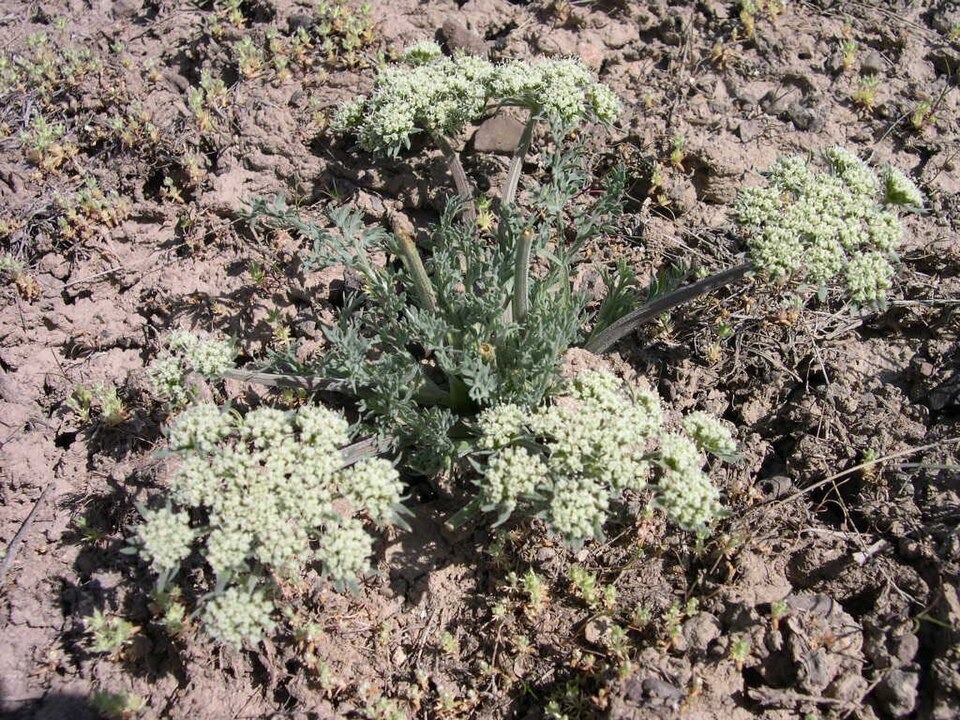
(Wikimedia)1
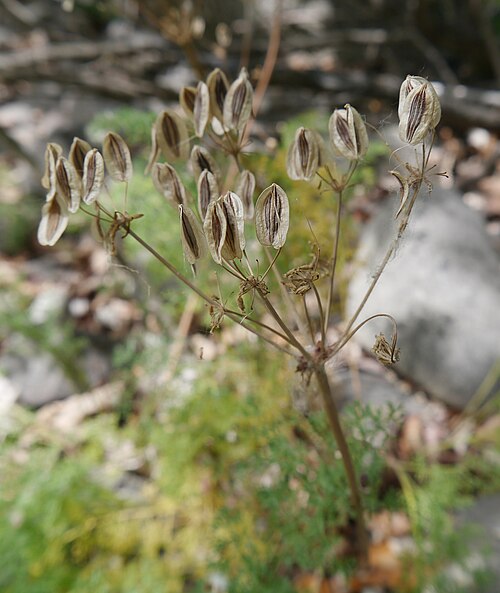
(Wikimedia)2
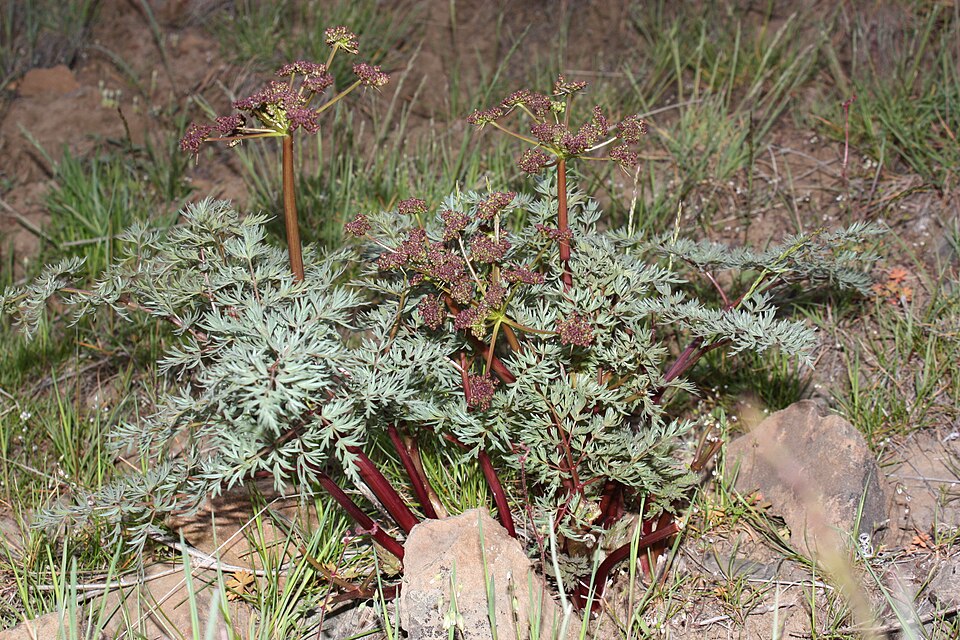
(Wikimedia)3
"Perennial herb, from taproot or generally deep-seated tuber, glabrous to tomentose. Stem: 0 or erect, simple or branched; base fibrous or not. Leaf: blade oblong to triangular-ovate or obovate, ternately, pinnately, or ternate-pinnately dissected or compound, segments or leaflets thread-like to wide; old basal leaf sheaths fibrous-persistent or not. Inflorescence: umbels compound, peduncled; bracts generally 0; bractlets generally present, 0 to conspicuous; rays, pedicels spreading to erect, generally webbed at base. Flower: calyx lobes generally 0; petals wide, yellow, white, or purple, tips narrowed; ovary tip projection 0. Fruit: linear to obovate, compressed front-to-back; marginal ribs widely to narrowly thin or thick-winged, others thread-like; oil tubes 1–several per rib-interval; fruit axis divided to base. Seed: face flat to concave.
+/- 75 species: central and southern North America. (Greek: bordered, from prominent marginal fruit wing) [Constance & Ertter 1996 Madroño 43:515–521] Fruit wing width given as width of 1 wing, not both together. Lomatium roseanum Cronquist is reported from High Cascade Range, northern High Sierra Nevada, Modoc Plateau." [Jepson]
Local species;
- Lomatium dissectum - fern-leaved desert-parsley [E-flora]
- Lomatium macrocarpum - large-fruited desert-parsley [E-flora]
- Lomatium martindalei - Martindale's lomatium [E-flora]
- Lomatium nudicaule - barestem desert-parsley [E-flora]
- Lomatium triternatum - nine-leaved desert-parsley [E-flora]
- Lomatium utriculatum - spring gold [E-flora]
Found elsewhere in B.C.;
- Lomatium ambiguum - Swale desert-parsley [E-flora]
- Lomatium brandegeei - Brandegee's lomatium [E-flora]
- Lomatium grayi - Gray's desert-parsley [E-flora]
- Lomatium multifidum - fern-leaved desert-parsley [E-flora]
- Lomatium papilioniferum - butterfly bearing lomatium [E-flora]
- Lomatium sandbergii - Sandberg's desert-parsley [E-flora]
- Lomatium simplex - Great Basin desert-parsley [E-flora]
Lomatium spp.
- "The edible roots of several species have been eaten raw, cooked or ground into flour (39)." [Krochmal]
- "Lomatium is also poorly researched but was widely used by both Native Americans and Mormon settlers in Utah and Oregon for lung problems, difficult fevers, and pneumonia. A Dr. Krebs reported that a decoction of the root was used successfully as a treatment in the 1918 pandemic.23 However, Dr. Krebs also noted that a decoction would fail to extract the plant’s oils that he considered to be the most active constituents. Lomatium contains many complex constituents and is known to occasionally cause a rash that is deemed not to be allergic in nature.24 Michael Moore states that the skin reaction can be avoided if lomatium is combined with dandelion root.25 " [Krochmal]
- "taprooted or tuberous rooted herbaceous perennials of dry plains and open wood and meadows, northwestern N America; tuberous roots cooked and eaten by indigenous peoples." [ETWP]
Lomatium dissectum - fern-leaved desert-parsley
"Lomatium dissectum is a PERENNIAL. The flowers are hermaphrodite (have both male and female organs) and are pollinated by Insects.The plant is self-fertile.
Suitable for: light (sandy), medium (loamy) and heavy (clay) soils and prefers well-drained soil. Suitable pH: acid, neutral and basic (alkaline) soils. It cannot grow in the shade. It prefers dry or moist soil." [PFAF]
"General: Stout perennial herb from a taproot; stems several, 0.5-1.5 (2) m tall." [IFBC-E-flora]
Habitat / Range
"Dry grasslands, shrublands, talus and rocky slopes in the steppe and montane zones; var. dissectum rare in S BC, var. multifidum frequent in SC and SE BC; E to SK and S to CO, AZ and CA." [IFBC-E-flora]
Origin Status: Native [E-flora]
Ecological Indicator Information
"A shade-tolerant/intolerant. montane to subalpine. Western North American forb distributed equally in the Pacific and Cordilleran regions. marginally in the Central region. Occurs on very dry to moderately dry, nitrogen-rich soils (Moder and Mull humus forms) within subalpine boreal, temperate, cool semiarid, and dry mesothermal climates. Sporadic in open-canopy forests on watershedding sites. A nitrophytic species characteristic of moisture-deficient sites. (IPBC)" [E-flora]
- Plant
- Several tribes of Indians ate the shoots and roots of dissectum. (CompMed)
- Roots
- "Cooked 105,177,183,257. Resinous and balsamic 207. The root can be dried and ground into a powder and then be mixed with cereal flours or added as a flavouring to soups etc. The roots have been boiled to make a refreshing and nutritious drink 257." [PFAF]
- Lomatium utriculatum (Nutt.) Coult. & Rose (possibly Daucus pusillus Michx.) ("wild carrot")
""Wild carrot" roots were eaten by the Kwakiutl, as they were by their Salish neighbours (Turner & Bell, 1971). Their botanical identity is still subject to question. Boas (1921) and Hunt (1922) applied the Kwakiutl terms to several umbelliferous species. Our informants, while they remembered eating the roots, had only vague recollections of what the plants were like. Lomatium utriculatum, one of plants specified by Hunt (op. cit. ), seems to fit the morphological and habitat description best.
The plants grew on grassy rocky points of land, particularly on the small offshore islands. They were marked when the leaves were above the ground, and they were dug the following spring before they had sprouted. The turf was peeled back with a yew wood digging stick, the larger carrot roots were picked out, and the turf was replaced. Cranmer (1969) states that the whitish roots were often eaten raw and that they were sweet and tasty, but according to Boas (1921), raw carrots had a strong taste and caused diarrhoea. The carrots were placed in a flat-bottomed small-meshed basket and cooked in a steaming pit lined with dry eelgrass and fern leaves. The pit was covered with old mats and the carrots were allowed to cook for several hours. They were eaten dipped in oil. Only the right hand could be used to eat them. One was allowed to drink water afterwards. In more recent times carrot roots were boiled in kettles (Boas, 1921)." [Turner&Bell2]
- Seeds
- "Young seed sprouts - raw 105,177,257. Seed 106,257. No more details are given, though it is most likely used as an aromatic flavouring in cooked foods K." [PFAF]
- Incense
- "The pulverized root has been burnt as an incense 257." [PFAF]
- Fish Poison
- "Some [tribes] immersed the fresh root in streams to stun fish for harvesting." (CompMed)
- "Some [tribes] immersed the fresh root in streams to stun fish for harvesting." (CompMed)
- Horse Medicine
- "Dissectum was used to cure equine distemper (a contagious upper respiratory tract infection of horses and other
equines caused by a bacterium)." (CompMed)
- "Dissectum was used to cure equine distemper (a contagious upper respiratory tract infection of horses and other
equines caused by a bacterium)." (CompMed)
- Anti-Lice
- "Dissectum used as a pediculicide (anti-lice) for humans and animals." (CompMed)
- "Dissectum used as a pediculicide (anti-lice) for humans and animals." (CompMed)
Medicinal Uses
"Fernleaf biscuitroot was widely employed medicinally by many native North American Indian tribes who considered it to be a universal
panacea and used it especially in treating chest problems and skin complaints 207,257. It is little, if at all, used in modern herbalism, but probably
warrants investigation." [PFAF]
"Lomatium dissectum was historically one of the most important medicinal plants of the western United States. Native Americans used the herb as an internal remedy for viral and bacterial infections, especially those of the eyes, respiratory tract and urinary tract." (CompMed)
Root
Pectoral: "The dried root was used in the treatment of rheumatism, stomach complaints, coughs, colds, hay fever, bronchitis, influenza, pneumonia and tuberculosis 207, 257. The root was burnt and the smoke
inhaled in the treatment of asthma and other chest complaints 257, it was also used as a herbal steam bath for treating chest complaints 257." [PFAF]
"A decoction of the root was taken internally, and the above ground portion of the plant was smoked or burned and inhaled to treat coughs, colds, hayfever, bronchitis,
asthma, influenza, pneumonia and tuberculosis." (CompMed)
Tonic: "The root was used to make a drink that was taken as a tonic to help people in a weakened condition gain weight 257." [PFAF]
Poultice: "A poultice of the peeled and crushed roots has been applied to open cuts, sores, boils, bruises and rheumatic joints 257." [PFAF] "The decoction was also applied externally for cuts, sores and rashes." (CompMed)
Antidandruff: "The root has been soaked in water and then used as an antidandruff wash for the hair 257." [PFAF]
Oil: "The root oil has been applied as a salve to sores and also used as an eye wash in the treatment of trachoma 257." [PFAF] "the oily sap was placed on skin lesions and used in the eyes for trachomal and gonorrheal infections." (CompMed)
Chewed: "The raw root was chewed for sore throat and used as a poultice for swellings, sprains and rheumatism." (CompMed)
"An infusion has been used as a tonic 257." [PFAF]
Other Medicinal Use
" The Nez Perce of North America mixed the roots with tobacco (Nicotiana spp.) and smoked them to treat sinus troubles (Hart 1996)." [UAPDS]
" The Northern Paiute, also of North America, mixed the roots with tobacco and smoked the mixture to relieve headaches and colds (Fowler 1989). Other Native Americans inhaled the smoke of burning roots to treat influenza, sinus, sore throats, congestion in the nose and lungs, hay fever, bronchitis, asthma, pneumonia, headaches, dizziness, and tuberculosis (Foster and Hobbs 2002)." [UAPDS]
" The Blackfoot, Ute, and Gosiute of North America burned the roots of this species and let their horses inhale the smoke to treat distemper (Chamberlin 1909). The Great Basin people, also of North America, burned dried roots on hot coals, inhaling the smoke for asthma and bronchitis, and the Paiute of North America inhaled smoke from burning pulverized roots for colds, asthma, and tuberculosis (Train et al. 1941). Moerman (1998) suggests another plant species may have been in these practices." [UAPDS]
"An extensive investigation of 100 British Columbian medicinal plant extracts found only one, derived from the roots of Lomatium dissectum (Umbelliferae), which was active against bovine rotavirus [16]. This extract completely inhibited viral cytopathic effects on African green monkey kidney cells, MA104. Clark et al." [ModPhyt]
Actvities
"Whole Plant but especially the root, is disinfectant, pectoral, salve, stomachic and tonic 257." [PFAF]
Antiviral
During the world wide influenza epidemic of 1917, the effectiveness of Lomatium dissectum came to the attention of the American white man, Dr. Alstat explained, when it was observed that native Americans in the Southwest
were recovering rapidly from the virus that was killing others.(CompMed)
“A doctor named Ernest Krebbs, who was working in the desert in Nevada, found that the Indians there were peeling dissectum root, drawing and boiling it and skimming off the oil. Using about a pound of herb, the Indians were getting well within a week’s time.” Krebbs and other doctors began using the root and found it had significant healing effects. It gained in popularity, and soon four manufacturing plants were producing the extract. Since it was a Western frontier remedy, however, dissectum never attracted the attention of the medical profession in general, and shortly after the influenza epidemic died off, interest in dissectum died as well.(CompMed)
The root is normally taken as a tincture. [Buhner Antivirals]
Fresh root tincture 1:2 herb:liquid ratio. 70 grain. let macerate for 2 weeks. "10-30 drops up to 5x daily. In acute conditions, take 10-30 drops each hour." [Buhner Antivirals]
"Dry root: Same as for fresh root, except powder the root and use an herb:liquid ratio of 1:5." [Buhner Antivirals]
SeedsThe seeds are highly active, "contain considerably more constituents than the root and may be used instead". Dosage: "Fresh seeds: Same as for the fresh root. Dry seeds: 1:3, 50 percent alcohol." "1 dropperfull 3-5x daily or once per hour in acute conditions." [Buhner Antivirals]
Phytochemicals
- Root: The root contains essential oil, gums, resins, glycosides (coumarins and saponins), carbohydrates, protein, fatty acids and ascorbic acid. (CompMed)
Cultivation & Propagation
"Seed - best sown as soon as it is ripe in a cold frame. Stored seed can be rather slow to germinate, when sown in the spring it usually takes at least 12 months to germinate. Giving it a period of cold stratification might reduce this time. The seedlings need to be pricked out into individual pots as soon as they are large enough to handle, and should be planted out into their permanent positions in the summer. Fresh seed can be sown immediately in situ. Division may be possible in spring or autumn." [PFAF]
"We have almost no information on this species and do not know if it will be hardy in Britain, though judging by its native range it should succeed outdoors in much of the country. It can be assumed that plants will require a dry to moist but well-drained soil in a sunny position. This is a taxonomically very difficult genus, many of the species now included in it have at times been included in other genera[60]." [PFAF]
Synonyms
- Leptotaenia dissecta.
- Leptotaenia multifida. [E-flora]
- (CompMed) L. dissectum. An Herbal Virucide? From 'Complimentary Medicine' May/June 1987 Reprinted with permission; The following article is based upon a literature search and paper by Edward K. Alstat, N.D., R.Ph., and an interview with Dr. Alstat. See also, “The History and Efficacy of Therapeutic Herbs from the March-April, 1987 issue of 'Complimentary Medicine' which also features Dr. Alstat. http://www.aminoacidbotanicalandsupplementsource.net/Lomatium_Info.htm
- [E-flora] http://linnet.geog.ubc.ca/Atlas/Atlas.aspx?sciname=Lomatium%20dissectum&redblue=Both&lifeform=7, Accessed May 4, 2015
- [PFAF] http://www.pfaf.org/user/Plant.aspx?LatinName=Lomatium+dissectum, Accessed May 8, 2015
Lomatium macrocarpum - large-fruited desert-parsley
"Lomatium macrocarpum is a PERENNIAL. The flowers are hermaphrodite (have both male and female organs) and are pollinated by Insects.The plant is self-fertile.
Suitable for: light (sandy), medium (loamy) and heavy (clay) soils and prefers well-drained soil. Suitable pH: acid, neutral and basic (alkaline) soils. It cannot grow in the shade. It prefers dry or moist soil." [PFAF]
Edible Uses
"Root - raw or cooked[257]. A staple food for a number of native North American Indian tribes[257]. The root is usually peeled before being cooked or eaten[257]. It can be dried and ground into a powder and then used to make cakes etc[105, 161, 183]. Seed - raw or cooked. Very nutritious, they can also be ground into a powder[183] and then used with cereal flours when making bread, cakes etc, or be used as a flavouring in soups etc[257]. The seed is very small, but quite easy to harvest[183, K]. A tea can be made from the leaves, stems and flowers[183]." [PFAF]
RootDried Bryoria in the "cake" form could be employed in a number of ways. It could be eaten "as is," like a cracker or crust of bread, or it could be boiled with meat in a soup. The Okanagan made a tasty dish by cooking it with bitter-root (Lewisia rediviva Pursh), dough, and fresh salmon eggs (Turner, Bouchard, and Kennedy, in press). The Thompson boiled it with dried "Indian carrots" [Lomatium macrocarpum (Nutt.) Coult. & Rose], saskatoon berries, yellow avalanche lily corms (grythronium grandiflorum Pursh), tiger lily bulbs (Lilium columbianum Hanson), or dried venison [Turner, 1977]
Medicinal Uses
"An infusion of the roots has been used as a general strengthener for a weakened patient[257]. The infusion is also used as a treatment for colds, influenza and bronchitis[257]. The root has been chewed and the juice swallowed as a treatment for sore throats[257]. The root has been eaten by childless couples, especially older people, in order to help them conceive[257]. A poultice made from the boiled root has been used to treat swellings[257]. The leaves have been used as a padding in a child's cradle to encourage it to sleep more[257]." [PFAF]
SmokeThe Blackfoot of North America burned the roots and used the smoke to treat distemper in their horses (Hart 1996). The Crow, also of North America, threw shavings of the roots on hot coals for incense purposes that were meant to purify and scent the air [UAPDS]
Cultivation
"We have almost no information on this species and do not know if it will be hardy in Britain, though judging by its native range it should succeed outdoors in much of the country. It can be assumed that plants will require a dry to moist but well-drained soil in a sunny position. Polymorphic[60]. This is a taxonomically very difficult genus, many of the species now included in it have at times been included in other genera[60]." [PFAF]
Propagation
"Seed - best sown as soon as it is ripe in a cold frame. Stored seed can be rather slow to germinate, when sown in the spring it usually takes at least 12 months to germinate. Giving it a period of cold stratification might reduce this time. The seedlings need to be pricked out into individual pots as soon as they are large enough to handle, and should be planted out into their permanent positions in the summer. Fresh seed can be sown immediately in situ. Division may be possible in spring or autumn." [PFAF]
- http://www.pfaf.org/user/Plant.aspx?LatinName=Lomatium+macrocarpum, Accessed May 8, 2015
- [Turner, 1977] Economic Importance of Black Tree Lichen (Bryoria fremontii) to the Indians of Western North America. NANCY j. TURNER, ECONOMIC BOTANY 31:461-470. October-December,1977
Lomatium martindalei - Martindale's lomatium
"In BC, this species is being assessed by the BC Conservation Data Centre. We presently list one variety (var. angustatum), however there may also be a second variety (var. martindalei) present." [E-flora]
"General: Perennial herb from an elongate taproot or a thickened, subterranean root crown or branching stem-base; stems prostrate to ascending, up to 40 cm long, glabrous." [IFBC-E-flora]
Habitat / Range
"Dry rocky slopes and meadows in the montane to alpine zones; infrequent in SW BC; S to OR." [IFBC-E-flora]
Origin Status: Native [E-flora]
References
- http://linnet.geog.ubc.ca/Atlas/Atlas.aspx?sciname=Lomatium%20martindalei&redblue=Both&lifeform=7 [Accessed: 5/09/2015]
Lomatium nudicaule - barestem desert-parsley
"Lomatium nudicaule is a PERENNIAL growing to 0.6 m (2ft) by 0.6 m (2ft in). The flowers are hermaphrodite (have both male and female organs) and are pollinated by Insects.The plant is self-fertile.
Suitable for: light (sandy), medium (loamy) and heavy (clay) soils and prefers well-drained soil. Suitable pH: acid, neutral and basic (alkaline) soils. It cannot grow in the shade. It prefers dry or moist soil." [PFAF]
"General: Stout perennial herb from a taproot, glabrous, strongly glaucous; stems solitary to several, 20-90 cm tall." [IFBC-E-flora]
Habitat / Range
"Dry rocky or grassy slopes and open woods in the lowland and steppe zones; locally common on SE Vancouver Island and the Gulf Islands, rare eastward in S BC; E to SW AB and S to UT and CA." [IFBC-E-flora]
Origin Status: Native [E-flora]
Edible Uses
- Roots
- Preparation: "Raw or cooked[207]. The root can be roasted and used as a vegetable, or can be dried and ground into a powder then used as a flavouring in soups etc [105, 161]." [PFAF]
- Properties: "The taste is rather like a hot spicy parsnip[207]." [PFAF]
- Preparation: "Raw or cooked[207]. The root can be roasted and used as a vegetable, or can be dried and ground into a powder then used as a flavouring in soups etc [105, 161]." [PFAF]
- Young Leaves & Stalks
- Young leaves and stalks eaten fresh or cooked; rich in vitamin C. [ETWP]
- Young leaves and stalks eaten fresh or cooked; rich in vitamin C. [ETWP]
- Leaves & Young Shoots
- "Eaten as a vegetable or used as a celery-like flavouring in soups etc[177, 183, 257]." [PFAF]
- "Eaten as a vegetable or used as a celery-like flavouring in soups etc[177, 183, 257]." [PFAF]
- Leaves, Stems and Flowers
- "Infused and used as a beverage[161, 183, 257]." [PFAF]
- "Infused and used as a beverage[161, 183, 257]." [PFAF]
- Seed
- "Raw or cooked[257]. The immature seed is chewed as a refreshing snack and can be used as a flavouring in soups etc[257]." [PFAF]
Other Uses
- Repellent
- "The seed is spicy and aromatic, it is used as a house fumigant and deodorant. It also repels mosquitoes[99]." [PFAF]
- Perfume
- "Minor products included perfumes; for example, the crushed seeds of Aquilegia formosa Fisch. (Ranunculaceae) were used on the Warm Springs Reservation. Often, these Indians used scented plant material like a sachet; the seeds of Lomatium nudicaule (Pursh) Coult. & Rose were placed with stored buckskin garments." [EthPacNorth]
- "Minor products included perfumes; for example, the crushed seeds of Aquilegia formosa Fisch. (Ranunculaceae) were used on the Warm Springs Reservation. Often, these Indians used scented plant material like a sachet; the seeds of Lomatium nudicaule (Pursh) Coult. & Rose were placed with stored buckskin garments." [EthPacNorth]
Medicinal Uses
"This was one of the most powerful medicines of the Salish of southern Vancouver Island (Boas, 1890)." [Turner&Bell1]
"According to French (1965), the leaves and stems were eaten by the West Coast Indians." [Turner&Bell1]
Seeds
"The aromatic seeds were highly valued as a medicine." [Turner&Bell2]
"Seeds were swallowed for some internal complaints. For headaches they were inhaled like smelling salts, or sometimes a poultice was placed on the head." [Turner&Bell1]
"Additionally, they were eaten to cure constipation, sucked to ease a cough or sore throat, and used along with black twinberry (Lonicera involucrata) and tobacco (Nicotiana sp.) to make a steam bath for general sickness." [Turner&Bell2]
Activities: "Analgesic, diaphoretic, febrifuge, laxative and pectoral[257]. " [PFAF]
- Chewed: "They have been chewed in the treatment of fevers, colds and sore throats[257]. " [PFAF] "The Saanich, Songish, and Cowichan chewed the seeds for colds and sore throats, and burned them to fumigate houses or "drive away ghosts" (Boas, 1890; Harry, 1969; Paul, 1968)." [Turner&Bell1]
- Infusion: "An infusion has been used by pregnant women to ensure an easy delivery[257]." [PFAF]
- Poultice: "A poultice of the crushed seeds has been applied to the head to relieve the pain of headaches. The poultice has also been applied to sore places, pains and itches[257]." [PFAF]
- Childbirth: "Water in which they had been steeped was drunk by a pregnant woman to insure an easy delivery (Boas, 1930)." [Turner&Bell2]
"When a man had a carbuncle, hiswife would chew the seeds and spit them on the sore, placing a warm skunk cabbage leaf (Lysichitum americanum) over the top. When a man had a headache, his child would chew up the seeds and blow them on the head of his parent. The seeds were similarly chewed and applied to the affected area for stomach aches, back aches, swelling of a woman's breasts, aching body, colds, and swollen knees and feet (Boas, 1930; Brown, 1969; Cranmer, 1969; Johnson, 1969; King, 1972)." [Turner&Bell2]
"For
tuberculosis and other ailments, an ex-
tract of the bark was drunk, one clam-
shellful at a time (Boas, 1966; Brown,
1969). The rotten stems were burnt, and
the ashes were mixed with catfish oil and
rubbed on swellings to shrivel them just as
the stems shriveled when burnt (Boas,
1966). The bark was used to prepare a
steam bath for a person with pains in his
body. Two different methods of prepara-
tion have been recorded. In one case, the
spines were scorched off four pieces of
devil's club and the bark boiled for a day
with
Folklore
"Hunters always kept the seeds, along with hellebore roots (Veratrum viride) in their canoe boxes for protection (Boas, 1921)." [Turner&Bell2] "The Songish burned the seeds with "red paint" and Typha as an offering for the First Salmon (Boas, 1890)." [Turner&Bell1]
Propagation
"Seed - best sown as soon as it is ripe in a cold frame[188]. Stored seed can be rather slow to germinate, when sown in the spring it usually takes at least 12 months to germinate. Giving it a period of cold stratification might reduce this time. The seedlings need to be pricked out into individual pots as soon as they are large enough to handle, and should be planted out into their permanent positions in the summer. Fresh seed can be sown immediately in situ[188]. Division may be possible in spring or autumn." [PFAF]
Cultivation
"Requires a sunny position in a fertile well-drained soil[188]. Plants are frost hardy[188]. This is a taxonomically very difficult genus, many of the species now included in it have at times been included in other genera[60]." [PFAF]
Synonyms
- Cogswellia nudicaulis (Pursh) M.E. Jones [E-flora]
- [E-flora] http://linnet.geog.ubc.ca/Atlas/Atlas.aspx?sciname=Lomatium%20nudicaule&redblue=Both&lifeform=7, Accessed May 9, 2015
- [EthPacNorth]Ethnobotany of the Pacific Northwest Indians, David H. French, July, 1965.
- [PFAF]http://www.pfaf.org/user/Plant.aspx?LatinName=Lomatium+nudicaule, Accessed May 9, 2015
Lomatium triternatum - nine-leaved desert-parsley
"Lomatium triternatum is a PERENNIAL growing to 0.8 m (2ft 7in). The flowers are hermaphrodite (have both male and female organs) and are pollinated by Insects.The plant is self-fertile.
Suitable for: light (sandy), medium (loamy) and heavy (clay) soils and prefers well-drained soil. Suitable pH: acid, neutral and basic (alkaline) soils. It cannot grow in the shade. It prefers dry or moist soil." [PFAF]
Subtaxa Present in B.C.
- Lomatium triternatum ssp. platycarpum
- Lomatium triternatum ssp. triternatum [E-flora]
" General: Perennial herb from an elongated taproot, seldom thickened, surmounted by a simple branched crown or stem-base; stems or scapes solitary or few, erect, 10-80 cm tall, glabrous." [IFBC-E-flora]
Habitat / Range "Dry open slopes and grasslands in the lowland, steppe and montane zones; frequent in SC and SE BC (ssp. triternatum), rare on S Vancouver Island (ssp. platycarpum); E to SW AB and S to CO, UT and CA." [IFBC- E-flora]
Origin Status: Native [E-flora]
Edible Uses
- Root
- "Root - raw or cooked[257]. About the size of peanuts, the roots were a staple food of the local native North American Indian tribes[2]. When roasted it makes an excellent vegetable[2]. It can also be dried and ground into a powder, when it develops a mild sweet flavour[2, 105, 161, 177]." [PFAF]
- Flowers & Upper Leaves
- "The dried flowers and upper leaves are used as a flavouring in soups and stews[257]." [PFAF]
Other Uses
- Incense
- "The seed is aromatic and is used as a scent[99]." [PFAF]
- "The seed is aromatic and is used as a scent[99]." [PFAF]
Medicinal Uses
- Leaves & Roots
- "An infusion of the leaves and roots has been used in the treatment of chest complaints[257]." [PFAF]
- "An infusion of the leaves and roots has been used in the treatment of chest complaints[257]." [PFAF]
- Flowers & Upper Leaves
- "An infusion of the flowers and upper leaves has been used in the treatment of colds and sore throats[257]." [PFAF]
Cultivation
"We have almost no information on this species and do not know if it will be hardy in Britain, though judging by its native range it should succeed outdoors in much of the country. It can be assumed that plants will require a dry to moist but well-drained soil in a sunny position. This is a taxonomically very difficult genus, many of the species now included in it have at times been included in other genera[60]." [PFAF]
Propagation
"Seed - best sown as soon as it is ripe in a cold frame[188]. Stored seed can be rather slow to germinate, when sown in the spring it usually takes at least 12 months to germinate. Giving it a period of cold stratification might reduce this time. The seedlings need to be pricked out into individual pots as soon as they are large enough to handle, and should be planted out into their permanent positions in the summer. Fresh seed can be sown immediately in situ[188]. Division may be possible in spring or autumn." [PFAF]
Synonyms
L. platycarpum. (Torr.)Coult.&Rose. [E-flora]
- [E-flora] http://linnet.geog.ubc.ca/Atlas/Atlas.aspx?sciname=Lomatium%20triternatum&redblue=Both&lifeform=7 [Accessed: 5/09/2015]
- [PFAF] http://www.pfaf.org/user/Plant.aspx?LatinName=Lomatium+triternatum, Accessed May 9, 2015
Lomatium utriculatum - spring gold
"Lomatium utriculatum is a PERENNIAL. The flowers are hermaphrodite (have both male and female organs) and are pollinated by Insects.The plant is self-fertile.
Suitable for: light (sandy), medium (loamy) and heavy (clay) soils and prefers well-drained soil. Suitable pH: acid, neutral and basic (alkaline) soils. It cannot grow in the shade. It prefers dry or moist soil." [PFAF]
"General: Perennial herb from a long, slender taproot, glabrous or short-hairy; stems 10-60 cm tall, leafy." [IFBC-E-flora]
Habitat / Range
"Mesic to dry bluffs, rocky slopes and grassy sites in the lowland zone; locally common on SE Vancouver Island and the Gulf Islands; S to CA." [IFBC-E-flora]
Origin Status: Native [E-flora]
Uses
"The Salish Indians sought the young sprouts in the early spring before the leaves had appeared above the ground (Anderson, 1925). They tasted like celery, but became pungent with age. Anderson also mentions that peeled roots were pounded and made into cakes by some Indian groups. Also, the roots were chewed or soaked in water and taken for stomach disorders or headaches (op. cit.)." [Turner&Bell1]
""Wild carrot" roots were eaten by the Kwakiutl, as they were by their Salish neighbours (Turner & Bell, 1971). Their botanical identity is still subject to question. Boas (1921) and Hunt (1922) applied the Kwakiutl terms to several umbelliferous species. Our informants, while they remembered eating the roots, had only vague recollections of what the plants were like. Lomatium utriculatum, one of plants specified by Hunt (op. cit. ), seems to fit the morphological and habitat description best. The plants grew on grassy rocky points of land, particularly on the small offshore islands. They were marked when the leaves were above the ground, and they were dug the following spring before they had sprouted. The turf was peeled back with a yew wood digging stick, the larger carrot roots were picked out, and the turf was replaced. Cranmer (1969) states that the whitish roots were often eaten raw and that they were sweet and tasty, but according to Boas (1921), raw carrots had a strong taste and caused diarrhoea. The carrots were placed in a flat-bottomed small-meshed basket and cooked in a steaming pit lined with dry eelgrass and fern leaves. The pit was covered with old mats and the carrots were allowed to cook for several hours. They were eaten dipped in oil. Only the right hand could be used to eat them. One was allowed to drink water afterwards. In more recent times carrot roots were boiled in kettles (Boas, 1921)." [Turner&Bell2]
Edible Uses
- Root
- "Root - raw or cooked. It can be dried and ground into a powder or roasted as a vegetable[177]." [PFAF]
- "Root - raw or cooked. It can be dried and ground into a powder or roasted as a vegetable[177]." [PFAF]
- Young Leaves & Shoots
- "Young leaves and shoots - raw or cooked as greens[105, 161, 183, 257]." [PFAF]
- "Young leaves and shoots - raw or cooked as greens[105, 161, 183, 257]." [PFAF]
Medicinal Uses
- Plant
- "A decoction of the plant has been used as a wash for swollen and broken limbs[257]." [PFAF]
- "A decoction of the plant has been used as a wash for swollen and broken limbs[257]." [PFAF]
- Root
- "The root is analgesic and stomachic[257]. It has been chewed or infused as a treatment for headaches and stomach complaints[257]." [PFAF]
Cultivation
"We have almost no information on this species and do not know if it will be hardy in Britain, though judging by its native range it should succeed outdoors in much of the country. It can be assumed that plants will require a dry to moist but well-drained soil in a sunny position. This is a taxonomically very difficult genus, many of the species now included in it have at times been included in other genera[60]." [PFAF]
Propagation
"Seed - best sown as soon as it is ripe in a cold frame[188]. Stored seed can be rather slow to germinate, when sown in the spring it usually takes at least 12 months to germinate. Giving it a period of cold stratification might reduce this time. The seedlings need to be pricked out into individual pots as soon as they are large enough to handle, and should be planted out into their permanent positions in the summer. Fresh seed can be sown immediately in situ[188]. Division may be possible in spring or autumn." [PFAF]
Synonyms Lomatium vaseyi (Coult. & Rose) Coult. & Rose [E-flora]
- [E-flora] http://linnet.geog.ubc.ca/Atlas/Atlas.aspx?sciname=Lomatium%20utriculatum&redblue=Both&lifeform=7 [Accessed: 5/10/2015]
- [PFAF] http://www.pfaf.org/user/Plant.aspx?LatinName=Lomatium+utriculatum, Accessed May 10, 2015
Other Species
Lomatium grayi - Gray's desert-parsley
Red Listed taxon in B.C. [E-flora]
Description
General: "Malodorous perennial herb from a long, stout taproot below a branching stem-base which is often covered by the dead leaves of the previous year; stems several, glabrous, 15-50 cm tall." [IFBC-E-flora]
Leaves: "Mostly basal, short rough-hairy, very finely dissected, with numerous, very narrow, often subterete ultimate segments that lie in numerous planes to form a thick mat." [IFBC-E-flora]
Flowers: "Inflorescence of compound umbels; flowers yellow; spokes of the umbel elongate unequally, 3.5-10 cm long; involucels well-developed." [IFBC-E-flora]
Fruits: "Elliptic, 8-15 mm long, glabrous, lateral wings 1/3 - 1/2 as wide as the body." [IFBC-E-flora]
Habitat/Range
Dry rocky or open slopes in the lowland zone; rare in SW BC, known only from Galiano Island and Saltspring Island; S to WY, CO, NV and OR." [IFBC-E-flora]
Status: Native [E-flora]
Synonyms
- Lomatium papilioniferum J.A. Alexander & W. Whaley = Lomatium grayi (J.M. Coult. & Rose) J.M. Coutl. & Rose [E-flora]
References
- Lomatium papilioniferum J.A. Alexander & W. Whaley, E-flora - https://linnet.geog.ubc.ca/Atlas/Atlas.aspx?sciname=Lomatium%20papilioniferum, Accessed April 28, 2026
Uses of Other Sp
Lomatium geyeri "The Biscuitroot is sometimes eaten raw, when it is said to have a celerylike flavor. Usually it is peeled, dried, then mashed or ground into a sort of flour and made into cakes. The cakes are said to have the taste of stale biscuits ; hence by the white people the plant was generally called Biscuitroot. The Indians sometimes made the cakes large enough to be strapped on the saddle and carried for miles on horseback and used when desired." [EWP]
"Lomatia silaifolia (Sm.) R. Br. (Proteaceae). wild parsley. The flowers of the wild parsley, when burned, produce smoke that has been reported to repel flies (McIndoo 1945)." [UAPDS]
"Suksdorfin from the fruit of Lomatium suksdorfii inhibits HIV infection in H9 cells with an EC 50 of 2.6 M but the mode of action of this coumarin appears to be different from inophyllums as it has no inhibitory effect on the enzyme RT (Lee et al., 1994)." [BCNS]
"Lomatium californicum (Nutt.) Math. & Const. Chuchupate; pa' (B,I), chpa' (V). To stupefy rattlesnakes for capture, the root was chewed or soaked in water and the liquid applied to the hands, thrown on the snake's body, or squirted through a hollow tube into its mouth while the animal was held down with forked sticks; this was said to make the snake docile. Piece of root carried in the clothing for protection from rattlesnakes. Root chewed and applied as poultice for pain, rheumatism, sores; root decoction drunk for paralysis, rheumatism. [0]" [Ethchumash]
"The most commonly used Lomatium is Lomatium dissectum but several others can be used identically and are (usually) not considered endangered: L. ambiguum, L. bicolor, L.cous, L. foeniculaceum, L. grayi, L. macrocarpum, L. nudicaule, L. orientale, L. simplex, L. triternatum." [Buhner Antivirals]
References
- [Jepson] Lincoln Constance & Margriet Wetherwax, 2013. Lomatium, in Jepson Flora Project (eds.) Jepson eFlora, http://ucjeps.berkeley.edu/cgi-bin/get_IJM.pl?tid=31441, accessed on Aug 2 2014
- [Krochmal]Useful Native Plants in the American Southwestern Deserts, A. KROCHMAL, S. PAUR ANY P. DUISBERG
Image References
- 1, Lomatium macrocarpum, Thayne Tuason, CC BY-SA 4.0
- 2, Lomatium grayi, Thayne Tuason, CC BY 4.0
- 3, Lomatium dissectum, Walter Siegmund, CC BY-SA 3.0