Ligusticum Sp. - Lovage
Family: name [E-flora]
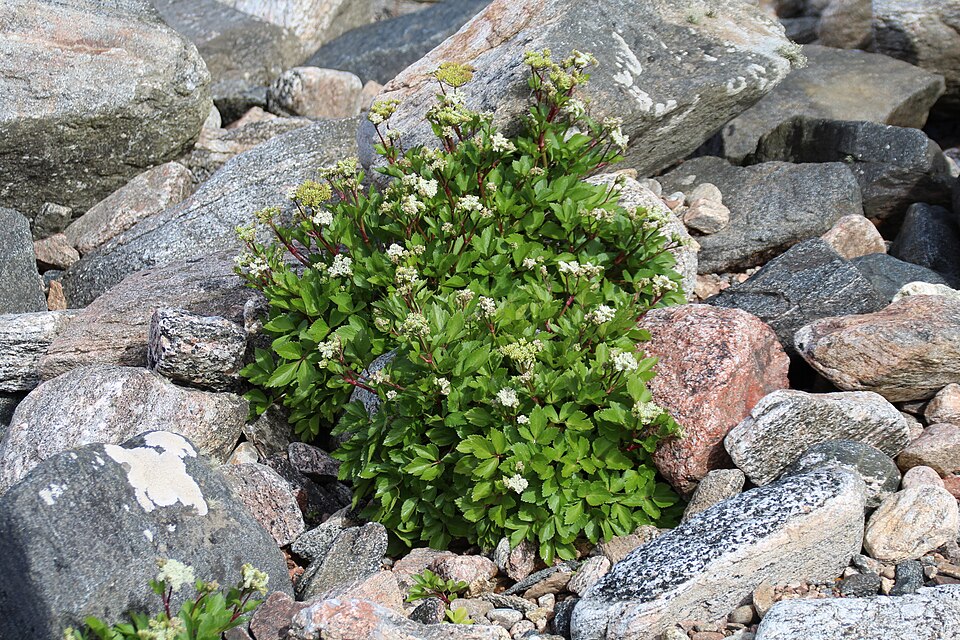
(Wikimedia)1
_-_Port_au_Choix,_Newfoundland_2019-08-19_(03).jpg)
(Wikimedia)2
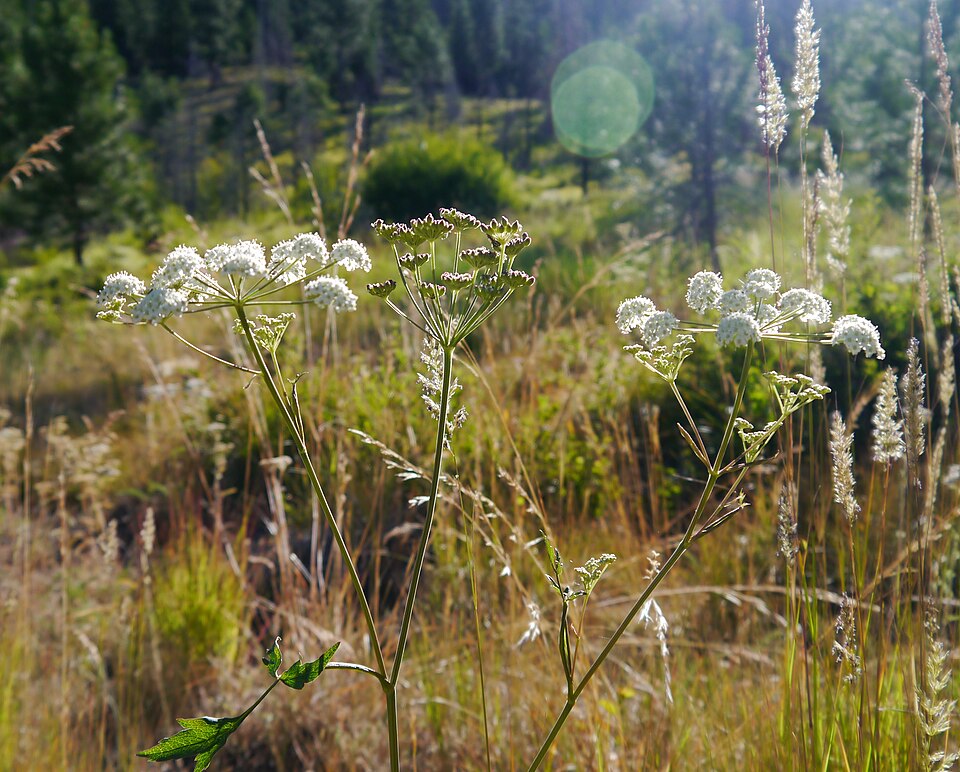
(Wikimedia)3
Image References
- 1, Ligusticum scoticum, GerritR, CC BY-SA 4.0
- 2, Ligusticum scoticum, Ryan Hodnett, CC BY-SA 4.0
- 3, Ligusticum canbyi, Thayne Tuason, CC BY-SA 4.0
"Perennial herb, taprooted, glabrous to minutely scabrous. Stem: erect, leafy, conspicuously fibrous at base, generally branched. Leaf: blade oblong to round, ternately or pinnately compound or dissected, leaflets oblong to obovate, entire to deeply pinnately lobed, segments linear to oblong. Inflorescence: compound umbels; bracts generally 0; bractlets 0 or inconspicuous; rays, pedicels few to many, spreading-ascending. Flower: calyx lobes minute; petals wide, white [± pink]. Fruit: oblong to elliptic, ± compressed side-to-side; ribs ± equal, thread-like to narrowly winged; oil tubes generally several per rib-interval; fruit axis divided to base. Seed: face flat to concave.
± 25 species: Eurasia, North America. (Liguria, Italy, home of related Levisticum, lovage) [Leute 1970 Ann
Naturhist Mus Wien 74:457–519] Genus and species poorly defined." [Jepson]
Local Species;
- Ligusticum calderi - Calder's lovage [E-flora]
- Ligusticum canbyi - Canby's lovage [E-flora]
- Ligusticum scoticum - Beach Lovage [E-flora]
References
- [Jepson] 2013. Ligusticum, in Jepson Flora Project (eds.) Jepson eFlora, http://ucjeps.berkeley.edu/cgi-bin/get_IJM.pl?tid=10195, accessed on Jan 28 2015
- [Krochmal] Useful Native Plants in the American Southwestern Deserts, A. KROCHMAL, S. PAUR AND P. DUISBERG
Ligusticum calderi - Calder's lovage
General: "Stout perennial herb from a taproot; stems 20-60 cm tall, leafy, with fibrous remains of leaf sheaths at the base." [IFBC-E-flora]
Habitat / Range
"Wet to moist boggy or rocky slopes and meadows from the lowland to alpine zones; locally frequent on the
Queen Charlotte Islands, infrequent on N Vancouver Island and
adjacent mainland (near-shore islands); N to SE AK." [IFBC-E-flora]
Origin Status: Native [E-flora]
References
- [E-flora] http://linnet.geog.ubc.ca/Atlas/Atlas.aspx?sciname=Ligusticum%20calderi&redblue=Both&lifeform=7 [Accessed: 5/05/2015]
Ligusticum scoticum - Beach Lovage
"Ligusticum scoticum is a PERENNIAL growing to 0.6 m (2ft). It is hardy to zone (UK) 4 and is not frost tender. It is in flower from Jul to August, and the seeds ripen from Aug to September. The flowers are hermaphrodite (have both male and female organs) and are pollinated by Insects.The plant is self-fertile.
Suitable for: light (sandy), medium (loamy) and heavy (clay) soils and prefers well-drained soil. Suitable pH: acid,
neutral and basic (alkaline) soils. It cannot grow in the shade. It prefers dry or moist soil. The plant can
tolerate maritime exposure." [Jepson]
SUBTAXA PRESENT IN BC
Ligusticum scoticum ssp. hultenii [E-flora]
General: "Stout perennial herb from thick taproot; stems single, 10-80 cm tall, glabrous, reddish-purple at the bases." [IFBC-E-flora]
Habitat / Range
"Moist to mesic upper beaches and coastal bluffs in the lowland zone; infrequent on the Queen Charlotte
Islands and adjacent mainland; amphiberingian, N to AK; E Asia." [IFBC-E-flora]
Origin Status: Native [E-flora]
Edible Uses
"Leaves, flowers and young shoots - raw or cooked[2, 4, 5, 100]. Strong and not very pleasant[115]. Superb in salads[172]. The leaves are usually blanched in order to make the flavour milder[61, 183], though this also reduces the nutritional value[K]. A celery-like flavour, it is used as a seasoning in salads, soups etc[183]. Another report says that the flavour is more like parsley[245]. The young shoots and roots are occasionally candied like angelica[183]." [PFAF]
- Seeds
- "Crushed or whole, Added to baked goods, breads, stews and soups. Powder the seeds as a pepper substitute. Seed - ground into a powder and used as a flavouring in soups and stews[172, 238, 245]. A sharp, hot taste it is used in the same ways as pepper[245]." [PFAF]
- Leaves
- "Superb in salads and dressings. Dried and used in soups, stews, and sauces. Used year-round this way. flavor improves with long simmering. Leaves can be blanched and frozen." [PFAF]
- Stems
- "Stem - used as a flavouring in soups, stews etc[5, 17]. A celery-like flavour[238]. The green stem is peeled and eaten[183]." [PFAF]
- Root
- "Root - raw or cooked[2, 5, 161]. A sweet flavour[161]." [PFAF]
Medicinal Uses
- Root
- "The root is aromatic and carminative[4]. It is used in the treatment of hysterical and uterine disorders[4, 238]." [PFAF]
Historical Usage
"A speciality of the Western Isles of Scotland, sionnas or shunnis in Gaelic, Ligusticum scoticum was once much valued there especially for diseases of cattle and sheep. Eaten raw first thing in the morning, it was also believed to preserve a person from infection for the rest of the day114; the root was reckoned good for flatulence115 and the plant had a reputation (like celery) as an aphrodisiac.116 On Lingay in the Outer Hebrides it was boiled with Alexanders (Smyrnium olusatrum) in a lamb broth and drunk ‘against consumptions’.117 In the Faeroe Islands it had a further use as a sedative,118 but of that no Scottish record has been traced." [MPFT]
Cultivation
"Succeeds in any well-drained soil in a sunny position[1, 200]. Dislikes shade. Succeeds in dry soils[238]. Plants are hardy to at least -15°c[238]. Scottish lovage has occasionally been cultivated as a pot herb, though it has been largely supplanted by celery[1, 4, 17]. All parts of the plant are aromatic when bruised, the aroma being likened to a mixture of parsley, angelica and pear skin[245].
Lovage can be propagated in fall from seed or root division, and planted as an edible ornamental. The plants are
very prolific. To avoid a lot of invasive weedy seedlings, cut off the seed heads in fall before
they ripen and disgorge. You can, of course, harvest them as they ripen
for your supply of lovage seed seasoning." [PFAF]
Propagation
"Seed - the seed only has a short period of viability and so is best sown as soon as it is ripe in a cold frame in the autumn. Stored seed should be sown as early in the year as possible in a greenhouse or cold frame[200]. Prick out the seedlings into individual pots when they are large enough to handle and plant them out into their permanent positions in the summer if they have grown large enough. Otherwise, keep them in a cold frame for the first winter and plant them out in early summer. Division of the rootstock in early spring. Make sure that each section of root has at least one growth bud. Very easy, larger clumps can be replanted direct into their permanent positions, though it is best to pot up smaller clumps and grow them on in a cold frame until they are rooting well. Plant them out in the spring." [PFAF]
- [E-flora] http://linnet.geog.ubc.ca/Atlas/Atlas.aspx?sciname=Ligusticum%20scoticum&redblue=Both&lifeform=7 [Accessed: 5/05/2015]
- [PFAF] http://www.pfaf.org/user/Plant.aspx?LatinName=Ligusticum+scoticum, Accessed May 5, 2015
Uses of Other Ligusticum Sp.
"AMERICAN LOVAGE—Ligusticum Actaeifollum PROPERTIES AND USES: of the root: Aro. Car. Sti. Sto." [Deschauer-2]
"Ligusticum ported Koch. Lovage. The aromatic roots are used to treat coughs and colds. Called " coughroot " in the drug market (39)." [Krochmal]
"Ligusticum canadense Britt. (Apiaceae). Canadian licorice root. The Cherokee of North America smoked the roots to treat various disorders of the stomach (Sturtevant 1955)." [UAPDS]
"Ligusticum canbyi Coult. & Rose (Apiaceae). canby’s licorice root. The Flathead of North America smoked the roots to stop seizures (Hart 1996). The Okanagan-Coville used the smoke of the roots to revive a singer during a ceremonial trance (Turner et al. 1980). It was also used to revive a person affected by the “blue jay spirit.” The Crow sprinkled shavings of the roots on live coals for incense purposes. They also mixed the shavings with tobacco (Nicotiana spp.) for their kinnikinnick. The Okanagan-Coville mixed the roots with tobacco to give it a menthol taste." [UAPDS]
"The root of Canby's lovage (Ligusticum canbyi) was used for chewing and as a flavoring for tobacco, as well as a spiritual medicine, by the Shuswap, OkanaganColville, and Kootenay of British Columbia and the Kootenay and Flathead Salish of Montana (Turner, 1978; Turner et al., 1980)" [Turner&Kuhnlein]
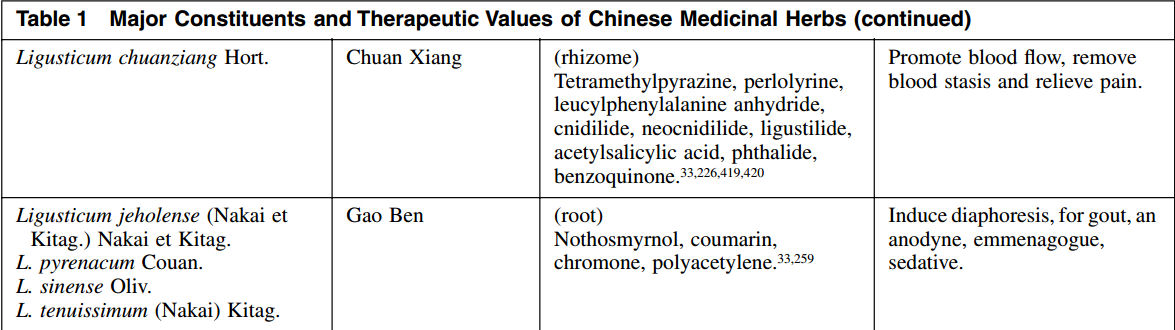 [CRNAH]
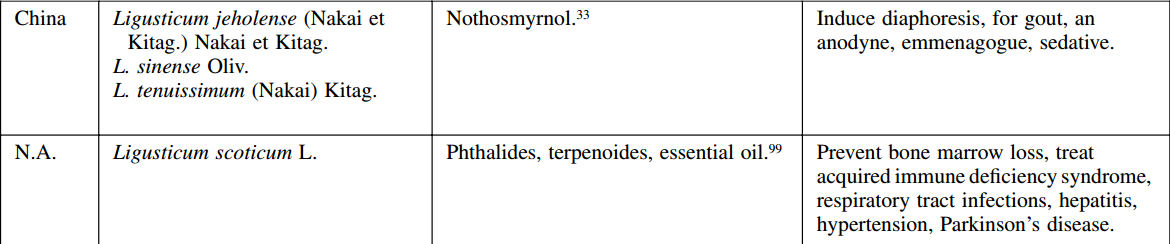 [CRNAH]
LIGUSTICUM (GAOBEN)
"Roots and rhizomes of several Ligusticum species, especially Ligusticum sinense Oliv. and L. jeholense Nakai et Kitag.
(Family Umbelliferae or Apiaceae), which are aromatic perennial herbs, erect, up to 1 m high, the former with irregular
cylindrical to round rhizome bearing many thin roots while the latter has a short rhizome. Ligusticum sinense
is distributed and produced in central China, including the provinces of Hubei, Shaanxi, and Sichuan while L.
jeholense (syn. Liaoning gaoben) is distributed and produced in northeastern provinces, including Liaoning, Jilin,
Inner Mongolia, Hebei, and Shandong (HU; JIANGSU). Roots and rhizomes are mostly wild crafted, in spring and
autumn, and after being rid of dirt, stem, and shoots, they are sun-dried
or dried by artificial heat (ZHU).
Traditionally regarded as acrid tasting and warming; removing rheumatic and arthritic pain (qu feng); dispersing
cold; eliminating wetness; and stopping pain. Used to treat the common cold and headache associated
with it, headache on top of head (dian ding tong), migraine, rheumatic and arthritic pain, acne,
acne rosacea, skin blemishes (freckles and dark spots), and abdominal pain and diarrhea; also
used in treating ringworm, scabies, and dandruff (CHP; JIANGSU; NATIONAL). In Jiangxi, gaoben
(chaxiong, L. sinense) is often brewed with tea for the prevention of diseases.2 Like Sichuan
lovage, it is one of the most commonly used ingredients in traditional Chinese beauty formulas
(see sichuan lovage).3
Contains 0.3–1.8% volatile oil;1–4 b-sitosterol, ferulic acid, and others. Amounts of volatile oil
and its individual components vary with the geographic and botanical sources; major components
present include: neocnidilide (0–25.57%), cnidilide (2.93–10.78%), myristicin (1.63–9.08%),
ligustilide (0–6.23%), butylidene phthalide (0–2.01%), b-phellandrene (0–33.32%), 4-terpinyl
acetate (3.59–13.82%), limonene (0–14.44%), terpineol-4 (2.7–8.0%), and terpinolene
(2.67–3.24%).4 Other compounds present include methyleugenol, butyl phthalide,
3-butylidene-4,5-dihydrophthalide, and senkyunolides A, G, H, and I (HU; IMM-2).2,5
The neutral fraction of the volatile oil (L. sinense) has been shown to have numerous
biological activities, including: sedative, analgesic, antipyretic, and anti-inflammatory in
experimental animals;6,7 antispasmodic and antihistaminic;8 markedly decreasing oxygen consumption,
prolonging survival time, increasing ability of tissue to tolerate anoxia and extending
survival time in mice under cerebral ischemic anoxia.9
Ferulic acid and ligustilides are some of the active principles of gaoben (see also Sichuan lovage).
Powder and extracts used in hair-care and skin-care products, (especially acne and whitening creams),
often together with Dahurian angelica, for many of the same functions (e.g., antiallergic,
anti-inflammatory, and tyrosinase inhibitory) as Sichuan lovage;3–10,11 also
imparts special aroma to products." [Leung ECNI]
Ligusticum chuanxiong Hort.
"I. Introduction
Ligusticum belongs to the Umbelliferae family, members of which include L. chuanxiong (Chuan Xiong), L. wallichii, L. sinense (Gao Ben), and L. brachylobum. The dried rhizome of L. chuanxiong is one of the most common crude drugs described in the traditional Chinese, Japanese, and Korean pharmacopoeia. In Japan, Senkyu is obtained from the dried rhizome of L. officinale Kitagawa (also known as C. officinale Makino). In China, the herb is grown in Sichuan province and the root is usually collected in the summer when the node of the plant stem becomes swollen and purplish. Once removed from the soil, it is gently baked until dry before storage.
II. PLANT/HERB RECOGNITION
The rhizome has an irregular knotty, fist-like appearance, is approximately 2–7 cm in diameter, and is yellowish in color. The external surface is rough, shrunken, and marked by parallel raised annulations. A cross-section of the root, reveals a compact, yellowish-gray matrix with scattered yellowish-brown oil cavities and a cambium in an undulated ring (Fig. 1). Chuanxiong is strongly aromatic and the taste of the rhizome is slightly bitter with a sweet aftertaste. These characteristics are part of the traditional methods for identification of this herb.
III. USAGE
A. Traditional Usage
Ligusticum is traditionally used ‘‘to invigorate blood circulation, to promote the flow of qi, to dispel wind, and to alleviate pain. ’’ It is prescribed for headaches, abdominal pain, menstrual disorders (amenorrhea, dysmenorrhea), and for patients with pricking pain in the chest and costal regions, pain due to traumatic injury, headache, and rheumatic arthralgia (1).
B. Modern Usage
In recent years, owing to the renewed interest in herbal medicines, many inventors in the United States, Japan, and China have submitted patents based on traditional usage of ligusticum. Among the patents filed in the Chinese patent office are products with L. chuanxiong extracts that are used as detergents to prevent and treat acquired immunodeficiency syndrome (2), as a bathing lotion to promote blood circulation, and to improve skin conditions (3). In Japan, the herb has been patented for having the property to improve brain function (4). In the U.S. patent and trademark office, herbal concoctions with L. chuanxiong have been patented for application to the skin to help skin regeneration in patients with eczema and psoriasis (5). Tao in 2002 (6,7) submitted two patent applications for the use of ligusticum herbal extracts with the addition of minerals and vitamins for the treatment of brain disorders as well as to enhance brain function and for the treatment of hand and wrist discomfort.
VII. TOXICITY
Ligusticum is prescribed in traditional Chinese decoctions at dosages up to 9 g administered over several days. Overdose symptoms may include vomiting and dizziness (44).
VIII. CONCLUSION
Chuanxiong is a herb that has traditionally been used to promote blood circulation and treat arthralgias and
menstrual disorders. Preliminary animal studies, from mainland China, indicate that administration of
the crude extract may improve muscle function, reduce cerebral ischemia, and ameliorate acute
nephrotoxicity induced by cyclosporine A. Tetramethylpyrazine, ferulic acid, and
butylidenephthalide, pure compounds present in ligusticum, have been variously
reported to display cardiovascular, antianginal, antiplatelet, anti-inflammatory,
and tocolytic properties. Some human studies, again from mainland China,
indicate that the herb may be beneficial in
ischemic strokes and as anticoagulation agents." [Packer HTM]