Foeniculum vulgare - Sweet fennel
Family: Apiaceae - Carrot Family [E-flora]
(Wikimedia)1
(Wikimedia)2
(Wikimedia)3
Image References
- 1, Foeniculum vulgare, H. Zell, CC BY-SA 3.0
- 2, Foeniculum vulgare, Taken by Carsten Niehaus (user:Lumbar)., CC BY-SA 3.0
- 3, Foeniculum vulgare, Holly Cheng, CC BY-SA 3.0
"Foeniculum vulgare is an evergreen Perennial growing to 1.5 m (5ft) by 1 m (3ft 3in). It is hardy to zone (UK) 5 and
is not frost tender. It is in leaf 12-Jan It is in flower from Aug to October, and the seeds ripen from Sep to October.
The flowers are hermaphrodite (have both male and female organs) and are pollinated by Insects.The plant is self-fertile.
It is noted for attracting wildlife.
Suitable for: light (sandy), medium (loamy) and heavy (clay) soils and prefers well-drained soil. Suitable pH: acid, neutral and
basic (alkaline) soils. It cannot grow in the shade. It prefers dry or moist soil and can tolerate drought. The plant can tolerates strong
winds but not maritime exposure." [PFAF]
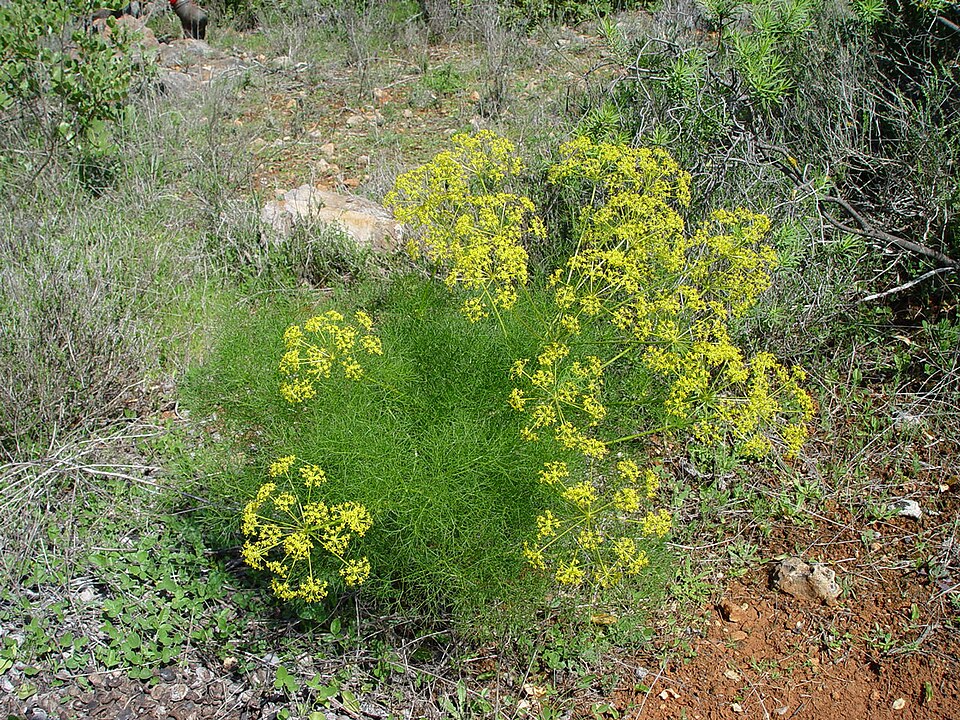
General: "Stout, short-lived perennial or biennial herb from a taproot, with a strong anise odor; stems erect,
often branched above, 1-2 m tall." [IFBC-E-flora]
Leaves: "Basal leaves lacking; stem leaves glabrous and glaucous, pinnately dissected into small, threadlike
ultimate segments, without well-defined leaflets; leaf stalks often sheathing, the blades 30-40 cm long." [IFBC-E-flora]
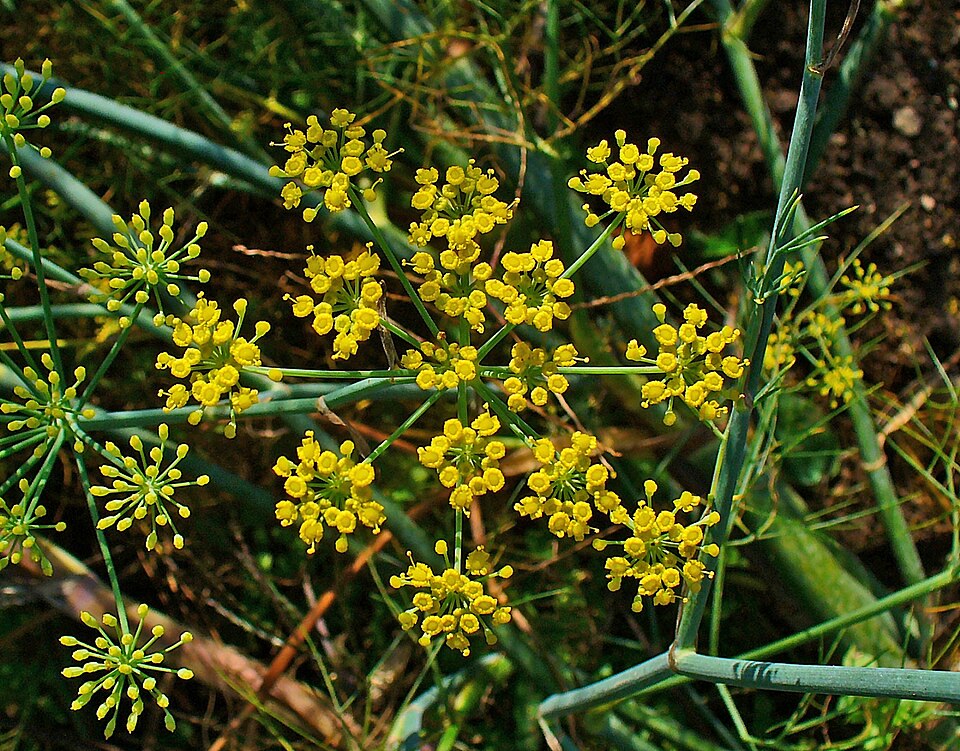
Flowers: "Inflorescence of compound umbrella-like clusters; flowers small, yellow; spokes
unequal in length." [IFBC-E-flora]
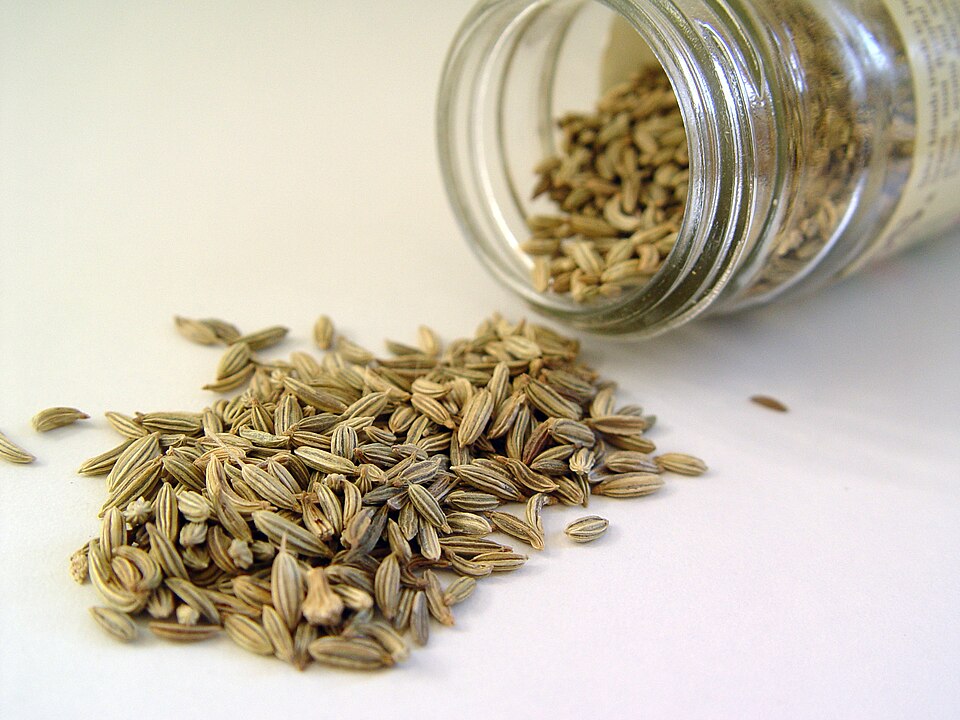
Fruits: "Oblong, not strongly flattened, 3.5-4 mm long, ribs not winged." [IFBC-E-flora]
Habitat / Range
"Mesic to dry roadsides, fields and waste places in the lowland zone; rare in SW BC, known from
SE Vancouver Island, the Gulf Islands and Vancouver; introduced from Europe." [IFBC-E-flora]
Origin Status: Exotic [E-flora]
Hazards
"Hazards and/or side effects not known for proper therapeutic dosages (PH2)." [PDR]
"Health risks or side effects following the proper administration of designated therapeutic dosages are not recorded. Allergic reactions following intake of Fennel have been only very rarely observed." [PDR]
Dermatitis
"Skin contact with the sap or essential oil is said to cause photo-sensitivity and/or dermatitis in some people[218, 222]. Ingestion of the oil can cause vomiting, seizures and pulmonary oedema[222]. Avoid for small children. Avoid if cirrhosis/liver disorders. Diabetics check sugar content of preparation [301]." [PFAF]
"Cross Sensitivity among patients with celery allergy appear to be possible." [PFAF]Contraindications
"Pregnancy: Preparations, excluding the drug itself and tea infusions are not to be administered during pregnancy." [PDR] "Commission E reports no contraindications for herbal teas (and other preparations providing similar doses of EO), but other dosage forms (e.g., the EO) should be avoided during pregnancy." [HMH Duke]
"Nursing mothers taking anise and/or fennel tea to stimulate lactation exhibited temporary CNS disturbances, emesis, lethargy, poor suckling, restlessness, and torpor in the newborn (15–20 days old), possibly due to anethole in the milk (infants were healthy at 6-month follow-up) (Acta Pediatrica 83: 683; 1994). To be avoided by women who are pregnant, lactating, or with an estrogen-dependent cancer (SKY)." [HMH Duke]
"Pediatric Use: Preparations, excluding the drug itself and tea infusions are not to be administered to small children." [PDR] "The EO should also be avoided in infants and small children (AEH)." [HMH Duke]
"Adverse effects: isolated cases of allergic reactions of skin and lungs (AEH). Fennel represents a low allergenic risk. A case of asthma with atopic disposition caused by fennel has been reported (AEH)." [HMH Duke]
"Seeds not to be long taken at rate of 6 g seed/day (Commission E), perhaps due to estrogenic anethole and carcinogenic estragole (I’d not be afraid.) We might extend to all apiaceous oils Bisset’s comments on celery seed oil, “The drug is contraindicated in inflammation of the kidneys,” since apiaceous EOs may increase the inflammation as a result of epithelial irritation (BIS). Extracts of fennel can induce estrus and cause growth of mammary glands (MAB). Moderate doses of an acetone extract increased the weight of the mammary glands in rats (MAB). LD50 of EO 3120 = 4500 ml/kg orally (MAB); LD50 anethole 2090 mg/kg orl rat (MAB); LD50 fennel seed tincture = >3000 mg/kg orl rat (equivalent to 30,000 seed) (MAB).[HMH Duke]
Edible Uses
Plant
- Leaves & Seeds: "The leaves or the seeds can be used to make a pleasant-tasting herbal tea[16, 183]." [PFAF]
Leaves
- "Raw or cooked[2, 4, 5, 9, 27]." [PFAF]
- Harvesting: "They can often be harvested all year round, especially if the plants are in a warm, sheltered position[K]. The young leaves are best since older ones soon become tough[K]." [PFAF]
- Preparation: "They are often used as a garnish on raw or cooked dishes and make a very pleasant addition to salads[183]." [PFAF]
- Preservation: "The leaves are difficult to store dried[200]." [PFAF]
- Properties: "A delicious aniseed flavour[183]. They help to improve digestion and so are particularly useful with oily foods[244]." [PFAF]
Leaf Stalks & Flowering Heads
- "Raw or cooked[14, 37, 52, 183]." [PFAF]
- Harvesting: "In spring, the entire young tender base of the newly emerging flower stalks (the section between the root and the leafy ferny tops) can be eaten. Eat this most delicious part as you would celery. Towards summer, as the plant's flower stalk develops, individual leaves can be pulled off and their enlarged base eaten like celery; or the leaves can be cooked." [PFAF]
- Properties: "Due to its succulence, fennel is very refreshing to eat when you're thirsty. A similar aniseed flavour to the leaves[K]." [PFAF]
Seeds
- "The sprouted seeds can be added to salads [183]." [PFAF]
- Tea: "The seeds can be steeped to make a licorice-flavoured tea." [PFAF]
- Flavoring: "The seeds are used commercially both in making candy and in French and Italian cooking. They are also used to flavor medicine. Fennel seeds have been used to flavor salads and other dishes. In Indian restaurants, one is served an after-dinner fennel tray as a breath freshener. The aromatic seeds are used as a flavouring in cakes, bread, stuffings etc[2, 4, 5, 21, 27, 183]." [PFAF]
- Properties: "They have a similar flavour to the leaves[K] and also improve the digestion[244]." [PFAF]
Essential Oil
"An essential oil from the fully ripened and dried seed is used as a food flavouring in similar ways to the whole seed[1, 46, 183, 245]." [PFAF]
Root
"Cooked[53]. Somewhat parsnip-like." [PFAF]
Other Uses
Dye
Dye
"Yellow and brown dyes are obtained from the flowers and leaves combined[168]." [PFAF]
Repellent
"The dried plant is an insect repellent[14, 53]. The crushed leaves are effective for keeping dogs free of fleas[201]. The plant was formerly used as a strewing herb[201]. Fresh or dried fennel leaf parts reputed to repel fleas from dogs." [PFAF]
Oil
"The seed yields up to 5% of an essential oil[1, 4, 46]. This is used medicinally, as a food flavouring, in toothpastes, soaps, perfumery, air fresheners etc[1, 46, 238]. The flavour of fennel oil depends upon its two main constituents. 'Fenchone' is a bitter tasting element whilst 'anethole' has a sweet anise-like flavour[238]. The proportions of these two ingredients varies according to strain and region. Plants growing in the Mediterranean and southern Europe usually have a sweet oil whilst plants growing in central and northern Europe usually produce a more bitter oil[238]. The quality of the oil also depends upon how well the seed has been dried - the oil from fully ripened and dried seeds being much sweeter and more fragrant[245]. Oil of fennel is used in soaps and perfumes." [PFAF]
Smoke
The Hopi of North America used fennel (F. officinalis) as a substitute for tobacco (Nicotiana spp.) (Whiting 1939). Moerman (1998) suggests that the species actually used was probably Foeniculum vulgare Mill. Ross (2002) reported that the seeds can be sprinkled on smoke mixes, giving them a sweet aroma." [UAPDS]
Medicinal Uses
"The medicinal parts are the Fennel oil extracted from the ripe fruit and the dried ripe fruit and Fennel seeds of Foeniculum vulgare." [PDR]
"Characteristics: Fennel has a spicy aroma." [PDR]
Production: "Fennel oil is the essential oil obtained from the dried, ripe fruits of Foeniculum vulgare by steam distillation. Fennel seed consists of the dried, ripe fruits of Foeniculum vulgare." [PDR] "Pick leaves to use fresh in summer prior to flowering. Pick flowers to use fresh as they open. Harvest seeds just as they change color from green to brown, and dry well." [Mcvicar GH]
Plant
- Infusion: An infusion is used in the treatment of indigestion, abdominal distension, stomach pains etc[254]. It helps in the treatment of kidney stones and, when combined with a urinary disinfectant like Arctostaphylos uva-ursi, makes an effective treatment for cystitis[254]. It can also be used as a gargle for sore throats and as an eyewash for sore eyes and conjunctivitis[254]." [PFAF]
Seeds
An infusion of the seeds is a safe and effective cure for wind in babies[244]. Fennel seeds in milk is said to combat giddiness and nausea. The seeds, leaves and roots can be used, but the seeds are most active medicinally and are the part normally used[4]." [PFAF]
Essential Oil
- "An essential oil is often extracted from the fully ripened and dried seed for medicinal use, though it should not be given to pregnant women[4, 238]. The essential oil is bactericidal, carminative and stimulant[218]. Some caution is advised, see notes above on toxicity[222]." [PFAF]
- Aromatherapy: "An essential oil obtained from the seed is used in aromatherapy. Its keyword is 'Normalising'[210]." [PFAF]
Root
"An infusion of the root is used to treat urinary disorders[238]." [PFAF]
Respiratory Aid
The German Commission E Monographs, a therapeutic guide to herbal medicine, approve Foeniculum vulgare for cough, bronchitis, dyspeptic complaints (see [302] for critics of commission E)." [PFAF]
Anti-flatulent
"Eating fennel is said to relieve gas. The best way found to use fennel as a gas preventive is to eat the raw young stalks
or the fresh foliage. Fresh or dried fennel in dishes, such as soups or stews, is equally effective as an anti flatulent.
Fennel also has a diuretic effect. Infused into tea, it is used for gas, upset stomach, and cramps.
Fennel is often added to purgatives in order to allay their tendency to cause gripe, and also to improve the flavour[4]." [PFAF]
Digestive Aid
"Fennel has a long history of herbal use and is a commonly used household remedy, being useful in the treatment of a variety of complaints, especially those of the digestive system[244]." [PFAF]
Further Medicinal Uses
Select Indications (Fennel) — Amenorrhea (1; CRC; KAB; MAB); norexia (1; BGB; JFM; KAB; KAP; MAB; VVG); Backache (f; CRC); Bacteria (1; APA; MAB; TAD); Bronchosis (2; PHR; PH2); Cancer (1; CRC; FNF; JLH); Catarrh (2; BGB; KOM; PH2; PIP); Cellulite (f; MAB); Childbirth (f; CRC; DEM); Cholera (f; CRC); Colic (1; APA; CRC; DEM; MAB; WAM); Colitis (f; AKT; MAB); Conjunctivosis (1; APA; MAB); Constipation (1; MAB; NAD; SUW); Cough (2; APA; KAB; MAB; PHR; PH2); Cramp (1; APA; BGB; CRC; KOM; MAB; PH2; PNC; TRA; WAM); Diarrhea (1; APA; MAB; SHT); Dysentery (f; AKT; KAB); Dysmenorrhea (f; AKT; BGB; HHB); Dyspepsia (2; KOM; MAB; PH2; SHT); Dysuria (f; CRC); Earache (f; TRA); Enterosis (2; AKT; BGB; CRC; KAB; KAP; PH2; PIP; TRA); Enuresis (f; APA; CRC); Fever (1; KAB; MAB; NAD; SKY; TAD); Frigidity (1; APA; CRC); Fungus (1; CRC; MAB; TRA); Gas (2; APA; KOM; PH2; PNC; SUW; TRA; VVG; WAM); Gastrosis (2; BGB; CRC; KOM; PIP; TRA); Heartburn (f; DEM; MAB); Hepatosis (1; JLH; PNC); Hernia (f; APA; CRC; MAB); IBS (f; MAB; SKY); Impotence (1; CRC; MAB); Induration (f; CRC; JLH); Infection (1; CRC; MAB; TRA); Inflammation (1; APA; KAB; PNC; SHT; TRA); Jaundice (f; HHB; ZUL); Mycosis (1; CRC; MAB; TRA); Nausea (1; APA; BGB; CRC; MAB); Nephrosis (f; CRC; KAB); Obesity (1; CRC; MAB); Oligolactea (1; WAM); Ophthalmia (f; CRC; DEM; KAB); Pain (1; APA; CRC; MAB; SKY; TAD); Respirosis (2; APA; KOM; PH2; PIP); Snakebite (f; APA; CRC; KAB); Splenosis (f; CRC; KAB); Stomachache (1; APA; KAB; WAM; ZUL); Strangury (f; CRC); Swelling (1; TRA); VD (f; CRC; KAB); Water Retention (1; APA; CRC; HHB; MAB; SUW; TRA; ZUL); Worm (1; CRC; KAB; SUW); [HMH Duke]
Dosages
"Dosages (Fennel) — 900–1800 fruit/day (MAB); 2–6 tsp fresh seed (PED); 1–3 g dry seed (PED); 2 g dry seed:10 ml alcohol/10 ml water (PED); 5–7 g seed/day (PIP); 1/2 tsp seed/cup water 3 ×/day (SKY); 1–2 tsp mashed seed/cup water (APA); 10–40 g powder (KAP); 5–10 ml oil (KAP); 3–6 ml fluid extract (1:2)/day(MAB); 0.5–2 ml liquid seed extract (PNC); 2–4 ml tincture (SKY); 7–14 ml tincture (1:5)/day (MAB); 0.5–1 tsp tincture 3 ×/day (APA); 5–7.5 g compound tincture (PIP); 5–20 drops EO/day (MAB); 0.1–0.6 ml EO (PH2); 0.03–0.2 ml EO (PNC); 10–20 g fennel syrup (PIP); 0.3–1 ml concentrated fennel water (PNC)." [HMH Duke]
Fennel Oil:
"Mode of Administration: Essential oil and galenic prepara-
tions for internal use.
Note: Diabetics must check the sugar content of available
preparations.
Daily Dosage: 0.1 to 0.6 ml of Fennel oil
Duration of administration: Maximum of 2 weeks." [PDR]
Fennel Seed:
Mode of Administration: Crushed or ground seeds for teas,
tea-like products, as well as other galenic preparations for
internal use.
Daily Dosage: 5 to 7 gm of drug" [PDR]
Pharmacology
"The plant is analgesic, anti-inflammatory, antispasmodic, aromatic, carminative, diuretic, emmenagogue, expectorant, galactogogue, hallucinogenic, laxative, stimulant and stomachic[4, 7, 9, 21, 147, 165, 176, 192, 238]." [PFAF]
Select Activities (Fennel) — Abortifacient (1; CRC); Analgesic (1; APA; CRC; MAB; SKY; TAD); Anorectic (1; APA; TAD); Antibacterial (1; APA; MAB; TAD); Antidote (f; APA); Antiinflammatory (1; APA; PNC; SHT; TRA); Antileukemic (1; MAB); Antipyretic (1; MAB; SKY; TAD); Antiseptic (1; KOM; MAB; TAD; TRA); Antispasmodic (1; APA; KOM; MAB; PH2; PNC; TRA; WAM); Aperitif (f; BGB; JFM; KAB; PNC); Aphrodisiac (1; CRC; KAB; MAB); Carminative (1; APA; PNC; SUW; TRA; WAM); Choleretic (1; MAB; SKY; TAD); Collyrium (f; CRC; DEM; JFM); Digestive (1; AKT; BGB; TAD; WAM); Diuretic (1; APA; HHB; MAB; SUW; TRA; ZUL); Emmenagogue (1; APA; CRC; FFJ14:382; SUW); Expectorant (1; APA; MAB; SHT; TRA); Estrogenic (1; APA; PNC; SKY); Fungicide (1; CRC; MAB; TRA); Gastrostimulant (f; PH2); Hepatoregenerative (1; PNC); Lactagogue (1; BGB; CRC; KAB; MAB; TAD; WAM); Laxative (f; NAD; SUW); Mucolytic (1; APA; BGB; MAB); Mutagenic (1; MAB); Myorelaxant (1; APA; MAB); Myostimulant (1; MAB); Narcotic (1; APA; CRC); Pectoral (f; CRC); Secretolytic (1; BGB; PIP; KOM); Stimulant (1; CRC; FFJ14:382; SUW); Stomachic(1; CRC; PNC; SUW); Tonic (f; CRC; JFM); Vermifuge (1; CRC; KAB; SUW). [HMH Duke]
Essenial Oil: "Stimulation of gastrointestinal motility; in higher concentra- tions, antispasmodic; experimentally, anethole and fenchone have shown a secretolytic action on the respiratory tract. In vitro, it is antimicrobial." [PDR]
Seed volatile Oil: "The seed promotes gastrointestinal motility. In higher concentrations, Fennel has an antispasmodic effect. Experi- mentally, anethole and fenchone have been shown to have a secretolytic effect in the respiratory tract of frogs. Aqueous Fennel extracts raised the mucociliary activity of the ciliary epithelium." [PDR]
Folk Use
"This beautiful aromatic herb has been in cultivation for thousands of years. The Greeks ate fennel to suppress hunger, and in the Middle Ages it was used to deter insects. Today, nearly all parts of the fennel plant are used for culinary purposes: the leaves for salads, the fennel stems on barbecues to add flavor to meat and fish, and the seeds ground as spice for use with lamb, pork, and vegetables. Care should be taken, however, because, if taken in large doses, oil made from fennel seed can cause convulsions and disturb the nervous system." [Mcvicar GH]
"Unproven Uses: Peptic discomforts, such as mild, spastic disorders of the gastrointestinal tract, feeling of fullness, flatulence; catarrh of the upper respiratory tract. Fennel honey is used for catarrh of the upper respiratory tract in children." [PDR]
Phytochemicals
- Roots
- Essential Oil (dillapiol as the main constituent; 90.1% - 700 μg/ml-IC50 vs. A. parasiticus (Antifungal)
- Flowers
- Essential Oil (transanethole as the main constituent; 68.4%) - 70% inhibition at 2,000 μg/ml (Antifungal)
- Aerial parts
- Essential Oil - 64-1,232 μg/ml-MICs vs. F. solani, F. oxysporum, F. verticillioides, F. poae, & F. equiseti
- Essential Oil - 300 μg/ml Vs. C. albicans. (Antifungal)
Bitter Fennel Essential Oil
"When extracted from bitter fennel the chief components are: Trans-anethols (50-75%) Fenchone (12-33%) Estragole (2-5%?)" [PDR]
"Additional components are - alpha-pinenes. camphene, p- cymene, myrcene, limonene, alpha- and beta-phellandrene, gamma-terpenes, terpinols, cis-ocimene" [PDR]
Sweet Fennel Essential Oil
"When extracted from sweet fennel the chief components are: Trans-anethole (80-90%) Fenchone (1-10%?) Estragole (3-10%?)" [PDR]
"Additional components are - alpha-pinenes. camphene, p- cymene, myrcene, limonene, alpha- and beta-phellandrene, gamma-terpenes, terpinols, gamma-fenchen" [PDR]
Bitter fennel seed volatile oil
"With bitter fennel the chief components are: Trans-anethole (50-75%) Fenchon (12-33%) Estragole (2-5%)" [PDR]
"Additional components - alpha-pinenes, camphene, p-cy- mene, myrcene, limonene, alpha- and beta-phellandrene, gamma-terpenes, terpinols cis-ocimene" [PDR]
Sweet fennel seed volatile oil
"With sweet fennel the chief components are: Trans-anethole (80-90%) Fenchon (1-10%) Estragole (3-10%)" [PDR]
"Additional components - alpha-pinenes, camphene, p-cy- mene, myrcene, limonene, alpha- and beta-phellandrene, gamma-terpenes, terpinols, gamma-fenchen" [PDR]
"Hydroxycoumarins (traces): umbelliferone, scopoletine, osthenol, scoparin, Furocoumarins traces) including bergap- ten, columbianetin, psoralen, xanthotoxin" [PDR]
Also Pyranocoumarins, Flavonoids and Fatty oil [PDR]
 [Turner&Kuhnlein]
 [Turner&Kuhnlein]
Propagation
"Seed - best sown in early spring in situ[1]. The seed can also be sown in situ in the autumn[4, 37]. In many gardens it self sows freely. Division in March as the new growth appears[16, 200]. The plants are very tolerant of disturbance, we have found divisions to take well at any time of the year, though these divisions are never as good as seed-sown plants[K]." [PFAF]
"Sow seeds in spring under protection at 68ºF (20ºC); germination takes seven to ten days. Continue to grow under protection until all threat of frost has past. Alternatively, sow seeds in late spring into prepared open ground when the air temperature at night remains above 41ºF (5ºC), and germination takes 14–20 days. If you have light soil, divide established plants in spring." [Mcvicar GH]
Cultivation
"Plant in a warm, sunny site in well-drained, fertile soil. If grown in poor soil or arid conditions, fennel will taste bitter. Also, do not plant fennel near dill or coriander—the former may cross-pollinate with fennel, and the latter alters the flavor. Fennel grows well in containers in a loam-based substrate." [Mcvicar GH]
"Harvest the seeds and then cut back the plant to promote new leaf growth. Replace fennel plants every three to four years to maintain a good flavor. In the fall, when the plant has died back, mulch the soil around the plant with well-rotted manure. In winter, protect the fennel plant from wet conditions because it is susceptible to mildew and/or rot." [Mcvicar GH]
"Cover the seeds because darkness aids germination. Thin Florence fennel plants to stand 10 to 12 inches apart. The slimmer stalks of sweet fennel may be thinned to a 6- inch spacing. You could start fennel indoors ahead of time, but you should sow seeds in pots and transplant the seedlings before they start to develop taproots. A light frost won’t hurt fennel. For more tender stalks, mound the soil a bit around the base of the plant." [NSSH Bubel]
"Fennel likes neutral soil, so add some limestone and compost if your soil is strongly acidic. Water the plants in dry spell. Days to Maturity: 60 to 70" [NSSH Bubel]
"The biggest mistake most gardeners make with fennel is to sow a whole row of it at once. Then it all matures at once and grows woody at once when not used. Make small succession plantings instead, beginning in April and early May, skipping the hot summer months, which tend to bring on bolting, and planting a fall crop in July." [NSSH Bubel]
Dynamic Accumulator: Na, N & P [DynamicAccumulator]
Synonyms
- Foeniculum foeniculum (L.) Karst. [E-flora]
References
- [Antifungal] Antifungal Plants of Iran: An Insight into Ecology, Chemistry, and Molecular Biology, Mehdi Razzaghi-Abyaneh, Masoomeh Shams-Ghahfarokhi and Mahendra Rai, Antifungal Metabolites from Plants, 2013
- [E-flora] http://linnet.geog.ubc.ca/Atlas/Atlas.aspx?sciname=Foeniculum%20vulgare, Accessed May 7, 2015
- [PFAF] http://www.pfaf.org/user/Plant.aspx?LatinName=Foeniculum+vulgare, Accessed May 10, 2015
Foeniculum Sp.
1 sp. (Latin: fennel) [Jepson]
Local Species;
- Foeniculum vulgare - Sweet fennel [E-flora]
References;
- [Jepson] 2013. Foeniculum, in Jepson Flora Project (eds.) Jepson eFlora, http://ucjeps.berkeley.edu/cgi-bin/get_IJM.pl?tid=10189, accessed on Jan 28 2015