Green Alder/Sitka Alder - Alnus viridus
Family: Betulaceae (Birch Family) [E-flora]
Other Names: green alder (green alder (ssp. crispa); Sitka alder (ssp. sinuata))[E-flora]
Fuel, Smoke, Insect Repellent Rheumatism
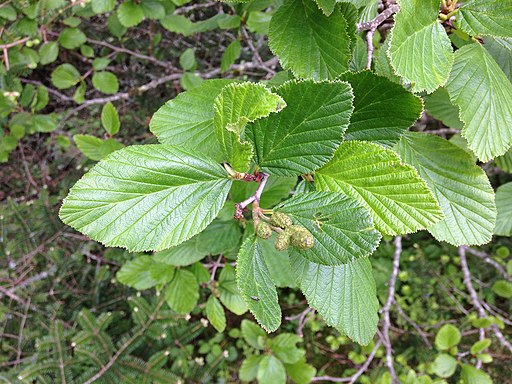
(Wikimedia)1
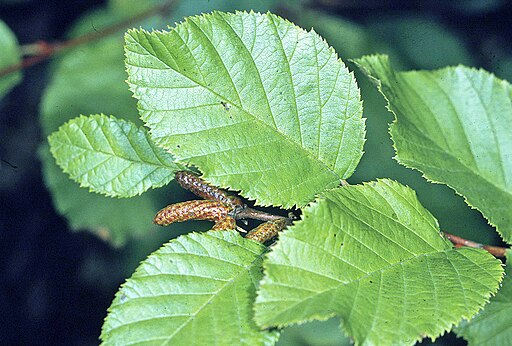
(Wikimedia)2
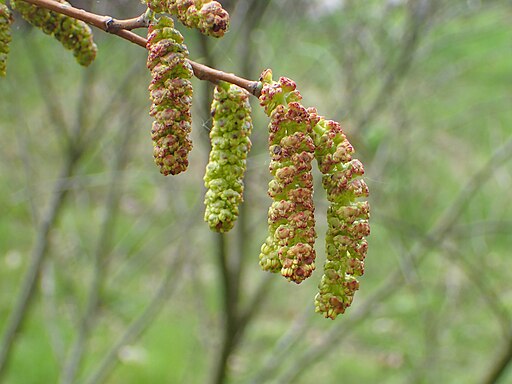
(Wikimedia)3
Image References
- 1, Mason Brock (Masebrock), Public domain, via Wikimedia Commons
- 2, Robert H. Mohlenbrock. USDA NRCS. 1995. Northeast wetland flora: Field office guide to plant species. Northeast National Technical Center, Chester, PA. Courtesy of USDA NRCS Wetland Science Institute., Public domain, via Wikimedia Commons
- 3, Krzysztof Ziarnek, Kenraiz, CC BY-SA 4.0
"Alnus viridis crispa is a deciduous Shrub growing to 3 m (9ft) by 3 m (9ft).
It is hardy to zone (UK) 4. It is in flower from Apr to May. The flowers are monoecious (individual flowers are either male or female, but both sexes can be found on the same plant) and are pollinated by Wind. It can fix Nitrogen.
Suitable for: medium (loamy) and heavy (clay) soils and can grow in heavy clay and nutritionally poor soils. Suitable pH: acid, neutral and basic (alkaline) soils. It can grow in semi-shade (light woodland) or no shade. It prefers moist or wet soil." [PFAF]
Subtaxa Present in B.C.
- Alnus viridis ssp. crispa
- Alnus viridis ssp. sinuata
Synonyms
A. crispa. A. sinuata. [PFAF].
Status: Native. [E-flora]
General: Deciduous shrub or tree, 1-5 m tall; pointed axillary buds without stalks; bark scaly, sometimes lichen-covered, yellowish-brown or grey. [IFBC-E-flora]
Leaves: Alternate, deciduous, smooth, finely toothed 1-2 times, oval with pointed tips, 4-10 cm long, brownish in the fall. [IFBC-E-flora]
Flowers: Inflorescence of male and female catkins which open at the same time as the leaves on current year's growth; male catkins unstalked. [IFBC-E-flora]
Fruits: Small nutlets, with broad wings; female cones 1.5-2 cm long, egg-shaped. [IFBC-E-flora]
Habitat / Range Moist slopes, streambanks, avalanche tracks, bogs and fens in all zones; ssp. crispa frequent in N BC, ssp. sinuata common throughout S BC, becoming less frequent and transitional to ssp. crispa in N BC; circumboreal, E to PQ and S to NC, MN, CO and CA. [IFBC-E-flora]
"All local alder species are shrubs or small trees. Alnus crispa subsp. crispa and subsp. sinuata are widespread across northern and northwestern North America, extending into northeastern Russia. Alnus incana subsp. tenuifolia is found in northwestern North America. These species are found across all of Alaska except along the arctic coast." [Jernigan EYK]
Notes:
Two subspecies occur in BC:
1. Leaf margins shallowly lobed as well as finely saw-toothed..................... ssp. sinuata (Regel) A.& D. Love
1. Leaf margins not at all or only slightly lobed, mostly merely finely saw-toothed..................... ssp. crispa [Ait.] Turrill [IFBC-E-flora]
A "recent study of the alders (the genus Alnus) of the world resulted in American green alder (Alnus crispa) and Sitka alder (Alnus sinuata) being changed from separate species to subspecies of Alnus viridis. Under this new nomenclature, American green alder becomes Alnus viridis subsp. crispa (Ait.) Turrill and Sitka alder becomes Alnus viridis subsp. sinuata (Regel) Love & Love. In the same study, thinleaf alder is renamed from Alnus tenuifolia to Alnus incana subsp. tenuifolia (Nutt.) Breitung." [Viereck ATS]
Other Uses
- Alnus viridis (Chaix) DC. ssp. crispa (Aiton) Turrill (Betulaceae). mountain alder. "...The smoke was also used as an insecticide to drive away mosquitoes and to smoke fish. The Upper Tanana of Alaska burned the wood to smoke fish (Kari 1985). This species was reported as Alnus crispa (Ait.) Pursh in the original texts."[UAPDS]
- A.crispa; Alders are very plentiful in the vicinity of the village and serve as the primary source of winter fuel. The small straight trees are preferred and are cut while green into nine foot lengths to be hauled to the village in a boat or sled.[Oswalt Eskimo]
- "The wood of mountain alder (Alnus crispa) was also a preferred fuel smoking fish and deer meat (cf. Turner et al., 1980; Kari, 1987; Myers et al. unpubl. notes, 1988)." [Turner&Kuhnlein] The wood produces good fuel and is used for smoking fish. [Viereck ATS]
- Dye: Alnus crispa (Ait.) Pursh ; "Alder bark was used in the past to impart a rusty-orange color to tanned skins. Bark was scraped from alder trunks and branches and soaked in cold water to release its color. The hides were then soaked in the dye. Alders are used as firewood when available and have been used occasionally in the past to make ashes to add to tobacco." (Ager,1980)
Medicinal Use
Alnus viridis (Chaix) DC. - leaf - Drug internal and external as tea - Fever, infections (Vogl et al.,2013)
Alnus crispa ssp. sinuata*(* "Denotes barks primarily used in mixtures with other plants.") - tonic - Gitksan (gottesfeld1992)
"Betulaceae Alnus crispa (Ait.) Pursh.... Alder leaves were used in the past as a poultice on infected wounds or sores. The poultice was left in place over the wound until the leaves stuck to it, and was then pulled off, removing the "poison" with it." (Ager,1980)
"3.1.3. Alnus viridis Concerning Alnus viridis, PPAR activating or NF-κB inhibiting properties have not been reported so far. A possible connection to the observed effects might be the diarylheptanoid derivate oregonin, mainly found in Alnus species, which was reported to display anti- inflammatory and anti-oxidative activities (Kuo et al., 2008)." (Vogl et al.,2013)
- Smoke: "Alnus viridis (Chaix) DC. ssp. crispa (Aiton) Turrill (Betulaceae). mountain alder. The Inuktitut of Canada burned the bark and inhaled the smoke to treat rheumatism (Wilson 1978). " [UAPDS]
"Indications (Green Alder) - Anorexia (f; DEM); Arthrosis (f; DEM); Bleeding (f; DEM); Childbirth (f; DEM); Constipation (f; DEM; MIC); Cramp (f; MIC); Dentistry (f; DEM); Diphtheria (f; MIC); Dropsy (f; DEM); Dysmenorrhea (f; DEM); Fever (f; DEM; MIC); Gas (f; DEM); Gastrosis (f; DEM); Gonorrhea (f; DEM); Infection (f; DEM); Lameness (f; MIC); Nephrosis (f; DEM; MIC); Neuralgia (f; MIC); Pain (f; MIC); Rheumatism (f; DEM; MIC); Sore (f; DEM); Toothache (f; DEM); VD (f; DEM); Wound (f; DEM; MIC)" [HMH Duke]
Phytochemicals
Pinosylvin methyl ether - Antifungal; insect antifeedant (“Showshoe Hare” Lepus americanus). [EncyTCMV.4]
"Alaskan green alder (Alnus crispa) produces a resin in buds, catkins, and internodes in which the primary constituents are pinosylvin and pinosylvin methyl ether (Clausen et al. 1986). Concentrations of pinosylvin methyl ether by itself on older buds and catkins are sufficient to account for their rejection by snowshoe hares (Bryant et al. 1983). In winter, however, internodes of both saplings and mature plants are defended against hare browsing by both pinosylvin and pinosylvin methyl ether, with the current year’s growth of the saplings containing three times more of both compounds than that of adults." [Langenheim PR]
Pharmacology
"Activities (Green Alder) - Abortifacient (f; DEM); Astringent (1; DEM); Carminative (f; DEM); Depurative (f; MIC); Emmenagogue (f; DEM); Hemostat (f; DEM); Insectifuge (f; DEM); Laxative (f; DEM; MIC); Tonic (f; DEM)." [HMH Duke]
Cultivation
"This pioneer species follows disturbances such as landslides, logging, or glacial retreat. It requires mineral soil seedbed and develops rapidly on moist sites but grows on soils too sterile for other trees. Sitka spruce often becomes established at the same time. Alder acts as a nurse tree, improving soil conditions, and adding organic matter and nitrogen. It thrives with overhead light but is intolerant of shade and disappears from the stand when overtopped by Sitka spruce. Being smaller and hence more quickly overtopped, Sitka alder is probably not such a serious competitor as red alder on logged areas." [Viereck ATS]
Plant Associations: "...people explained to me that spiny wood fern (Dryopteris expansa) rootstock, ... a formerly important carbohydrate food, was associated with... (Alnus crispa) and that one should look for it in a “ravine”..." [Johnson TSTP]
Poplus balsamifera is allelopathic vs. Alnus crispa. Seedling growth, radicle growth, and nodulation are affected. Water-soluble chemicals. Experiment performed in-vitro. [Zeng ASA]
Ectomycorrhizal Fungi
"Varga (1998) found 14 and 31 distinct ECM RFLP variants for Sitka alder (Alnus crispa var. sinuata (Regel) Hulten) and lodgepole pine (Pinus contorta Dougl. ex Loud.)..." [Mah2001]
"The isolation of the endophyte, Frankia, has enabled progress to be made with non-legume nodule physiology. Blom and Harkink (15) found that Frankia, isolated from Alnus viridis, could not take up and utilise glucose although it grew on free fatty acids and the fatty acid residues of some detergents as the sole carbon sources. Growth with Tween and added glucose still did not induce the organism to use glucose and it was found that the organism did not possess the glycolytic enzymes, hexokinase, pyruvate kinase and pyruvate dehydrogenase. It did possess the enzymes concerned with the glyoxylate cycle, isocitrate lyase and malate synthetase and it also possessed all the citric cycle enzymes looked for. However, Baker et ai. (16) cultured the same strain of Frankia, Avcll, on a medium containing yeast extract, glucose and amino acids. Tjepkema et ai. (17) were able to culture an isolate from Comptonia on a similar medium and by changing the carbon source to succinate and omitting any nitrogen source were able to obtain vesicles and nitrogen fixation in culture. Thus although progress has been made, the nutrition of the endophyte in the host plant remaius uuclear." (dixon1983)
"The nodules of Alnus have nitrogenase activity with a greater temperature dependence suggesting that diffusion is not limiting the activity. The effect of oxygen also differs and is consistent with the fact that diffusion of oxygen is not a limiting factor. Oxygen concentrations above 20% enhance nitrogen fixation in soya bean root nodules and inhibition only becomes apparent when the concentration of oxygen in the gas phase exceeds 50% and the rate of respiration continues to rise at oxygen concentrations higher than this. Non-Iegnminous root nodules tend to have optimal fixation rates at 20% oxygen and higher levels are inhibitory." (dixon1983)
"A very similar system operates in actinorhizal nodules of Alnus. No detectable activity of glutamine synthetase was found in isolated vesicle clusters but large amounts were found in the whole nodule nomogenate. The situation with regard to GOGAT is less clear as proportionately large amounts were found in the vesicle clusters (51) Akkermans et al. thus concluded that this enzyme together with glutamate dehydrogenase, which was also present, were of endophyte origin. It is possible that there is a shuttle of nitrogen compounds between endophyte and host and that ammonia assimilation is cooperative but more evidence will be needed to be sure of this." (dixon1983)
"For example, in a series of experiments in which nodulated and non-nodulated Alnus glutinosa were compared the roots of non-nodulated plant always comprised 10-20% more of the plant total fresh weight, even though shoot growth of the two sets of plants was maintained at similar rates by controlling the levels of mineral nitrogen supplied to the non-nodulated plants (72). Obviously, it could be argued that differences in the response of two such groups of plants to a particular environmental stress might result from differences in root form rather than from effects special to the nodules." (dixon1983)
"Environmental adaptation has been clearly demonstrated for some legumes e.g. a low temperature optimum ofl2-ISc C for Astragalus alpinus in Northern Scandinavia (9S) but the only evidence favouring similar adaptation for actinorhizal species is the slightly higher temperature optimum for acetylene reduction of glasshouse grown Alnus glutinosa (92) compared with field grown plants (96) and a higher temperature optimum for Alnus rubrain the warmer soils (in summer) of plants of the same species in Scotland. (97, 98)." (dixon1983)
"Annual changes in nitrogen fixation have been described for several woody, actinorhizal species e.g. Alnus (96, 98, 131), Myrica gale (132) Purshia tridentala (133), Hippophae rhamnoides (134). The precise pattern of change in nitrogenase activity obviously will vary considerably depending on the local environment of the study site." (dixon1983)
"Frankia has not yet been isolated directly from soils but a bioassay of different soils has suggested pH as one factor affecting variability within this group of microorganisms (98). In these experiments, Alnus glutinosa seedlings were grown in soils from existing alder stands for a period sufficient to allow nodulation. The seedlings were then transferred to nitrogen-free water culture for further growth so that soil nitrogen had minimal effect on total plant nitrogen. Total nitrogen content of nodulated plants after further growth for several weeks suggested that nodules of highest specific nitrogen fixation were formed on seedlings initially infected in soils of pH 4.5 to 6.5, while in soils lower than pH 4.5 the nodules were oflower specific activity, suggesting less effective forms of the endophyte. Excep- tions to these general observations showed that other factors additional to pH are also important determinants of the effectivity of soil-borne Frankia. A major advantage of actinorhizal plants over leguminous species lies in the diversity of genera in the former group, within which are plants suited to a wide variety of ecological niches." (dixon1983)
"The supportive role of mycorrhizal infections in mineral absorption by nodulated plants is currently the subject of much interest. For example, among actinorhizal species, ectomycorrhizal roots of Alnus viridis have been shown to absorb phosphate five times more rapidly than non-mycorrhizal roots (170) while increases in nodule number and weight and elevated levels ofN, Ca and P have been demonstrated in Ceanothus velutinus, infected with both vesicu- lar-arbuscular mycorrhizae and Frankia, (172)." (dixon1983)
"In Alnus incana, nitrogen fixation by young plants is stimulated by the addition of ammonium nitrate up to an incremental rate of addition which increased by 12% daily. Under these experimental conditions, rates of nitrogen fixation were obtained which at their best were 55% higher than the rates shown by plants receiving no combined nitrogen. At daily incremental rates in mineral nitrogen above 12%, rates of nitrogen fixation decreased rapidly. It is not known whether these relationships hold for field situations, but in any event regular and frequent return to a plantation to supply additional fertiliser nitrogen to enhance sym- biotic fixation of nitrogen is unlikely to be a practical proposition. In these experiments, additional nitrogen which inhibited nitrogen fixation nevertheless stimulated further growth of the plant, so again it appears that maximum growth may only be achieved by supply of fertiliser nitrogen at levels which largely suppress nitrogen fixation." (dixon1983)
"Some actinorhizal species show morphological or anatomical adaptations which suit them particularly well for growth and nodule function in water logged soils e.g. the presence of aerenchymatous tissue in the roots of Alnus glutinosa (229) or the development of negatively geotropic nodule roots, whicb develop profusely in some water culture plants and have been shown clearly in Myrica gale to aid nodule aeration (33). In dry condition, the possession of a corky periderm (230) may help to render the nodules more resistant to droughting than those of many legumes." (dixon1983)
"Again, genetic improvement of actinorhizal plants for symbiotic nitrogen fixation is only just being considered. Some genera of actinorhizal plants are of wide geographic distribution and taxonomic diversity with correspondingly large genetic variation which may be used for species improvement. Important traits in Alnus species which might be utilised to breed for tolerance of particular environmental conditions include (277) water economy (A. jorullensis), resis- tance to water logging (A. maritima), tolerance of cool conditions (A. viridis), shrubby growth (A. serrulata, A. viridis, A. rugosa) or tree form (A. rubra, A. incana, A. glutinosa, A. cordata). Alders hybridise fairly readily, with many of the hybrids showing good growth e.g. hybrids between A. incana and A. glutinosa have a greater tree volume than the parental species (278). However, breeding for improved nitrogen fixation to accompany desired growth characteristics has not been attempted on any large scale. That such scope exists is shown by cross inoculation studies between clones of three different species of Alnus and Frankia isolates from Comptonia peregrina and Alnus crispa. Both the Frankia isolate and host plant species contributed significantly to the growth of plants in nitrogen free culture (276). A positive correlation between photosynthetic capacity and nitrogen fixation has also been shown for different clones of Alnus glutinosa, inoculated with the same endophyte source (279)." (dixon1983)
"Vegetative reproduction from cuttings or from tissue culture has been used for several alder species (212, 280) and may be suitable for large scale multiplication of other plants showing characteristics of advantage in forestry or land improvement. Natural variation within the genus Alnus alone provides enormous scope for species selection and improvement to fit a wide variety of cultural practices and environmental situations. When considered together with the other known genera of actinorhizal plants, the prospective matching of Frankia and actinorhizal host plants offers almost limitless opportunities for improvement of growth habit and symbiotic nitrogen fixation in these associa- tions in the future." (dixon1983)
- (Ager,1980) Ager, Thomas A., and Lynn Price Ager. "Ethnobotany of the eskimos of Nelson Island, Alaska." Arctic Anthropology (1980): 26-48.
- (dixon1983) Dixon, Robert OD, and Christopher T. Wheeler. "Biochemical, physiological and environmental aspects of symbiotic nitrogen fixation." Biological nitrogen fixation in forest ecosystems: foundations and applications. Dordrecht: Springer Netherlands, 1983. 107-171.
- [E-flora] http://linnet.geog.ubc.ca/Atlas/Atlas.aspx?sciname=Alnus viridis&redblue=Both&lifeform=4, Accessed Jan 11, 2015
- EncyTCMV.4 - J. Zhou et al., Encyclopedia of Traditional Chinese Medicines Molecular Structures, Pharmacological Activities, Natural Sources and Applications: Vol. 4: Isolated Compounds N-S, DOI 10.1007/978-3-642-16779-9, © Springer-Verlag Berlin Heidelberg 2011
- (gottesfeld1992) Gottesfeld, Leslie M. Johnson. "The importance of bark products in the aboriginal economies of northwestern British Columbia, Canada." Economic botany 46.2 (1992): 148-157.
- Mah2001 - The impacts of broadcast burning after clearcutting on the diversity of ectomycorrhizal fungi associated with hybrid spruce seedlings in central British Columbia, Karen Mah, Linda E. Tackaberry, Keith N. Egger, and Hugues B. Massicotte, Can. J. For. Res. 31: 224–235 (2001) © 2001 NRC Canada
- [PFAF]http://www.pfaf.org/user/Plant.aspx?LatinName=Alnus+viridis+crispa, Accessed Jan 11, 2015
- (Vogl et al.,2013) Vogl, Sylvia, et al. "Ethnopharmacological in vitro studies on Austria's folk medicine—An unexplored lore in vitro anti-inflammatory activities of 71 Austrian traditional herbal drugs." Journal of ethnopharmacology 149.3 (2013): 750-771.
Image References
- Mason Brock (Masebrock), Public domain, via Wikimedia Commons

Data Analytics
Source Material Depth
This graph represents the unique prevalence of "Alnus" within the Eflora local research library. Penetration indicates the percentage of total documents containing at least one of the search terms.