Family: Pyronemataceae [E-flora]
Caution; Edible
"Summary: Aleuria aurantia has bright orange cup-shaped to flattened or distorted thin-fleshed fruitbodies with the exterior downy and paler or whitish, growing in ground especially in areas where the soil is disturbed. It is common in the Pacific Northwest. Distribution includes BC, WA, OR, ID, and also AZ and CA, (Larsen), NF to WA, CA, and WV, probably throughout temperate North America, and also Europe, (Seaver), AB, NT, YT, and AK, (Schalkwijk-Barendsen), and MA (Perry)." [E-flora]
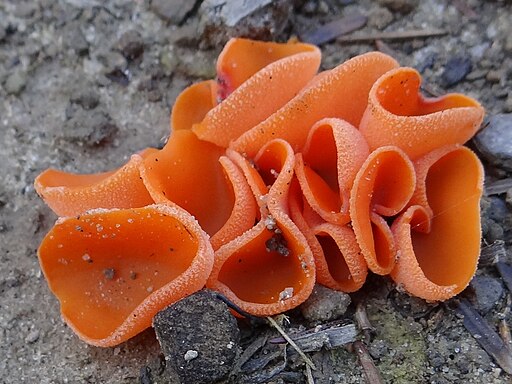
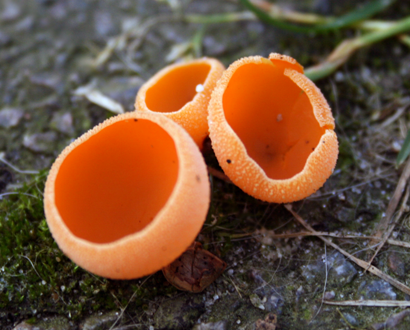
Aleuria aurantia (Orange Peel Fungus)
"FRUITING BODY 1-10 cm broad, sometimes
nearly round at first but soon becoming cup-shaped to saucer-shaped to flattened or wavy, or
sometimes irregularly contorted (especially if clustered). Fertile (upper or inner) surface bright
orange to golden-orange, fading somewhat in age, more or less smooth; margin often wavy or lobed.
Exterior (underside) pallid or at least paler, smooth or minutely downy. Flesh thin, brittle orfragile.
STALK absent or rudimentary. SPORES 18-24 )( 9-11 microns, elliptical, coarsely reticulate or
ridged at maturity, typically with two oil droplets. HABIT A T: Scattered to gregarious or in fused
clusters on ground, fruiting mainly in the fall and winter in our area; widely distributed and very
common. It seems to prefer bare soil or sand along roads, paths, landslides, etc., but also grows in
grass or moss." [MushDemyst]
"COMMENTS: The orange peel fungus is most likely to be mistaken for one of the old orange peels that frequently litter our woods and roadsides. It is much more fragile, however, and less common. Its size and shape vary considerably depending on environmental conditions, but the "aleuring" bright orange color and absence of a stalk are constant. Some species of Otidea are orangish, but have a more erect rather than prostrate growth habit, while A. rhenana is smaller and has a stcdk. A variety of A. aurantia with smaller spores (13-15 microns long) occurs in our area. See also Melastiza chateri (under Scutel- linia scutellata), a somewhat similar but smaller species with brown hairs on its exterior." [MushDemyst]
"Aleuria aurantia does indeed look like orange peels turned inside-out and scattered by a passing hiker or motorist. The inner fertile surface is a brilliant deep orange, the outer surface paler with a somewhat dan druffy texture. The spores are ellipsoid, 13–24 × 7.5–10 µm, and covered by a network of ridges. Aleuria aurantia is very common in the fall, and is especially abundant along gravelly forest roads, in campgrounds, and at trailhead parking areas. It is one of several ascomycetes that will discharge many spores simultaneously when disturbed, producing a visible smoke-like cloud. Sometimes this can be induced by breathing on the cups; at other times it will occur on its own when the fruitbody is removed from its collecting container. Aleuria aurantia is widespread in the Northern Hemisphere; it is edible, but brittle and hard to collect intact, and has little taste." [Trudell MPNW]
"It is one of several ascomycetes that will discharge many spores simultaneously when disturbed, producing a visible smoke-like cloud. Sometimes this can be induced by breathing on the cups; at other times it will occur on its own when the fruitbody is removed from its collecting container." [Trudell MPNW]
"Habitat / Range scattered to gregarious or in fused clusters on ground, preferring bare soil or sand along roads, paths, landslides, etc., but also in grass or moss, (Arora), in groups or clusters on hard or disturbed soil in gardens, in grass, or along roadsides, (Phillips), on west coast fruits in spring and fall but most abundant in fall (McKnight), summer and fall (Bacon)" [E-flora] "Usually occurring on areas of disturbed soil such as those found along roads and paths, orange-peel mushroom is widely distributed throughout the world." [EPMW Hall]
"Single to closely clustered on damp soils in woods and open areas, occasionally in lawns but more common on exposed clay soils or on edges of gravel paths; late summer, fall." [MOFMUS Huffman]
Status: Native [E-flora]
Monomethylhydrazine : An unquantified amount of monomethylhydrazine was found in Aleuria aurantia. "Methylhydrazines are cytotoxic poisons whose alkylating activity is known because of the industrial use as an essential intermediary in many syntheses and as rocket fuel."(Andary,1985) No other further details were given and no other reports of methylhydrazines could be found for this species or genera.
nonpoisonous. [MOFMUS Huffman]
Food Use
"Edibility yes (Arora)" [E-flora] "Though thin and rather brittle, the fruiting bodies are edible and have been consumed either raw or cooked. The latter, of course, is the safer choice." [EPMW Hall] "Edible and highly rated by one authority, but bland according to others. One of my colleagues uses it raw in salads, but it is so thin-fleshed and fragile that it hardly seems worth the trouble to collect it." [MushDemyst] "it is edible, but brittle and hard to collect intact, and has little taste" [Trudell MPNW]
Aleuria aurantia - edible - (Hall et al., 1998a; Villarreal and Perez-Moreno, 1989; Vasil' eva, 1978. Note: This is only for the Russian far east.; www.mykoweb.com) [WEFGO]
Aleuriaxantbin: C40H56O "Constit. of Aleuria aurantia. Cryst. (Et20fpet. ether). Mp 122-122.5°." [Connolly DT]
"Aleuriaxanthin, the main xanthophyll of the fungus Aleuria
aurantia, has been shown to have the novel structure ... , the
first example of a methylene-containing acyclic end-group.
"Isotopic analyses of ascocarps using 15N and 13C isotopes indicate that the fungus may be mycorrhizal (Hobbie et al., 2001). The orange colour of the hymenium is due to carotenoid-enriched granules in the club-shaped tips of the paraphyses (Fig. 14.3). The main carotenoids are b-carotene, g-carotene and aleuriaxanthin (Gill & Steglich, 1987)." [IntrotoFun3]
"It is not surprising that little structural similarity can be seen among the fucose-binding lectins since they have been isolated from such diverse sources as green plants (Lotus tetragonolobus and Ulex euro paeus), fungus (Aleuria aurantia ), and animals (Anguilla anguilla)." [Liener Lectins]
"The fucose-binding lectins from L. tetragonolobus in conjunction with those from Ulex europaeus and/or Aleuria aurantia have been used suc cessfully to infer structural information about complex glycoconjugates (Morgan and Watkins, 1953; Grundbacher, 1973; Rovis et al., 1973b; Napier et al., 1974; Pereira and Kabat, 1976; Gurd, 1979; Gustavsson et al., 1982). Though the L. tetragonolobus lectins exhibit a rather narrow specificity, they appear to be capable of recognizing a specific subset of chicken lymphocytes (Flower and Wilcox, 1981) (see also Chapter 5)." [Liener Lectins]
(a-L-Fucose) "The fucose-binding lectin isolated from the fruiting bodies of the orange peel fungus exhibits no ABO(H) blood group specificity (Kochibe and Furukawa, 1980, 1982).... Inhibition by saccharides of precipitation between the lectin and H-active mucin demonstrated (see Table XXVI) that the binding site is specific for α-L-fucosides and binds fucosylated oligosaccharides analogous to Lea, Leb, and types 1 and 2 H-active blood group immunodominant structures equally well. However, methyl a-L- fucoside was 16-50 times more potent than any of the oligosaccharides tested. This lectin shows promise as a reagent capable of detecting ch unked fucosyl units regardless of the structure of the aglycone. Karlsson and colleagues (Ohlson and Karlsson, 1983; Gustavsson et al., 1982) have successfully employed this lectin to examine fucoglycoproteins unreac- tive with the lectins from Lotus tetragonolobus and Ulex europaeus." [Liener Lectins]
Cultivation
"Tertiary Decomposers: An amorphous group, the fungi represented by this group are typically soil dwellers. They survive in habitats that are years in the making from the activity of the primary and secondary decomposers. Fungi existing in these reduced substrates are remarkable in that the habitat appears inhospitable for most other mushrooms. A classic example of a tertiary decomposer is Aleuria aurantia, the Orange Peel Mushroom. This complex group of fungi often pose unique problems to would-be cultivators." [GGMM Stamets]
Local Species
"Aleuria seems to be closely related to Pyronema (Landvik et al., 1997). There are about 10 species of Aleuria, growing especially on forest soil. Aleuria is similar in appearance to Peziza (see below) but is distinguished from it in having non-amyloid asci. The best-known species is A. aurantia, the so-called orange-peel fungus..." [IntrotoFun3]
"The apical dome of the ascus may be modified in various ways. In certain types of discomycete with an open saucer-like fruit body or apothe- cium, the ascus is capped by a wall which has an annulus of thinner wall material forming a lid or operculum (Lat. operculum ¼ a cover, lid) (van Brummelen, 1981). When the ascus explodes to discharge its ascospores, the operculum may be lifted off completely or may hinge to one side (see Figs. 14.5, 14.6). Such asci are operculate" [IntrotoFun3]
"Operculate asci are characteristic of Pezizales including genera such as Aleuria, Ascobolus and Pyronema...." [IntrotoFun3]
Blue-Listed in B.C.[E-flora-2]

Sowerbyella rhenana(4)
"Summary: Features include a stemmed cup that is orange to yellow-orange with pale orange to white underside and stem, and guttulate reticulate spores that lack an apiculus. (Castellano). It is found in WA, ID, CA and known from Europe and Japan, (Castellano). There are collections from OR deposited at Oregon State University. It was photographed by Kem Luther on Vancouver Island in BC."[E-flora-2]
"Habitat / Range scattered to gregarious or cespitose in duff of moist, relatively undisturbed, older coniferous forests, (Castellano), gregarious, often in small clusters, on ground or moss in woods (usually under conifers), (Arora)"[E-flora-2]
"Aleuria rhenana Fuckel (= Sowerbyella rhenana) is similarly colored [as Aleuria aurantia], with smaller cups borne on clustered stipes; it is much less frequently encountered, seemingly preferring old-growth forests." [Trudell MPNW]
Sowerbyella rhenana (Fuckel) J. Moravec - "Although often confused with Aleuria spp., the combination of a stem and nonapiculate spores makes it quite distinctive. Other Sowerbyella species share the yellow or yellow-orange or orange stipitate, cup sporocarp; however, they have smaller spores and have less reticulation on the spores." [FSNF]
Aleuria rhenana (Stalked Orange Peel Fungus)
"FRUITING BODY 1-2cm broad, cup-
shaped with a stalk. Fertile (inner or upper) surface bright orange to yellow-orange, smooth. Exterior
white or whitish and minutely hairy or downy. Flesh thin, brittle. STALK present, 1-3 cm long, 2-5
mm thick, slender, equal or ta pered downward, colored like the exterior; base often arising from a
dense mass of white mycelium that may bind several stalks together. SPORES 20-23 x 11-13 microns,
elliptical, coarsely reticulate at maturity. HABITAT: Gregarious, often in small clusters, on ground or
moss in woods (usually under conifers); widely distributed but infrequent. I have found it only twice-
in Mt. Rainier National Park in Washington, in September, and near San Francisco in January.
EDIBILITY: Presumably consumable, but much too small and rare to be of value. COMMENTS: This
petite cup fungus is the same color as its cosmopolitan cousin, A. aurantia, but is much rarer and
usually smaller, possesses a stalk, and likes to grow in dainty clusters (see color plate)." Leucoscypha rutilans "...is a similar moss-inhabiting
species with slightly larger spores and
longer hairs on its underside." [MushDemyst]


Caloscypha fulgens is more yellow, typically flushed with green or blue-green on exterior, and grows only in spring whereas Aleuria aurantia fruits in spring and fall, (McKnight)." [E-flora]
"Caloscypha fulgens (Persoon: Fries)
Boudier
Caloscypha fulgens is another mediumsized orange cup that could be confused with Aleuria aurantia. Like Pseudaleuria
quinaultiana, however, it is a spring-fruiter, and is one of the common members of the western montane snowbank mycota that
fruit in areas recently uncovered by melting snow. In addition to its habitat and fruiting season, it can be distinguished from the
other orange cups by the blue to green staining that occurs as the fruitbodies age. Caloscypha fulgens is a parasite of conifer
seeds. Although most common in the western mountains, it occurs across North America, as well as in Europe and temperate
Asia." [Trudell MPNW]
"Neottiella rutilans is a similar moss-inhabiting species with slightly larger spores and longer hairs on the underside, (Arora)." [E-flora-2]
"Pseudaleuria quinaultiana Lusk
Pseudaleuria quinaultiana is a rare cup that looks somewhat like Aleuria aurantia. It differs in being more saucer-like than
cup-shaped, having a more reddish fertile surface, occurring in ones or twos rather than large groups, having smooth ellipsoid
spores (15.5–21.5 × 7.5–10.5 µm), and fruiting in spring rather than fall. The species was described from a collection made
near Lake Quinault, in the southwestern portion of the Olympic Peninsula, and it has been found primarily in old-growth forest
with Sitka spruce, western hemlock, and Douglas-fir. As far as we know, it occurs only in Washington and Oregon but,
because seemingly suitable habitat is present from northern California to B.C. and southeast Alaska, it could well occur in
those areas too." [Trudell MPNW]
Synonyms
References
This graph represents the unique prevalence of "Aleuria" within the Eflora local research library. Penetration indicates the percentage of total documents containing at least one of the search terms.


