Aethusa cynapium - Fool's parsley
Family: Apiaceae [E-flora]
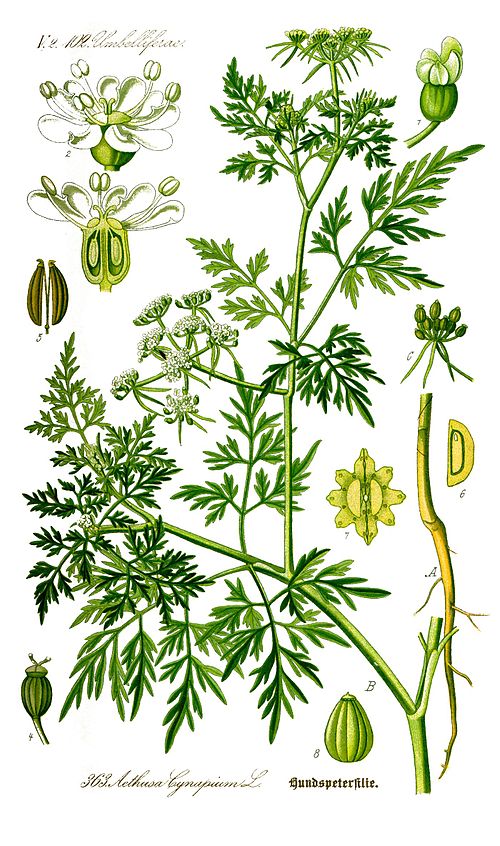
(Wikimedia)1
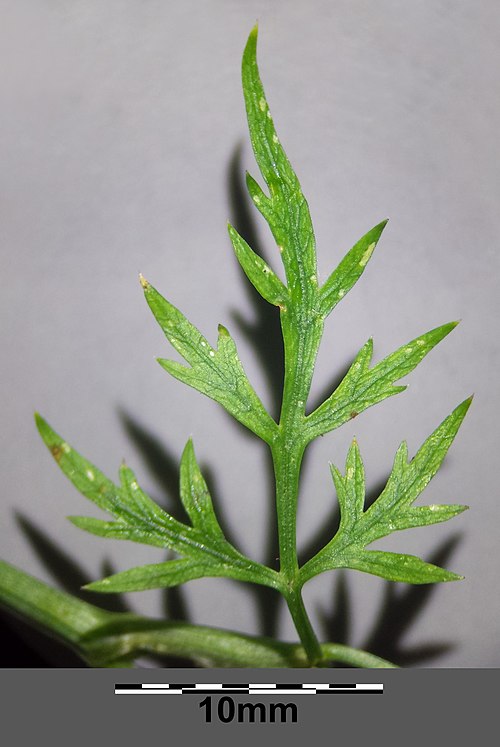
(Wikimedia)2
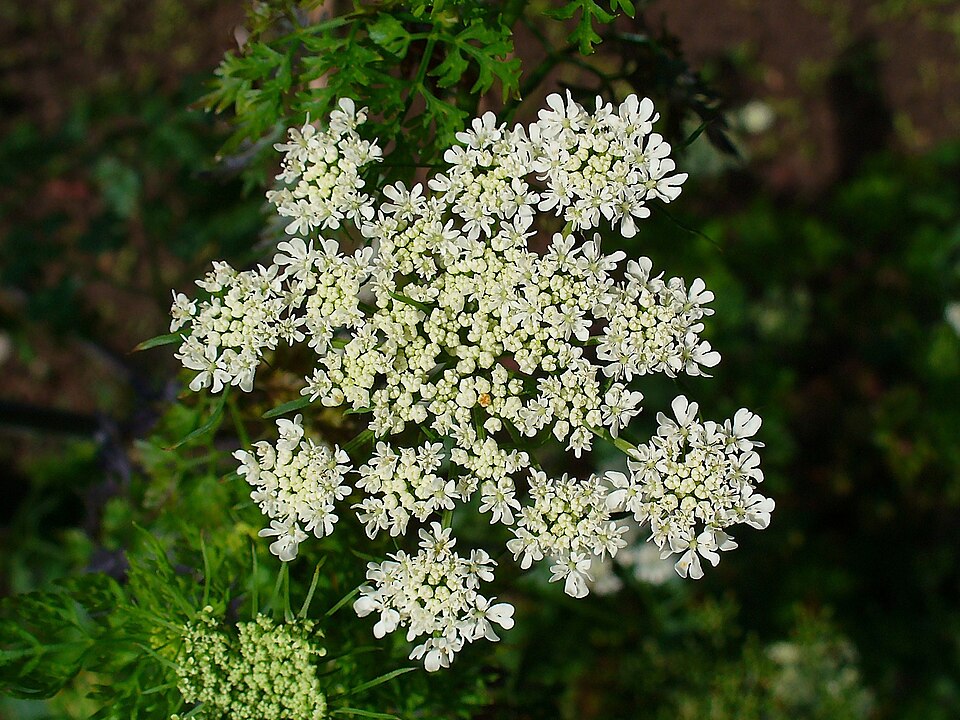
(Wikimedia)3
Image References
- 1, Aethusa cynapium, Kilom691, CC BY-SA 3.0
- Aethusa cynapium plate 363 in: Otto Wilhelm Thomé: Flora von Deutschland, Österreich u.d. Schweiz, Gera (1885) (modified)
- 2, Aethusa cynapium subsp. elata, Stefan.lefnaer, CC BY-SA 4.0
- 3, Aethusa cynapium, H. Zell, CC BY-SA 3.0
Hazards
"This is a poisonous species." [E-flora]
".... There are, however, some black sheep in the family, including three of our most deadly plants: poison hemlock (Conium macula- tum), water hemlock (Cicuta maculata) and fool's parsley (Aethusa cynapium). These three, unfortunately, look and smell so much like the useful species that it is easy to mistake one for the other in the leaf stage." [WFF] Volume 9, No. 4
"FOOL'S PARSLEY (Aethusa cynapium). Plant considered very dangerous for herbal use." [CPPM]
"Aethusa cynapium contain volatile alkaloid cynopine which resembles coniine compound." (Dwivedi et al., 2021)
"The entire plant is poisonous though less so than Conium maculatum (q.v.)[4, 10, 19]. Small amounts can cause pain, confusion of vision and vomiting[268]. The dried plant might be safe to eat[10]." [PFAF]
Introduction
"Fool's parsley is native to Europe, western Asia and northwest Africa but has been introduced elsewhere (Wikipedia 2012)." [E-flora]
"There is a historical report of this species for BC in the Illustrated Flora of British Columbia, which says it was "reported by Scoggan". However, no additional information is available; no specimen at CAN." [E-flora]
"The plant is carrot-like and 8 to 24 inches in height. The leaves of the plant show resemblance with parsley have a glossy shine appearance on both sides with an unpleasant garlic-like odor. The white flowers and seedpods are inconspicuous and are formed on the stem tips." (Dwivedi et al., 2021)
Edible Use
"Leaves - raw or cooked[105]. It is very inadvisable to eat this plant, see the notes above on toxicity[177]." [PFAF]
Other Use
Fodder
"Fool’s Parsley is fatal when fresh, but it become nonpoisonous when dried out (Salisbury1961). Toxins like cynopine are damaged by drying, and hay containing the plant is not poisonous (Fleming 2000, Moreau 1996)." (Dwivedi et al., 2021)
Medicinal Use
"Although fairly toxic, fool's parsley has occasionally been used in folk medicine[268]. The herb is sedative and stomachic. It has been used in the treatment of gastro-intestinal problems, especially in children, and also to treat convulsions and summer diarrhoea[4, 61, 268]. Extreme caution in the use of this herb is advised, see the notes above on toxicity." [PFAF]
"A. cynapium has been used in traditional medicine for gastrointestinal issues in children, infantile cholera, summer diarrhea, convulsions, anxiety, sleep disorders, delirium, and as stomachic (Fleming 2000, Vikramaditya and joshi 1997). However, the concentration of toxin is insufficient to cause serious effects in most cases. If poisoning occurs, onset of effect is rapid, usually within 1 hour of ingestion. Generalized seizures also may occur. Death may occur if seizures do not terminate (Nelson et al., 2007, Teuscher et al., 1990)." (Dwivedi et al., 2021)
Activities
"To conclude the present investigation bioactivity guided fractionation of methanol extract of A. cynapium ultimately led to the isolation of a new fatty acid—trideca-7, 9, 11 trienoic acid, which was found to be responsible for the antianxiety activity of A. cynapium." "In the present investigation it was found to be present to the extent of 0.2% w/w in the aerial parts of the plant."(Shri et al.,2010)
Phytochemicals
"Unsaturated aliphatic alcohols (e.g., aethusanol A) closely related to cicutoxin (from Cicuta species) and traces of coniine (Nelson et al., 2007). The plant embraces a volatile alkaloid named cynopine which imitate coniine in its physical and chemical characters, as well as physiological behaviour (Vikramaditya and joshi 1997, Clapham et al., 1987, Tutin 1980, power and Tutin 1905); polyacetylenes (Andreev et al., 2001) including aethusin, aethusanol A & B; essential oil; flavone glycosides such as rutoside, narcissine, and ascorbic acid (Fleming 2000)." (Dwivedi et al., 2021)
Aethusa Sp. -
Journals of Interest
- Davison, H. E. "Poisoning By" Fool's Parsley"(Aethusa Cynapium)." The British Medical Journal (1904): 124-124.
- Teuscher, E., Greger, H., and Adrian, V. 1990.Investigation of the toxicity of AethusacynapiumL. (Hundspetersilie). Pharmazie. 45:537–538.
- Bohlmann, F., Mannhard, H.J. 1960.Polyenes from Aethusacynapium L. Chem. Ber. 93:981–987.
- Leupen, Alex. "A Boy with Post-Mononucleosis Depression: Aethusa." Homœopathic Links 26.04 (2013): 278-278. DOI: 10.1055/s-0033-1350940
- Dollinger, M. "Distribution, biology, damages and control of foolsparsley (Aethusa cynapium L.)." (1992).
References
- (Dwivedi et al., 2021) - Dwivedi, Harshita, Mohini Bhardwaj, and Girjesh Kumar. "A Comprehensive Study of Poisonous Plants of Family Apiaceae." Apiaceae: Ecology, Uses and Toxicity. Nova Publisher, New York (2021): 1-14.
- [E-flora] - Aethusa cynapium L., https://linnet.geog.ubc.ca/Atlas/Atlas.aspx?sciname=Aethusa%20cynapium, Accessed May 6, 2026
- Note Author: Frank Lomer, Honorary Research Associate, University of British Columbia Herbarium
- [PFAF] Aethusa cynapium - L. - https://pfaf.org/user/Plant.aspx?LatinName=Aethusa+cynapium, Accessed May 8, 2026
- (Shri et al.,2010) Shri, Richa, K. K. Bhutani, and Anupam Sharma. "A new anxiolytic fatty acid from Aethusa cynapium." Fitoterapia 81.8 (2010): 1053-1057.