"Conifer barks and pitches are still widely collected. Uses
of Picea and Pinus, and Abies, were mentioned by 9 con-
sultants each (Table 3). The liquid and solid pitches of
spruce, pine, and fir are used for wound dressings and
taken internally. All three species, and other related spe-
cies, are widely used in northwestern North America. Thir-
teen groups in the map area are known to use Abies lasiocarpa (Hook.) Nutt., while 8 use Abies grandis
(Dougl.) Forbes or Abies amabilis (Dougl.) Forbes (Fig. 5).
For 11 groups there is no record of use of Abies." (Johnson, 2006)
"Abies is used for a variety of purposes: the bark in mixed
decoctions for treatment of tuberculosis, or as a tonic, or
for internal medicine or lung disease (Additional file 1).
The liquid pitch is regarded as the strongest part of the
subalpine fir, and is used for TB treatment, as a purgative
or cleanser, or for cuts or boils. Pine and spruce pitch and
bark have been given together, as consultants often con-
sider them interchangeable. There is high consensus on
use of pitch of pine or spruce for infections, burns and
boils (9 of 9). Other uses are in tonic "wood medicine"
mixed decoctions and for treatment of tuberculosis." (Johnson, 2006)
Boletus Edulis SENSU LATO. - Abies spp. (Hall&Lyon)
"Because the artificial nature of pure-culture syn-
theses creates problems in interpreting host-fungus
compatibility (Duddridge, 1986 a, b), Massicotte et
al. (1994) tested the specificity hypotheses put forth
by Molina & Trappe (1982a, 1994) for Rhizopogon
by growing species of five genera of Pinaceae (Abies,
Picea, Pinus, Pseudotsuga and Tsuga) in pasteurized
soil in pots and inoculating them with spores of 11
Rhizopogon spp. They grew the hosts in single- and
two-host culture combinations to examine the effect
of co-cultured plants on the ectomycorrhizal host
range of the fungi. In single-host treatments, all
Rhizopogon species developed ectomycorrhizas only
on Pseudotsuga menziesii or Pinus ponderosa (ponderosa pine); in two-host cultures, some Rhizopogon
species maintained specificity for either Pseudotsuga
or Pinus, whereas others also were able to colonize
Abies, Picea or Tsuga. Massicotte et al. (1994)
believed that those Rhizopogon species able to
colonize Abies, Picea or Tsuga first formed ectomy-
corrhizas with Pseudotsuga or Pinus (primary hosts)
and then spread vegetatively to the secondary hosts." (Molina,1997)
|
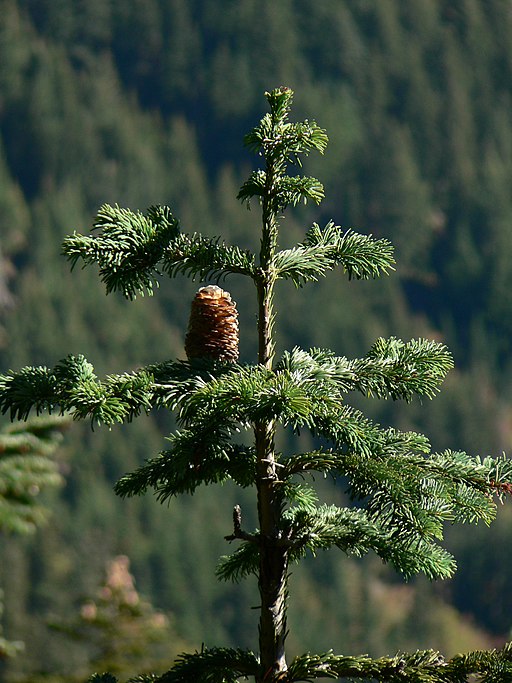
"This is a tall, evergreen, coniferous tree species found from Alaska south to northern California in forests with deep, well-drained soils."[IFBC-E-flora]
Status: Native.[E-flora]
Habitat / Range
Moist to mesic forests with deep, well-drained soils in the lowland to subalpine zones; common in and W of Coast-Cascade Mountains, except Queen Charlotte Islands; N to SE AK and S to N CA. [IFBC-E-flora]
General: "Tall, straight tree, up to 55 m tall, with dense cylindric or conical crown; bark grey to nearly white, smooth but becoming scaly with age, with resin blisters; branches flattened and spray-like." [IFBC-E-flora]
Leaves: "Needles flattened, blunt and mostly notched at the tip; shiny, dark green and grooved above, having two distinct silvery bands of stomata and ridged below; spreading to somewhat erect needles 1.5-3 cm long; strongly appressed needles on upper surface of twig 0.7-2 cm." [IFBC-E-flora]
Cones: "Seed cones erect, deep purple, 8-10 (15) cm long, 3.5-4 (5) cm thick, the bracts deciduous; pollen cones reddish." [IFBC-E-flora]
Ecological Indicator Information
"A very shade-tolerant, submontane to subalpine, Western North American evergreen conifer distributed more in the Pacific than the Cordilleran region (absent on Queen Charlotte Islands). Occurs in maritime to sub maritime sub-alpine boreal and summer-wet cool mesothermal climates on fresh to very moist soils; its occurrence increases with increasing elevation and precipitation, and decreases with increasing latitude and continentality. Grows in pure or mixed-species stands (usually with western or mountain hemlock) on water-shedding and water-receiving sites. Regenerates underneath closed-canopy stands, particularly on mycorrhizal Mors. (The mycorrhizae may explain this species' tolerance of nutrient-poor sites.) Most productive on submontane, fresh to moist, nutrient-rich (seepage) sites within wet cool mesothermal climates. Characteristic of wet maritime forests." [IPBC][E-flora]
Food Uses:
- "... amabilis fir (Abies amabilis (Dougl. ex Loud.) Dougl. ex
Forbes)... used in particular regions of northwestern North America for their edible cambium and secondary
phloem" (Dilbone et al.,2013) " The Haisla
report using the "cambium" of amabilis fir (Abies amabilis (Dougl.) Forbes) for food. Gordon Robinson states that it is
similar to hemlock "cambium." " (Gottesfeld1992)
Other Uses:
- "The Native American Ojibwa, who occupied the upper Midwest of the United
States and parts of Canada, inhaled the smoke of burning leaves to treat colds
(Smith 1932). The Nitinaht of British Columbia, Canada, burned the boughs and
inhaled the smoke to prevent sickness (Turner et al. 1983)." [UAPDS]
Cultivation
"Requires a good moist but not water-logged soil in a sheltered position(1). Grows well in heavy clay soils. Plants are very shade tolerant(11, 81)
but growth is slower in dense shade(81). Intolerant of atmospheric pollution(1). Prefers slightly acid conditions down to a pH of about 5(200).
Prefers growing on a north-facing slope(200). Trees are somewhat shallow rooted and are therefore susceptible to strong winds(229). Grows best in
the Perthshire valleys of Scotland(11). It does very well on glacial moraines in Scotland(81). When grown in an open position, the tree clothes
itself to the ground with gracefully drooping branches, though on the whole, this species does not grow well in Britain(11). Trees have been of
variable growth in this country and seem to be short-lived(185). The best and fastest growing specimens are to be found in the north and far
west of the country(185). Growth in girth can be very quick, 1.8 metres in 35 years has been recorded(185). Trees should be planted into their
permanent positions when they are quite small, between 30 and 90cm in height. Larger trees will check badly and hardly put on any growth for
several years. This also badly affects root development and wind resistance(200). The crushed leaves have an odour like orange peel(11).
Plants are strongly outbreeding, self-fertilized seed usually grows poorly(200). They hybridize freely with other members of this genus(200).
This species is often confused with A. nordmanniana(11). A very ornamental plant(1). Trees are sometimes grown as 'Christmas trees'(200).
Plants are susceptible to injury by aphis(11)." [PFAF]
Propagation
"Seed - sow early February in a greenhouse or outdoors in March(78). Germination is often poor,
usually taking about 6 - 8 weeks(78). Stratification is said to produce a more even germination so it is probably best to sow the seed in a cold
frame as soon as it is ripe in the autumn(80, 113). The seed remains viable for up to 5 years if it is well stored(113). When large enough to
handle, prick the seedlings out into individual pots and grow them on for at least their first winter in pots. Plant them out into their permanent
positions in late spring or early summer, after the last expected frosts. Alternatively, if you have sufficient seed, it is possible to sow in an
outdoor seedbed. One report says that it is best to grow the seedlings on in the shade at a density of about 550 plants per square metre(78) whilst
another report says that they are best grown on in a sunny position(80)." [PFAF]
References
- Dilbone et al.,2013 - Megan Dilbone , Nancy J. Turner & Patrick von Aderkas (2013) Lodgepole
Pine Cambium (Pinus contorta Dougl. ex Loud. var. latifolia Engelm. ex S. Wats.): A Springtime
First Peoples’ Food in British Columbia, Ecology of Food and Nutrition, 52:2, 130-147, DOI:
10.1080/03670244.2012.706013
- E-flora - http://linnet.geog.ubc.ca/Atlas/Atlas.aspx?sciname=Abies amabilis&redblue=Both&lifeform=1, Accessed Jan 12, 2015
- PFAF - http://www.pfaf.org/user/Plant.aspx?LatinName=Abies+amabilis, Accessed Jan 12, 2015
Abies grandis - Grand Fir
"Abies grandis is an evergreen Tree growing to 75 m (246ft) by 8 m (26ft) at a fast rate.
It is hardy to zone (UK) 6 and is not frost tender. It is in leaf 12-Jan, and the seeds ripen from Sep to October. The flowers are monoecious (individual flowers are either male or female, but both sexes can be found on the same plant) and are pollinated by Wind.
Suitable for: light (sandy), medium (loamy) and heavy (clay) soils and can grow in heavy clay soil. Suitable pH: acid and neutral soils. It can grow in full shade (deep woodland) semi-shade (light woodland) or no shade. It prefers moist soil. The plant can tolerates strong winds but not maritime exposure.
It cannot tolerate atmospheric pollution." [PFAF]
This is a tall evergreen, coniferous, tree species that is found from southern British Columbia (primarily southwestern BC)
south to northern California.[IFBC-E-flora]
Status;
Native.[E-flora]
Habitat / Range
"Moist to mesic slopes and river terraces in the lowland and montane zones; frequent in SW BC, infrequent in SC BC; S to N CA, ID, W MT, SE WA and NE OR." [IFBC-E-flora]
General:
Tall, straight tree, up to 80 m tall; bark greyish to light brown, with resin blisters, smooth to shallowly ridged, becoming flaky; branches flattened and spray-like.
[IFBC-E-flora]
Leaves:
Needles flat, rounded and usually notched at the tip; dark green and shallowly grooved above, having two distinct whitish bands of stomata below; definitely spreading horizontally, 2-4 (5) cm long.
[IFBC-E-flora]
Cones:
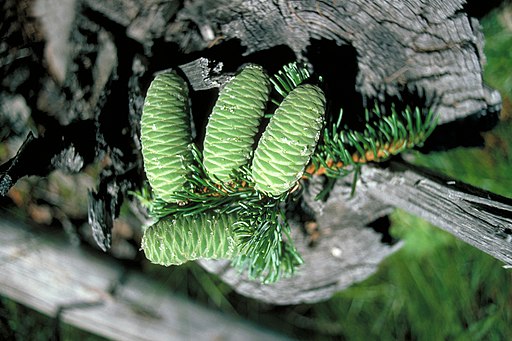
Seed cones erect, yellowish-green to green, 6-11 cm long, 3.5-4 cm thick, the bracts deciduous; pollen cones yellowish.
[IFBC-E-flora]
Ecological Indicator Information
"A shade-tolerant to shade-intolerant, submontane to montane, Western North American evergreen conifer distributed less in the Pacific than the Cordilleran region. Occurs in cool temperate and cool mesothermal climates; its occurrence decreases with increasing latitude, precipitation, and elevation. Grows in mixed-species stands (usually with Douglas-fir or western redcedar) on water-shedding and water-receiving sites. Tolerates fluctuating groundwater tables. Most productive on submontane, fresh to moist, nutrient-rich (alluvial and seepage) sites. Characteristic of nutrient-rich sites." (IPBC)[E-flora]
Actions
Alopecia; Anodyne; Boil; Bruise; Canker; Cold; Collyrium; Cough; Dandruff; Gingivitis; Laxative; Pertussis; Psoriasis; Rejuvenation;
Side; Skin; Sore; Stomach; Tonic; Tuberculosis; Wound [DukePhyto]
Uses
Used as a tea plant [Turner,Davis]
"This tree was well known among the
Kwakiutl for its medicinal value. Wilson
(1969) has taken a tonic made from the
bark every day since he can remember. He
claims it keeps him young and strong.
(When we talked to him, he was 75, but
looked about 50. His youngest child was
10). The green bark is brought to a boil
and allowed to stand overnight. Dried
bark can also be used, but it must be
broken into small pieces first.
Pitch collected from the small blisters
on the young trees was used in many
ways. It was mixed with water, boiled,
and taken as a tonic and laxative, or for
coughs and tuberculosis (Roberts, 1969;
Brown, 1969; Cranmer, 1969; King,
1972). It was mixed with oulachen grease
and eaten or rubbed on sores and boils
(Brown, 1969). Sometimes for tuberculosis it was rubbed on a person's chest and
back and left until it dropped off, or
"until all the medicine was gone" (op.
cir. ). It was also heated, mixed with catfish oil, and taken twice a day for constipation (Boas, 1966). Sometimes the root
was held in the mouth to cure gum boils
and canker sores (op. cit. ).
Grand fir branches were also used in
Kwakiutl purification rites. A person
would scrub his body with them until he
was bleeding (Boas, 1935). In the winter
ceremonials, the Cannibal Dancer of the
Wolves rubbed the pollen all over his body
(op. cir. ). Koskimo shamans wore head
and neck rings of this tree (Boas, 1966)" [Turner&Bell]
"The pitch from the blisters of this tree was
often rubbed on canoe paddles and other
wooden articles, then scorched to provide a
good finish (Barnett, 1955). According to
Paul (1968), an infusion of the bark of the
roots made an excellent hair tonic for falling
hair and dandruff. It was prepared by
pounding the bark from the roots, then
steeping it in warm water. The resulting
fluid was then rubbed into the scalp. Mr.
Paul's late wife, a Nanaimo woman, sold a
great deal of this hair tonic.
The Saanich mixed the pitch of this and
other conifer species with venison suet, then
rubbed this ointment on the skin to cure
psoriasis and other skin diseases and to salve
cuts and bruises (Paul, 1968). The Songish
Indians warmed grand fir branches and applied them to the stomach and sides as a
remedy for pains in those regions (Boas,
1890)." [Turner&Bell]
- Respiratory ailments, digestive tract
ailments and gynaecological problems were treated with bark of Abies
grandis (Lans et al., 2007)
- "NW: Pitch steeped in hot water for 15 to 20 minutes, then sticky substances strained off, to
make gargle for sore throat (Ortiz and others 2006: 126). Used for Christmas trees (McCovey
2006)." [Ortiz, GTR]
- The heartwood contains D-pinitol (Poongothai,2003)
- "A. grandis... was widely employed, being applied in at least six individual treatments." (Turner1990)
- Smoke: The Nitinaht of British Columbia, Canada, burned the boughs of this species in
their fires and inhaled the smoke to prevent general sickness (Turner et al. 1983) [UAPDS]
Ten Barks Medicine
It is part of the "ten barks" medicine used to treat TB and scrophula sores. This remedy contains; "Abies grandis (long strip of bark);
Amelanchier alnifolia (strip of bark);
Arbutus menziesii (long strip of bark, about 60 cm);
Cornus nuttallii (strip of bark);
Malus fusca (strip of bark);
Oemleria cerasifonnis (stick about 30 cm long; said to work on your blood);
Populus tremuloides (long strip of bark);
Prunus emarginata (strip of bark from bottom part of tree);
Rhamnus purshiana (strip of bark);
Salix lasiandra (“Pussy Willow”; long strip of bark); and (possibly)
Tsuga heterophylla (strip of bark; suggested during one interview as an ingredient by EC)." (Turner1990)
"Cut barks and sticks into piece, and boil together with a piece of rhizome of Polypodium glycyrriza about 20 cm long,
preferably growing on a trunk or branch of Acer macrophyllum. (The rhizome was considered a sweetener, but also to have some
medicinal properties" (Turner1990)
"Boil the materials for a long time, until the liquid is black and "really strong". Pour into
sterilized jars. Cool to room temperature. Have patient drink about 250 ml (1 cup) per day until medicine is used up.
Continue preparation and use as required, until affliction is healed." (Turner1990)
Cultivation
"Prefers a good moist but not water-logged soil(1). Grows well in heavy clay soils and succeeds in poor sandy soils(185).
Very shade tolerant, especially when young, but growth is slower in dense shade(81). Intolerant of atmospheric pollution(1).
Trees succeeds in very exposed positions, even if the top is blown out by the wind the trees make one or more new tops and
continue growing with no loss of vigour(11, 185). Prefers slightly acid conditions down to a pH of about 5(200).
Prefers growing on a north-facing slope(200). This species thrives exceedingly well in the moister parts of Britain,
where it grows very quickly(11). It is cultivated for timber in W. and N. Europe(50). Trees are slow growing for the
first few years but they are then quite fast with trees growing 60 - 100cm in height and 8cm in girth per year even
when they are quite large(1, 185). New growth takes place from early May to July(185). Trees grow best in the
Perthshire valleys of Scotland and in the far west of Britain(11). Some trees have reached heights in excess of
60 metres in 100 years in Wales and Scotland, making them amongst the tallest trees in Europe(200). A very ornamental
plant(1), it is rarely harmed by disease, insects or frost(1). The crushed leaves have a fruity orange-flavoured aroma(185).
Trees should be planted into their permanent positions when they are quite small, between 30 and 90cm in height. Larger trees
will check badly and hardly put on any growth for several years. This also badly affects root development and wind resistance(200).
Plants are strongly outbreeding, self-fertilized seed usually grows poorly(200). They hybridize freely with other members of
this genus(200)." [PFAF]
Propagation
"Seed - sow early February in a greenhouse or outdoors in March(78). Germination is often poor, usually taking about 6 - 8
weeks(78). Stratification is said to produce a more even germination so it is probably best to sow the seed in a cold frame as soon as
it is ripe in the autumn(80, 113). The seed remains viable for up to 5 years if it is well stored(113). When large enough to handle,
prick the seedlings out into individual pots and grow them on for at least their first winter in pots. Plant them out into their
permanent positions in late spring or early summer, after the last expected frosts. Alternatively, if you have sufficient seed,
it is possible to sow in an outdoor seedbed. One report says that it is best to grow the seedlings on in the shade at a density
of about 550 plants per square metre(78) whilst another report says that they are best grown on in a
sunny position(80)." [PFAF]
Synonyms
- A. excelsior [PFAF][E-flora].
- Abies grandis var. grandis [E-flora]
- Abies grandis var. idahoensis Silba [E-flora]
Further Reading
- Muzika, R. M., Pregitzer, K. S. and Hanover, J. W. (1989) Changes in terpene production following nitrogen fertilization of grand fir (Abies grandis (Dougl.) Lindl.) seedlings. Oecologia 80, 485-489.
References
- DukePhyto http://www.ars-grin.gov/cgi-bin/duke/ethnobot.pl?Abies%20grandis, Accessed Dec 23, 2014
- E-flora http://linnet.geog.ubc.ca/Atlas/Atlas.aspx?sciname=Abies grandis&redblue=Both&lifeform=1, Accessed Jan 12, 2015
- Lans et al., 2007 - Lans, Cheryl, et al. "Ethnoveterinary medicines used for ruminants in British Columbia, Canada." Journal of ethnobiology and ethnomedicine 3.1 (2007): 11.
- PFAF - Material obtained from Plants For A Future Database, http://www.pfaf.org/user/Plant.aspx?LatinName=Abies+grandis, Accessed Jan 12, 2015
- Poongothai,2003 - Poongothai, G., and Shubashini K. Sripathi. "A review on insulinomimetic pinitol from plants." (2013): P-992.
- Turner1990 - Turner, Nancy J., and Richard J. Hebda. "Contemporary use of bark for medicine by two Salishan native elders of southeast Vancouver Island, Canada." Journal of ethnopharmacology 29.1 (1990): 59-72.
Abies lasiocarpa - Subalpine Fir
"Abies lasiocarpa is an evergreen Tree growing to 25 m (82ft) by 4 m (13ft) at a slow rate.
It is hardy to zone (UK) 5 and is not frost tender. It is in leaf 12-Jan, and the seeds ripen in September. The flowers are monoecious (individual flowers are either male or female, but both sexes can be found on the same plant) and are pollinated by Wind."
"Suitable for: light (sandy), medium (loamy) and heavy (clay) soils and can grow in heavy clay and nutritionally poor soils. Suitable pH: acid and neutral soils. It can grow in full shade (deep woodland) semi-shade (light woodland) or no shade. It prefers moist soil."[PFAF]
SUBTAXA PRESENT IN BC
- Abies lasiocarpa var. lasiocarpa [E-flora]
Status:
Native.[E-flora]
Habitat / Range "Moist to mesic slopes in the montane to alpine zones; common in BC in and E of Coast-Cascade Mountains, locally frequent on Vancouver Island; N to S AK and YT, E to SW AB and S to OR, N NV, AZ and NM." [IFBC-E-flora]
- Alaska
- "Subalpine fir is of rare, local occurrence in mountains of southeast Alaska. This inland tree grows in cool, moist subalpine slopes near
timberline, becoming shrubby or prostrate, and is found on the valley floors as well. It appears to be very shade tolerant" [Viereck ATS]
- "Subalpine fir has been reported from 3 localities in south central Alaska: Copper River basin, Mentasta Pass on Glenn Highway, and
mountains northeast of Anchorage. Specimens are needed before those unverified range extensions should be accepted." [Viereck ATS]
General:
"Usually straight tree, seldom over 35 m tall (up to 50 m in some areas), with distinctly spire-shaped crown; bark grey, smooth, with resin blisters, becoming somewhat ridged with age; branches not spray-like; a common tree-line species, in stunted form." [IFBC-E-flora]
Leaves:
"Needles flattened, blunt and usually notched at the tip; bluish-green, flat above, ridged beneath, having stomata on both sufaces; (2) 2.5-3 (4) cm long, tending to curve upwards, not horizontally spreading."
[IFBC-E-flora]
Cones:
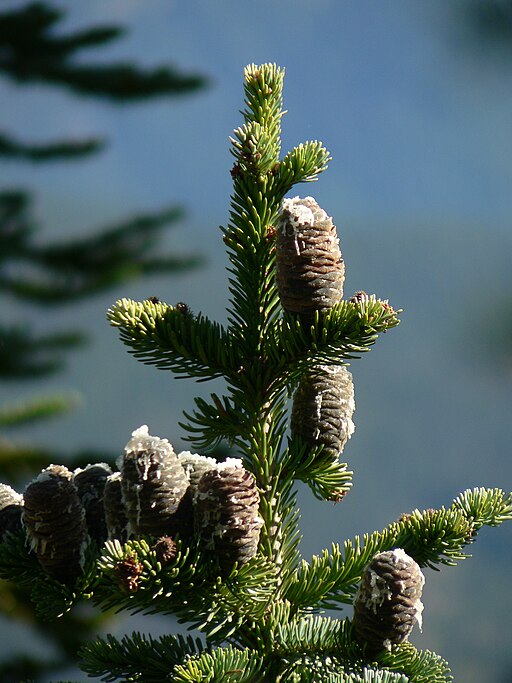
"Seed cones erect, deep purple, 6-10 (11) cm long, 3-3.5 cm thick, the bracts deciduous; pollen cones bluish. Note: In the recently published Flora of North America, Hunt (1993) recognized Abies lasiocarpa as occurring only along the coast with the interior populations assigned to Abies bifolia. Differences between the two occur in the wood chemistry, lack of crystals in ray parenchyma in A. bifolia, shape of basal bud scales, and color of the periderm. However, introgression occurs throughout most of BC, thus hybrid populations predominate. The only unique populations of A. lasiocarpa are in coastal Alaska. Due to the introgression in BC and the relatively minor morphological differences between the two taxa, we include A. bifolia within A. lasiocarpa." [IFBC-E-flora]
Ecological Indicator Information
"A shade-tolerant to shade-intolerant, montane to subalpine, Western North American evergreen conifer distributed less in the Pacific than the Cordilleran region. Occurs predominantly in continental boreal climates; its occurrence increases with both elevation and continentality. Grows in mixed -species stands (usually with Engelmann spruce, Pacific silver fir, or mountain hemlock) on leeward slopes of Vancouver Island and Coastal Mountain Ranges. There are occasional pure stands at high elevations on exposed outcrops of base-rich rocks, or on valley bottoms affected by cold air drainage. On sites where it is shade-tolerant, it regenerates under closed-canopy stands, particularly on mycorrhizal Mors. (The mycorrhizae here may explain its tolerance of nutrient-poor soils.) Most productive on montane, fresh to moist, nutrient-rich (seepage) sites within wet cool temperate climates. Characteristic of continental boreal forests.[IPBC]" [E-flora]
Food Use
Cambium - Harvested in spring and eaten fresh. [Prentiss CHG]
Medicinal Use
The lichen Lobaria oregana was traditionally "Boiled with juniper and used as medicine for sore throats. Best for medicine if
collected off Abies lasiocarpa (fir) (Turner and Thompson 2006)" [Rankovic LSM]
"Abies lasiocarpa (Hook.) Nutt. (Pinaceae). Rocky Mountain fir.
The Crow, who inhabited parts of Montana and Wyoming, burned the twigs and leaves of this species for incense purposes (Uphof 1968) and during certain ceremonies (Blankinship 1905). The Blackfoot, also of Montana and parts of Canada, inhaled the smoke from smudges made with the needles to treat headaches, to help an unconscious person recover, and to treat tuberculosis (Hellson 1974). It was also used as a fumigant for people whose faces had swollen because of venereal diseases and to help sick horses. The Cheyenne of Montana and Oklahoma burned the needles as incense
when people were frightened of thunder (Hart 1981). They considered the aromatic smoke useful for chasing away bad influences. The Nez Perce of Idaho, Oregon, and other parts of the United States burned the boughs as incense in sweathouses (Hart 1996). The Native Americans of the Rocky Mountain area of the United States burned
the twigs and leaves for smoke that was used for unspecified purposes (Usher 1974)" [UAPDS]
Uses:
"The Crow, who inhabited parts of Montana and Wyoming, burned the twigs and
leaves of this species for incense purposes (Uphof 1968) and during certain ceremonies (Blankinship 1905). The Blackfoot, also of Montana and parts of Canada, inhaled
the smoke from smudges made with the needles to treat headaches, to help an unconscious person recover, and to treat tuberculosis (Hellson 1974). It was also used as a
fumigant for people whose faces had swollen because of venereal diseases and to help
sick horses. The Cheyenne of Montana and Oklahoma burned the needles as incense
when people were frightened of thunder (Hart 1981). They considered the aromatic
smoke useful for chasing away bad influences. The Nez Perce of Idaho, Oregon, and
other parts of the United States burned the boughs as incense in sweathouses (Hart
1996). The Native Americans of the Rocky Mountain area of the United States burned
the twigs and leaves for smoke that was used for unspecified purposes (Usher 1974)." [UAPDS]
Activities
Antiseptic, Chest-Cold, Cold, Fever, Hair-Oil, Infection, Poultice, Rash, Skin, Sore, Wound [DukePhyto]
Cultivation & Propagation
"Results of laboratory experiments by Ochs (1996) suggested that exudation of simple organic ligands by mycorrhizal roots and fungi enhanced
dissolution of minerals whereas exudates from non-mycorrhizal roots and
humic substances did not significantly affect weathering. This interpretation
was confirmed by Arocena et al. (1999) who compared the chemistry of soil
solution from ectomycorrhizosphere and non-ectomycorrhizosphere soils
under the subalpine fir Abies lasiocarpa. In soil associated with mycorrhizal
roots and fungi, concentrations of the base cations Ca2+, K+ and Mg2+ were
higher than in soil devoid of roots and hyphal rhizomorphs. This was attributed to a reduced pH due to exudation of organic acids, as found by Cromack
et al. (1979) who reported that the pH of soil colonised by mats of the ectomycorrhizal fungus Hysterangium crassum was reduced to 4.9, compared with
uncolonised soil which had a pH of 6.1." [BassiriRad NAP]
"Minerals such as mica and chlorite appear to be transformed at higher
rates in the ecto-mycorrhizosphere of Abies lasiocarpa compared with the
rhizosphere of NM roots (Arocena et al. 1999), resulting in higher cation concentrations (Arocena and Glowa 2000). This is important because it suggests
that EMF not only increase uptake from the soil solution, but can also increase
the capacity of the soil to supply nutrients." [Heijden ME]
ECM Relationships
- Lactarius caespitosus - Kernaghan et aI. (1997) [Cairney EF]
- Lactarius deliciosus - Kernaghan et aI. (1997) [Cairney EF]
"Forestry practices can affect the abundance of fruit bodies produced by ectomycorrhizal fungi. For example, several studies have found a positive correlation between
the number of ectomycorrhizal host species and the number of ectomycorrhizal fungi
that are fruiting (Ferris et al., 2000; Kranabetter, 2001). This suggests that planting
mixtures of tree species would increase the range of ectomycorrhizal fungi that would
fruit in a second-growth stand. Furthermore, Durall et al. (1999) found a clear threshold
in gap size, above which the number of mycorrhizal fruit bodies decreased. In gaps larger
than 900 m2, the number of species fruiting dropped by 87%. Production of hypogeous
sporocarps (truffles) stopped altogether in clear-cut gaps of 0.1 ha or larger in a subalpine
forest of Abies lasiocarpa and Picea engelmannii (Durall, unpublished) during the first
5 years after harvest, and this major reduction in fruiting appears to last up to 30 years
(Amaranthus et al., 1994). In some studies, selective harvest or thinning appears to have
little clear overall effect on production of epigeous or hypogeous ectomycorrhizal sporocarps, although the frequency of occurrence of individual species may be affected
(Kranabetter, 2001)." [Dighton TFC]
Cultivation "Prefers a good moist but not water-logged soil(1). Grows well in heavy clay soils. Very shade tolerant,
especially when young, but growth is slower in dense shade(81). Intolerant of atmospheric pollution(1). Prefers slightly acid conditions down to a
pH of about 5(200). Prefers growing on a north-facing slope(200). Occasionally planted for timber in N. Europe(50) but this species does not
thrive in Britain(11). It is a very cold-hardy tree but the milder winters of this country make it susceptible to damage by aphis and late
frosts(1, 11, 81). The sub-species A. lasiocarpa arizonica. (Merriam.)Lemmon. is growing somewhat better here(185). Trees should be
planted into their permanent positions when they are quite small, between 30 and 90cm in height. Larger trees will check badly and hardly put
on any growth for several years. This also badly affects root development and wind resistance(200). Plants are strongly outbreeding,
self-fertilized seed usually grows poorly(200). They hybridize freely with other members of this genus(200). The crushed foliage has a
balsam aroma(185)." [PFAF]
Propagation
"Seed - sow early February in a greenhouse or outdoors in March(78). Germination is often
poor, usually taking about 6 - 8 weeks(78). Stratification is said to produce a more even germination so it is probably best to sow the
seed in a cold frame as soon as it is ripe in the autumn(80, 113). The seed remains viable for up to 5 years if it is well stored(113).
When large enough to handle, prick the seedlings out into individual pots and grow them on for at least their first winter in pots.
Plant them out into their permanent positions in late spring or early summer, after the last expected frosts. Alternatively, if you
have sufficient seed, it is possible to sow in an outdoor seedbed. One report says that it is best to grow the seedlings on in the
shade at a density of about 550 plants per square metre(78) whilst another report says that they are best grown
on in a sunny position(80)." [PFAF]
Synonyms
A. subalpina. Pinus lasiocarpa. [PFAF]
Journals of Interest
- Kernaghan G, Currah RS, Bayer RJ (1997) Russulaceous ectomycorrhizae of Abies lasiocarpa and
Picea engelmannii. Can J Bot 75:1843-1850
- Kranabetter JM, Hayden S, Wright EF (1999) A comparison of ectomycorrhiza communities from
three conifer species planted on forest gap edges. Can J Bot 77:1193–1198
- Stratification and quality assessment of
Abies lasiocarpa seeds. For. Can. and B.C. Min.
For., Victoria, B.C. FRDA Rep. 095.
Zavarin, E., K. Snajberk, T. Reichert, and E. Tsien. 1970.
- On the geographic variability
of the monoterpenes from the cortical blister oleoresin of Abies lasiocarpa. Phytochemistry 9: 377–395.
References
- DukePhyto -http://www.ars-grin.gov/cgi-bin/duke/ethnobot.pl?Abies%20lasiocarpa Accessed Dec 23, 2014
- E-flora -http://linnet.geog.ubc.ca/Atlas/Atlas.aspx?sciname=Abies lasiocarpa&redblue=Both&lifeform=1, Accessed Jan 12, 2015
- PFAF - http://www.pfaf.org/user/Plant.aspx?LatinName=Abies+lasiocarpa Material obtained from Plants For A Future Database. Accessed Jan 12, 2015
Non-local species
Abies alba - Silver fir
Abies alba Mill. - "The native range of this species is Pyrenees to Carpathians and Balkan Peninsula.
It is a tree and grows primarily in the temperate biome." [POWO]
Food Use
"Culinary habits are never static. Within the last few years
a strong revival in the use of wild plants can be observed.
Local food producers are trying to popularise, rediscover
or even invent "local products" which can be sold to tour-
ists. This process had already started in the 1980s when
villagers in Łapsze Niżne, in the Carpathians, sold Abies
alba shoots syrup to tourists as a 'local speciality' [49]." (Luczaj, 2007)
"Young
shoots: covered with sugar to make syrup, mainly as a
children's snack, probably still used, sold to tourists in the
1980s, Mp [49]" (Luczaj, 2007)
Medicinal Use
"Sap from the silver fir (Abies alba L.) of was used for gout of the
feet and hip pains (Matt.) Tab. recommended distilling a schnaps
from the sap." (Adams et al., 2009)
Phytochemicals
"Sap from Abies alba once known as “Strassburger Terpentin”,
contains essential oil, resene, succinic acid, bitter principles and
resin acid." (Adams et al., 2009)
Bioaccumulator
"Barghigiani and Bauleo (1992) found the mercury levels
in Abies alba needles correlated with soil Hg levels." (Ellis,1997)
Abies balsamea - Balsam Fir
"The native range of this species is Central & E. Canada to Virginia. It is a tree and grows primarily
in the temperate biome." [POWO]
Abies concolor - White fir
"The native range of this species is W. U.S.A. to Mexico (N. Baja California, NE. Sonora, N. Chihuahua). It is a tree and grows
primarily in the temperate biome." [POWO]
Throat Gargle: "Pitch steeped in hot water for 15 to 20 minutes, then sticky substances strained off, to
make gargle for sore throat (Ortiz and others 2006: 126)" [Ortiz,GTR]
Abies magnifica - Red fir
The native range of this species is SW. Oregon to California and W. Nevada. It is a tree and grows primarily
in the temperate biome." [POWO]
Throat Gargle: "Pitch steeped in hot water for 15 to 20 minutes, then sticky substances strained off, to make gargle for
sore throat." [Ortiz,GTR]
Wood: "Insect-resistant wood may be used for holding featherwork (Ortiz
and others 2006: 126)." [Ortiz,GTR]
Abies nordmanniana - Nordmanns FirHabitat/Range "Caucasus: in mountain woods of Kuban, Western Transcaucasia and Central Caucasus Along the upper
course of streams, tributaries, of Kuban, Rion, and Kura rivers" (Batsatsashvili2017) Medicinal Use "Abies nordmanniana is used to to heal eczema, 200 g resin, three egg yolks, and one glass salt-free lard are mixed together and applied
to the diseased skin. The bandage is changed once in 2–3 days." (Batsatsashvili2017) Food Use "Young branches can be used for phkhali (vegetable spread made from a variety of herbs)
(Bussmann et al. 2014, 2016a, b, 2017a, b, c)." (Batsatsashvili2017)
References
- Adams et al., 2009 - Adams, Michael, et al. "Medicinal herbs for the treatment of rheumatic disorders—a survey of European herbals from the 16th and 17th century." Journal of ethnopharmacology 121.3 (2009): 343-359.
- Batsatsashvili2017 - Batsatsashvili, Ketevan, et al. "Abies nordmanniana (Steven) Spach Pinaceae." Ethnobotany of the Caucasus.
Springer, Cham, 2017. 67-71.
- (Ellis,1997) - Ellis, R. W., and L. Eslick. "Variation and range of mercury uptake into plants at a mercury-contaminated abandoned mine site." (1997): 763-769.
- POWO - Abies alba Mill., https://powo.science.kew.org/taxon/urn:lsid:ipni.org:names:60468511-2, Accepted Dec 17, 2025
- POWO - Abies concolor (Gordon & Glend.) Lindl. ex Hildebr., https://powo.science.kew.org/taxon/urn:lsid:ipni.org:names:1031026-2, Accessed Dec 18, 2025
- POWO - Abies magnifica A.Murray bis, https://powo.science.kew.org/taxon/urn:lsid:ipni.org:names:325664-2, Accessed Dec 18, 2025
- POWO - Abies balsamea (L.) Mill., https://powo.science.kew.org/taxon/urn:lsid:ipni.org:names:1084057-2, Accessed Dec 18, 2025
Data Analytics
Source Material Depth
This graph represents the unique prevalence of "Abies" within the Eflora local research library.
Penetration indicates the percentage of total documents containing at least one of the search terms.
Unique Sources: Books
257 / 943 vols
Unique Sources: Journals
109 / 1459 articles
Total Page Hits (Pages containing search term(s))
2001
cumulative
|