Agarum clathratum - Sieve Kelp
Family: Laminariaceae (kelp family)
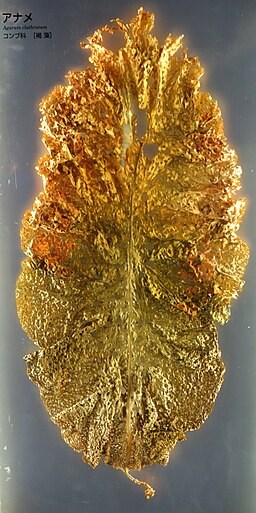
"Common name: Japanese: Aname (Tokida 1954)." [Pereira ESW]
_-_Elliston,_Newfoundland_2019-08-13_(02).jpg)
(Wikimedia)1
(Wikimedia)2
(Wikimedia)3
Characteristics
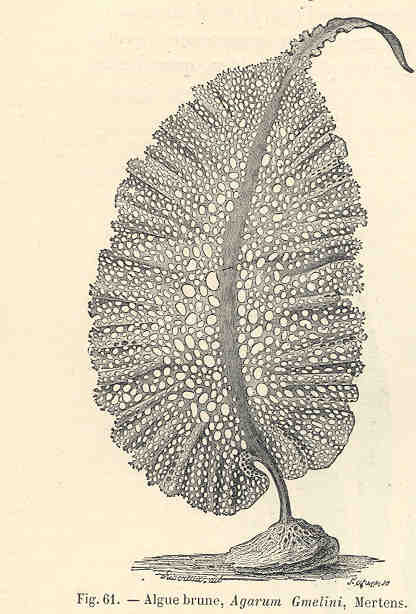
"Thalli sieve-like, profusely perforated, with numerous small holes (Stearn 1973)." [Pereira ESW]
Habitat/Range
"Geographic distribution: Asia (China, Japan, Korea, Russia); N Atlantic (Arctic, Greenland); NW Pacific (Alaska)." [Pereira ESW]
In the Arctic, Agarum clathratum remains a dominant canopy vegetation in zone IV, which lies between approximately 25 and 30 meters in depth. It co-occurs with Laminaria solidungula and, in the upper portions of this zone, with occasional large populations of Desmarestia aculeata. [Lobban SEP]
Edible Use
"Uses: In Japan and Korea is used for foodstuff, especially for the manufacture of potash salts (Tokida 1954, Kang 1968), and for production of alginates (Kang 1968, Bonotto 1976)." [Pereira ESW]
Arctic Sea
"Because of the unfavourable environment, especially the grinding action of ice in shallow waters, the greatest quantity of algae is to be found in the sublittoral at depths of 20-25 m. Although substantial subllttoral beds of Laminaria spp. have been reported from the Kara Sea, the north Alaskan coast and the northern Canadian coast, where Alaria and Agarum are associated with the Laminaria, as well as some areas of rockweed in sheltered Canadian localities, conditions make harvesting almost impossible." [Chapman SU]
Biochemistry
Agarum clathratum is used for the production of alginates in Japan and Korea. Alginates are a significant chemical constituent of brown algal cell walls, providing flexibility and strength. [Mouritsen Seaweeds] These polysaccharides are composed of β-(1→4)-linked D-mannuronic acid (M units) and α-(1→4)-linked L-guluronic acid (G units), or a mixture of the two. [Mouritsen Seaweeds] The ability of alginates to form gels and viscous solutions makes them valuable in various industrial applications. [Pereira ESW]
Synonyms: Agarum cribrosum [Pereira ESW]
"Docosahexaenoic acid (22:6n-3, DHA) is not a common FA in brown seaweeds. Nevertheless, it was quantified in 13 species at a level >1%, ....DPA has been described in 15 macroalgae belonging to five different orders, most often at trace level (<1%).... However, Padina pavonica and D. dichotoma presented about 4% of DPA (Tabarsa et al., 2012a) and Agarum clathratum about 11% of DPA (Kelly et al., 2008; Khotimchenko, 1998)." [Fleurence SHDP]
Grazing
"Seaweed-urchin-predator interactions often are complex and controversial. In the Strait of Georgia, British Columbia, the green urchin Strongylocentrotus droebachiensis is at its southern limit and frequently fails to recruit because of water temperatures that are too high (Foreman 1977). Its successful recruitment led to temporary reductions in both biomass and species diversity (Fig. 3.6). The urchins removed the foliose macrophytes first, then filamentous forms, and finally, to a small extent, crustose algae and corallines. The period of time required for the community parameters to be restored to their pre-urchin levels (not necessarily the exact pre-urchin flora) was 4-6 years in the mid-subtidal regions dominated by Agarum or Laminaria, but a little less, 3-5 years, for shallower subtidal communities (Foreman 1977)." [Lobban SEP]
Synonyms
- Agarum cribrosum [Pereira ESW]
Agarum Sp. -
"Southern California has some of the largest and most diverse kelp habitats in the world, .... Large kelp forests occur on most hard and cobble substrata at depths of 20-25 m. The floating canopies in these forests include Macrocystis pyrifera, Egregia menziesii, and two species of Pelagophycus, as well as two fucoids (Cystoseira osmundacea and Sargassum muticum). There are two stipitate species, Pterygophora californica and Eisenia arborea, and two prostrate species, Laminaria farlowii and Agarum fimbriatum." [Lobban SEP]
"Several, such as Agarum clathratum, Laminaria solidungula, Alaria esculenta, and especially a variety of crustose forms, appear to be long-lived, perhaps considerably more than one or two decades." [Lobban SEP]
"In zone II, from about 3 to 6 m below ELWS, there is less scour and a more stable salinity, and this area of the sublittoral commonly supports more species and a greater biomass than zone I. Three kelps, Laminaria saccharina, L. longicruris, and Agarum clathratum, and annual populations of Chorda tomentosa form a conspicuous canopy in this zone. With increasing depth, two more kelps, Alaria esculenta and Agarum, become increasingly abundant. Unlike boreal and sub-Arctic populations of A. esculenta, Arctic representatives of this species in zone II and deeper areas perennate only as infrequent clumps of several, often large, thalli, with long, rigid, robust stipes and deeply pigmented, tattered blades. The habitat, longevity, and, to some extent, the form of Arctic A. esculenta differ from these aspects of the species in southerly regions." [Lobban SEP]
"In zone III, from about 7 to 20 m, Laminaria solidungula and Agarum clathratum dominate the vegetation. Both species may occur as dense mixed populations or as virtually monospecific canopies, with only several of the seemingly most tenacious understory species remaining." [Lobban SEP]
"In zone IV, between about 25 and 30 m, canopy vegetation is sparse and discontinuous; Laminaria solidungula and Agarum clathratum remain dominant, with occasional large populations of Desmarestia aculeata in upper portions of this zone. Agarum is the last of the large erect macrophytes to disappear, with increased depth, in the sublittoral. The depth limit of this species is unknown, but I have seen large forests of this kelp between 40 and 50 m and have dredged representatives of the species from 75-90 m. Its unknown mode of adaptation to perennation in Arctic deep-water environments and the enigma of its common occurrence in the American and western Greenland Arctic, but not in northeastern Greenland or the remainder of the Arctic, help to identify Agarum as future tool of research." [Lobban SEP]
"In zone V, from about 30 to 90 m, a number of small forms, as well as noncalcareous (fleshy) and calcareous crusts, occur as the foundation layer of the macrophyte vegetation at all depths. Most of these species have disappeared below about 20 m. Only brown crusts, Sorapion simulans and Pseudolithoderma species, and several calcareous crusts persist below 20-25 m." [Lobban SEP]
"Generalizations regarding zone IV vegetation include the spotty character of Agarum clumps, with Ptilota, Callophyllis, and Scagelia mingled among Agarum haptera." [Lobban SEP]
Activities
- Agarum crathrum - Methanolic extract - In vitro promoting activity of human interferon B production - Nakano et al., 1997 [PTFC]
Biochemicals
- Agarum cribrosum Bory - whole thallus - Fucoidan Content 1.2 (% Dry Wt.) [Kim MNPP]
- Agarum fimbriatum - 3.16-4.16 % dry wt laminaran (after Powell, 1964) [Chapman SU]
"Phytosterols are bioactive compounds in all terrestrial and marine plants and algae. More than 200 types of phytosterols have been found (Lagarda et al., 2006). Newburger et al. (1979) reported that seven phytosterol compounds have been identified in brown alga (Agarum cribosum). Fucosterol and 24-methylenecholesterol accounted for 88.7 and 10.8% of the total unsaponifiable lipid fractions, respectively. The main phytosterols in brown seaweeds are fucosterol and fucosterol derivatives (Sánchez-Machado et al., 2004b)." [Tiwari SS]
Metal Accumulation
"As it can be observed, different species accumulate metals in different ways....Moreover, the characteristics of many other species have been studied. For example, among the 16 species examined by Saenko et al. (1976) in Japan, Ptilota filicina concentrated Ti, V, Mn, Fe, Ni, Cu, Zn, and Mo; Polysiphonia japonica Ti, V, Mn, Fe, Zn, Mo and Cr; Rhodomela larix Ti, V, Mn, Fe, Ni, Zn and Cr; Agarum cribrosum Ti, V, Mn, Fe, Ni, Zn, and Cr; Ulvaria splendens Ti, V, Mn, Fe, Ni, and Cu; Ulva fenestrata Mn, Fe, Ni, and Cu; Enteromorpha prolifera Mn, Co, Zn, Mo, and Cr; Codium yessoensis V, Mn, Fe, Zn, and Cr." [HMA]
Journals of Interest
- Agarum cribosum: demonsterol in a brown alga. Phytochemistry 18, 2042–2043.
Image References
- 1,Agarum clathratum Ryan Hodnett, CC BY-SA 4.0
- 2,Agarum clathratum Daderot, CC0, via Wikimedia Commons
- 3,Agarum clathratum syn. A. gmelini Edmond Perrier, Public domain, via Wikimedia Commons
Data Analytics
Source Material Depth
This graph represents the unique prevalence of "Agarum" within the Eflora local research library. Penetration indicates the percentage of total documents containing at least one of the search terms.